

Paper
Ashley J. Tellis
{
  "authors": [
    "Ashley J. Tellis"
  ],
  "type": "legacyinthemedia",
  "centerAffiliationAll": "dc",
  "centers": [
    "Carnegie Endowment for International Peace",
    "Carnegie India"
  ],
  "collections": [],
  "englishNewsletterAll": "ctw",
  "nonEnglishNewsletterAll": "",
  "primaryCenter": "Carnegie Endowment for International Peace",
  "programAffiliation": "SAP",
  "programs": [
    "South Asia"
  ],
  "projects": [],
  "regions": [
    "North America",
    "United States",
    "South Asia",
    "India"
  ],
  "topics": [
    "Foreign Policy"
  ]
}
Source: Getty
Animated by the reality of shared values and increasingly convergent interests, Modi seeks a robust fraternity with Washington, which enhances Indian power.
Source: India Today
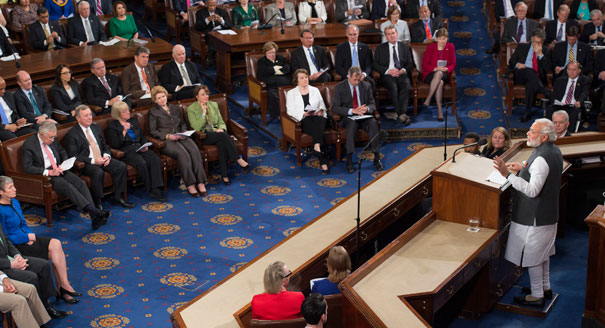
In his astounding address to the Joint Session of Congress on June 8, 2016, Prime Minister Narendra Modi declared that the US-India relationship had finally “overcome the hesitations of history”. He was being far too coy. In declaring the United States to be “an indispensable partner” in India’s forward march, he was, in fact, exorcising the ghosts of decades past—spectres that prevented India from realising Atal Bihari Vajpayee’s bold vision of the United States and India as “natural allies”.
The most pernicious of these bogeys has been the belief that a productive partnership with the United States was impossible because it would reduce India to the status of a camp follower in the American alliance system. This fear was so overwhelming during Manmohan Singh’s first term that it almost prevented him from consummating the US-Indian nuclear deal—that singular act of American strategic perspicacity intended to liberate India from over three decades of unyielding global constraints on civilian nuclear cooperation.
The strident opposition to the agreement demonstrated that some Indian elites were willing to suffer continued isolation if necessary, rather than grasp the benefits of the fellowship offered by Washington. During Singh’s second term, his opponents within the government and the Congress party exacted their revenge for his courage, delaying and suspending all significant bilateral cooperation not because collaboration would undermine India’s strategic interests but because it threatened the pretence that New Delhi could thrive without any partnerships worth the name.Modi’s clarion call on the United States to now “convert shared ideals into practical cooperation” signals, above all, a freedom from fear. It rejects the notion that a preferential affiliation with Washington automatically implies the loss of agency and autonomy, or that it accepts subordination in an eternally unequal relationship. To the contrary, animated by the reality of shared values and increasingly convergent interests, Modi seeks a robust fraternity with Washington, which enhances Indian power. No association with any other country promises comparable rewards, and the prime minister appears determined not to lose this opportunity, least because its only downside might be dispensing with the affectation of a permanently ‘non-aligned’ India.
It may come as a shock to Modi’s critics, but Washington has long accepted New Delhi’s quest for geopolitical independence. What confuses US policymakers is not India’s yearning for decisional autonomy, but that its policies are often constrained by its fears rather than being impelled by its interests. No American administration, at least since the Cold War’s end, has imagined that an association with India was desirable because New Delhi could be enticed into doing Washington’s bidding. Rather, cooperation was sought simply because it enabled the purposeful realisation of shared strategic interests. Recognising that the US was clearly the stronger partner—and would remain so for a long time to come—US policymakers have in recent years been willing to walk the extra mile for India so long as they perceived a genuine desire for deepened collaboration.
Nothing illustrates this more than the achievements in defence cooperation memorialised during Modi’s recent visit to Washington. India’s desire to implement various initiatives that bolster its own security in the broader Indo-Pacific region—which simultaneously advance mutual interests in “peace, prosperity and stability”—has resulted in its designation as a ‘Major Defence Partner’, a categorisation intended to progressively increase its access to the best US defence technologies that have hitherto been reserved only for America’s closest allies. In this context, the convoluted language about aircraft carrier technology cooperation actually signals the end of exploratory conversations, marking the start of the transfer of design knowledge relevant to constructing advanced flattops in India.
And the conclusion of the Logistics Exchange Memorandum of Agreement (LEMOA)—one of the dreaded ‘foundational agreements’ on which more mendacity has been displayed by Indian commentators than its pedestrian character would warrant—is worth mentioning not because it provides Washington with new and unprecedented access to Indian bases and facilities. It will not. Rather, it is significant because it finally permits both countries to engage in military activities that are not pre-planned, without having to worry about paying in advance or upon delivery for the supplies and services consumed.
These highlights of the expanded defence cooperation agreed to during Modi’s visit, complemented by new commitments to strengthening Indian defence manufacturing, cooperative cyber-defence and bilateral counter-terrorism activities, only demonstrate that the US seeks not to strip India of its political autonomy but to strengthen its capacity to secure their common goals. It is to Modi’s credit that, far from being fearful of such opportunities, he has seized upon them resolutely, in fact challenging his American partners to think boldly of how this evolving compact might produce “not just... a better future for ourselves, but for the whole world”. If this sentiment comes to be ingrained in India’s policy towards the US, the Modi whirlwind will have exorcised many ghosts long-resident in New Delhi and blown both nations much good.
Former Senior Fellow
Ashley J. Tellis was a senior fellow at the Carnegie Endowment for International Peace.
Recent Work
Ashley J. Tellis
Ashley J. Tellis
Carnegie does not take institutional positions on public policy issues; the views represented herein are those of the author(s) and do not necessarily reflect the views of Carnegie, its staff, or its trustees.
Soft power on its own is insufficient to meet U.S. national security needs, but hard power also has its limits. Soft power allows for more effective and efficient use of hard power than hard power alone, as it encourages cooperation and compliance which deters the need for hard power.

Sarah Yerkes
A deep dive into the policy ecosystems behind battery development in China, South Korea, Japan, the European Union (including some of its member states), the United States, Canada, and India.



Milo McBride, Herbert Crowther, Darcie Draudt-Véjares, …

In an interview, Ian Lustick and Eli Clifton discuss their new book on why a prominent ally has so much influence in America.

Michael Young

Germany, India, and other middle powers can’t build frontier AI alone, and they risk being cut off if they depend on the United States or China. The way through is to build the capacity for a frontier sprint while hoping never to use it.


Anton Leicht, Sam Winter-Levy

Trump has promised Belarus a massive potash deal. But Minsk is seeking something greater: restored Western transit and greater room for maneuver from Russia.

Balázs Jarábik