

Other
François Godement, Ashley J. Tellis
{
  "authors": [
    "François Godement"
  ],
  "type": "legacyinthemedia",
  "centerAffiliationAll": "dc",
  "centers": [
    "Carnegie Endowment for International Peace"
  ],
  "collections": [],
  "englishNewsletterAll": "asia",
  "nonEnglishNewsletterAll": "",
  "primaryCenter": "Carnegie Endowment for International Peace",
  "programAffiliation": "AP",
  "programs": [
    "Asia"
  ],
  "projects": [],
  "regions": [
    "East Asia",
    "China",
    "Eastern Europe",
    "Western Europe"
  ],
  "topics": [
    "Foreign Policy",
    "Economy",
    "Trade"
  ]
}
Source: Getty
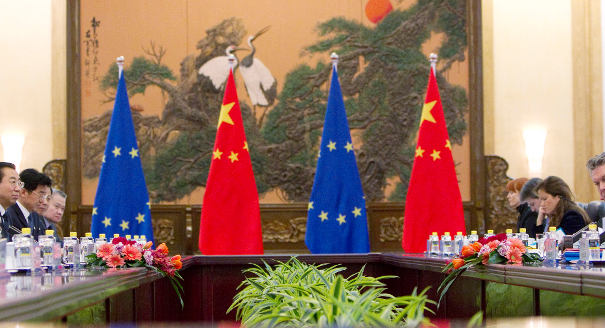
The European Union’s recent move to grant Market Economy Status (MES) to China and its South China Sea ruling are important signals of EU solidarity and resilience, but also highlight the relative strength and weakness of the union itself.
Source: European Council on Foreign Relations
The EU this month made important statements within days of each other on two key issues in its relationship with China. One concerns the granting of Market Economy Status (MES) to China, which was widely expected to follow China’s completion in December this year of a 15 year transition period at the WTO. The other was a response to the Permanent Court of Arbitration’s ruling against China in a dispute with the Philippines over territorial claims in the South China Sea.
Coming so soon after the existential shock of the Brexit referendum, the two statements are an important signal of EU solidarity and resilience. But the large differences between them also highlight the relative strength and weakness of the European Union itself.Strength
Most striking is the position agreed by the College of Commissioners on July 20 regarding China’s MES, explained by European Commission Vice-President Jyrki Katainen in a press conference the following day. Katainen shoved aside the question of MES, saying “it is better to forget this concept because our approach is entirely different.”
Instead, while complying with international law by discarding the anti-dumping rules set for China during the WTO transition period, the Commission is developing a new set of rules for trade defence – WTO-proof in that it will apply to all trade partners – to take into account “state meddling into any given country or sector”. It plans to reinforce anti-dumping instruments, including potentially discarding the ‘lesser duty rule’ that has limited the EU’s ability to impose punitive anti-dumping duties.
This decision is notable for several reasons: first, it essentially followed a Franco-German position paper on the reform of trade defence instruments that has reportedly gained much traction among member states. Second – and contrary to predictions made by some media (notably the Financial Times in the UK and Les Echos in France) - it concurred with the EU Parliament’s resolution in May this year, which rejected MES.
Third, there is no report of major opposition from any member state to this. Of course, Jyrki Katainen himself notes that the specific decisions on trade defence instruments remain to be taken before the end of the year. And while dropping the issue of MES obviates the need for a co-decision between the European Commission, Parliament and Council, those specific measures will require a co-decision, including agreement of a qualified majority of member states, which will test the solidarity seen thus far.
The other important statement, which came on July 15 in response to the Permanent Court of Arbitration’s ruling against China on South China Sea issues, was much less convincing. The Court’s award has taken the world, and presumably China, by surprise. There was a general sense that the ruling would go badly for China, but there had been no prediction that the Court would rule against China on all of the 15 issues brought by the Philippines. It was also a surprise that the Court used such strong and clear language to deny in detail any case made by China to excuse itself from the ruling.
In ruling so adamantly, the Court has drawn a line strictly based on law, ignoring political considerations of China’s strength. China’s international partners, however, do not have this luxury, and now face the embarrassment of having to choose between their commitment to international law and their relationship with China by upholding or ignoring the ruling.
It is almost inconceivable that any state would take it upon themselves to militarily enforce the ruling, but few statements have been as cautious and restrained as the EU’s. In contrast with a stronger declaration in March against the militarization of the South China Sea, the High Representative stated that the EU and its member states “acknowledge the award… (but) do not take a position on sovereignty aspects relating to claims.”
This softer position is partly explained by the fact that the Court is setting a precedent that has implications worldwide – including in Europe – by severely restricting the basis on which states can lay claim to offshore territories known as exclusive economic zones (EEZs).
This is a welcome and healthy development: perversely, the 1982 UN Convention on the Law of the Sea (UNCLOS) created a whole new category of international quarrels overnight when it introduced the concept of EEZs, which extend 200 nautical miles beyond the traditional boundary of territorial seas. The Court’s recent ruling on the South China Sea clarifies some of those quarrels and also reduces the ability of UNCLOS signatory states to exempt themselves from the Court’s proceedings.
At least three EU member states have cause for concern over these developments. France, with the world’s second largest maritime domain and claims on EEZs, may find it has a problem in the Indian Ocean with its co-called Scattered Islands, claimed by Madagascar and Mauritius. Croatia withdrew in 2015 from an arbitration process with Slovenia on its maritime border around Piran Island. And Greece has seen the Court deny jurisdiction in a similar case with Turkey in 1976, a case directly cited by China’s official statement after the recent ruling.
This presented a thorny problem for the EU Council, which had to find language without implications on the above cases. But according to informed participants, the biggest obstacle was Hungary’s determination to fight for China inside the Council - evidence of the success of Chinese bilateral lobbying. Even the language from the March declaration could not be agreed upon again, and instead was included merely as an annex to the new resolution.
In light of these constraints, it is striking that the Council arrived at a common position within three days, and especially on the heels of the EU-China Summit on July 12-13. Three conclusions should be drawn from this. First, the stress created by Brexit did not break the EU’s decision process in the weeks that followed. Second, any action that does not require unanimity or a qualified majority, but merely a Commission position, is likely to be stronger. And third, unfortunately, EU action on the core areas of economic and trade issues is still infinitely more efficient than that on foreign and security policy. This is a strong argument in favour of retaining executive control over economic and trade policy within the commission, rather than reverting to decisions by member states. The cost of collective decision-making, it would seem, is watered down decisions and statements.
This piece was originally published by the European Council on Foreign Relations.

Former Nonresident Senior Fellow, Asia Program
Godement, an expert on Chinese and East Asian strategic and international affairs, was a nonresident senior fellow in the Asia Program at the Carnegie Endowment for International Peace.
Recent Work
François Godement, Ashley J. Tellis

François Godement, Abigaël Vasselier
Carnegie does not take institutional positions on public policy issues; the views represented herein are those of the author(s) and do not necessarily reflect the views of Carnegie, its staff, or its trustees.

It should address the shortcomings of previous crisis communication efforts and adapt to the demands of frontier AI.

Lucy Luo

If the Russian-speaking community in Latvia cannot articulate their interests without being seen as disloyal, they could end up embracing a pro-Kremlin agenda.

Sergejs Potapkins
Washington’s decision to support some UN functions while letting others wither is pulling the organization apart at the seams.

Stewart Patrick, Theodore Zaritsky

Are Germany’s economic, industrial, and political struggles becoming a liability for the EU’s ability to rise to the geopolitical moment?

Rym Momtaz, ed.

China’s police training infrastructure construction projects provide benefits to recipient countries, promote China’s image as a major global security provider, and are likely to reinforce alignment between Beijing’s security priorities and those of countries in the Global South.


Cameron Waltz, Sheena Chestnut Greitens, Kim Nguyen, …