Relations between Russia and the West have deteriorated to levels not seen in a generation. The annexation of Crimea and the undeclared war in eastern Ukraine have rekindled fears of a new Cold War in Europe, and the military deployment to Syria in support of Bashar al-Assad’s regime has positioned Russia as a major actor in the Middle East in a way that has not been seen in decades. Both Russia and the West accuse each other of making provocative moves, disrupting the balance, and violating each other’s interests. The West has imposed sanctions on Russia in an effort to make it rethink its policy in Ukraine and elsewhere in Europe. But Russia continues undeterred, as concerns about its ultimate goals mount in the West.
In a new Q&A, Alexey Arbatov discusses the key drivers and goals of Russian foreign policy.
What are the drivers of Russia’s recent foreign policy actions?
From 2011 to 2013, the drivers of Russia’s foreign policy were primarily external, but since 2014 they have been increasingly domestic. Challenging the West turned out to be an effective tool for domestic political consolidation.
Russia’s assertive moves abroad began as a reaction to perceived unfair treatment by the West, as well as the West’s expansionism and arbitrary use of force over the previous two decades. These are precisely the issues President Vladimir Putin spoke about in his 2007 speech at the Munich Security Conference. Russia’s first counterattack with the use of military force was in Georgia in 2008, and the second occurred in Ukraine in early 2014.
Since 2012, Russia has embarked on a course of active resistance to what it perceives as dominance by the United States and NATO. It launched a massive media campaign against the purported Western threat, which includes alleged designs to gain control of Russia’s natural resources, the possible expansion of NATO to Ukraine and Georgia, and plans to deploy ballistic missile defense and conventional prompt global strike systems. Moscow pursued a massive arms buildup (the State Armaments Program 2020 and related procurement efforts), large-scale military exercises and weapons tests, an uncooperative stance on nuclear arms control, and anti-Western alliance building (for example, through the Eurasian Economic Union, the Shanghai Cooperation Organization, and the BRICS group—made up of Russia along with the other major emerging economies of Brazil, India, China, and South Africa).
This course of action was adopted on the basis of very optimistic projections of economic growth: Russia’s defense budget for 2020 was projected to reach $200 billion, implying a GDP of $5 trillion—2.5 times the 2012 GDP of $2 trillion. This projection assumed growth rates on par with China’s, which Russia is nowhere near achieving. In fact, the defense budget in 2015 was below $60 billion.
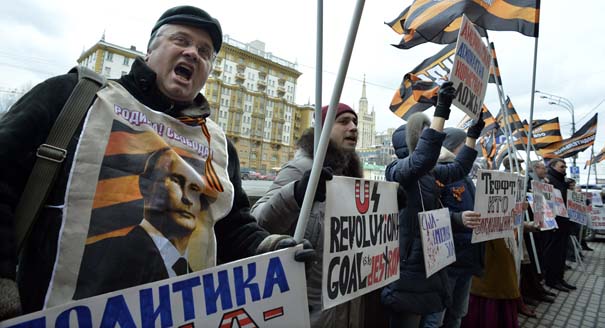
Putin had anticipated a cold reception from the West when he returned to the Kremlin in 2012 after serving as prime minister for four years. But the mass street protests of 2011 and 2012 radicalized the Kremlin’s already anti-Western stance, since they were perceived as an active Western attempt to topple a state that was resisting U.S. hegemony. Moscow put a new emphasis on “traditional Russian values” and the pivot to the East—tools employed to distance Russia from the Western political model, which was seen as a latent threat to the existing political system.
Against this background, Ukraine’s pivot to the West and its second color revolution in early 2014 were perceived as both geopolitical challenges to Russia and domestic challenges to Putin, and in turn they spurred Moscow’s harsh responses in Crimea and the Donbas.
Since then, the economic crisis, Western sanctions, and the fall in oil prices have exacerbated the fear of a color revolution in Russia. The Kremlin responded by tightening domestic political controls and increasing pressure against opposition groups, such as they were. Its foreign policy response to new economic woes was the opposite of what one might have expected of a Western country: Russia increased its support for Donbas separatists, launched a military intervention in Syria, and continued its arms buildup.
As of mid-2016, these tactics have been paying off. Putin’s assertiveness has been supported by the vast majority of the population in a country suffering from a post-Weimar/post-Versailles syndrome. Despite the ongoing economic crisis and other social calamities, the restoration of national pride (for which average Russians credit Putin’s leadership) keeps his popularity ratings high.
Are there any signs that Russia will change its tactics?
Russia’s economic crisis, its expanding circle of enemies, the increasing unreliability of its allies, and the growing assertiveness of China, India, Iran, and other partners, are all constraining Russia’s power and influence. Yet paradoxically, the regime is loath to come up with long-term fixes for the economy. Serious economic reform would require democratization of the political system, which could endanger political positions of the ruling elite and undercut the symbiotic link between business and the 1.5-million-strong state bureaucracy. Needless to say, the elite is not willing to cut off the branch on which it is perched. It would rather maintain the concept of Russia as a “besieged fortress.” And it would rather appeal to traditional values such as national pride, patriotism, and support for the omnipotent leader while extolling Russia’s military prowess and the “gathering of historic lands.”
It should also be noted that the current public mood is such that any attempt at rapid democratization would probably bring to power parties and leaders from two extremes: leftists and groups that are even more nationalistic than the present elite.
The fact that the West seems to be faltering also tempers the effect of Russia’s economic problems on its foreign policy. The EU is facing economic problems, a refugee crisis, and fierce internal divisions, while the United States is coping with a bizarre election campaign. As a result, Russia does not perceive itself to be that frail by comparison.
Nevertheless, the state of the economy will cause Russian leadership to seek a de-escalation of tensions with the West in 2016, provided that this is not perceived as a sign of weakness or retreat. The ideology from which Putin derives his legitimacy will not permit a return to the policy (or even the rhetoric) of Prime Minister Dmitry Medvedev’s Partnership for Modernization with the West. However, the Kremlin could be ready for a new détente, provided that it could spin it favorably for domestic audiences and imply that the West had finally conceded that it would treat Russia as an equal partner.
Self-reliance is the slogan of the day, but so is the rejection of isolationism. Russia’s domestic economic needs and its great-power claims necessitate cooperation with both the West and the East. The unresolved dilemma Russia faces with the West is how to expand cooperation without endangering the existing Russian political system. In the East, Russia must find a way to avoid succumbing to China’s overwhelming economic and demographic dominance, which could result in Russia losing de facto control over vast territories and natural resources.
The most obvious way out of these two dilemmas is deep economic reform on the basis of political democratization, but this solution is, sadly, not currently an option.
Is the United States still a primary focus for Russia?
No, international terrorism has replaced the United States as enemy number one. But despite its reduced intensity, the anti-U.S. mass media campaign remains an effective tool for domestic political consolidation. The United States is blamed for its reluctance to genuinely cooperate with Russia on counterterrorism as well as for its plans for world domination, its encroachment on the post-Soviet space, and its desire to undermine the Russian political system. As long as the the state authorities attribute the main internal threat to the liberal opposition, the West will remain the primary perceived external opponent. This may change if, as a result of the economic crisis, the popular appeal of communists seriously grows.
How will Russia approach its relations with the United States?
Russia will not play along with U.S. foreign policy and will continue to engage with anti-U.S. regimes and movements (with the exception of known terrorist groups). It will strongly resist Western economic and political expansion in the post-Soviet space, and it will demand that the United States negotiate and compromise with Russia on all issues of discord, rather than ignoring or circumventing it.
More cooperation may be feasible in terms of de-escalating military confrontation in Europe and the Arctic, and in nuclear arms limitation and nonproliferation. For example, the precedent set by the Iran deal could be applied to other cases, including North Korea. And more flexibility may be possible in Syria and in Ukraine, where there might be a conditional withdrawal of “volunteers.”
Are the concerns about Russian military overreach—first voiced during deployment in Syria—still valid?
No, the partial curtailment of the operation (announced by Putin in March 2016) demonstrated the flexibility of these engagements and Russia’s ability to limit the costs of operations.
What is Putin’s foreign policy doctrine following Russia’s 2014 annexation of Crimea?
Putin’s doctrine consists foremost of asserting Russia’s status as a global center of military and political power, despite its economic weakness. Putin would like for negotiations on problems important to the West, such as nuclear arms control, to be linked with negotiations on issues important to Russia, such as the removal of sanctions. He also wants to see a de-linkage of Russian domestic policy from its relations with the West. There is a strict (often cynical) separation between rhetoric and actual policy, and a profound disbelief in the sincerity of the West’s declared principles. Finally, there is a hypertrophied emphasis on public relations in both domestic and foreign policy, and a love of special effects and surprise actions. Ultimately, it seems Putin hates most of all to look weak, which he cannot afford to appear.
How has the rapidly changing international environment impacted Russian foreign policy decisionmaking and options?
The growing complexity, increasing frequency, and sheer number of external events that Russia has to deal with have overwhelmed its policymaking mechanisms. Decisionmaking relies on the expertise of top officials and loyal advisers. Decisions are mostly reactive, made on a case-by-case basis, and premised on tactical considerations, without much thought for what the reaction from others might be. The process is confined to a very narrow, secluded circle, or at times to just one person. The decisionmaking is secretive and nontransparent to a fault.
Without a doubt, the Kremlin believes that between 2012 and 2015 it made its point to both the United States and to the world in general. At this point, Putin would probably like to realize the goals of his first two terms: to establish cooperation with the West on an equal footing and to maintain close relations with non-Western states that do not condition collaboration on the nature of Russia’s domestic governance or dealings in its perceived sphere of influence.