

Article
Dalia Ghanem
{
  "authors": [
    "Dalia Ghanem"
  ],
  "type": "legacyinthemedia",
  "centerAffiliationAll": "dc",
  "centers": [
    "Carnegie Endowment for International Peace",
    "Malcolm H. Kerr Carnegie Middle East Center"
  ],
  "collections": [],
  "englishNewsletterAll": "menaTransitions",
  "nonEnglishNewsletterAll": "",
  "primaryCenter": "Malcolm H. Kerr Carnegie Middle East Center",
  "programAffiliation": "MEP",
  "programs": [
    "Middle East"
  ],
  "projects": [],
  "regions": [
    "Levant",
    "Middle East",
    "North Africa"
  ],
  "topics": [
    "Political Reform"
  ]
}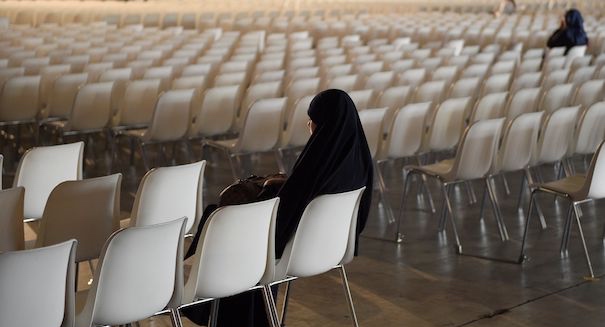
Source: Getty
Europe must enact better integration policies to help curb extremism.
Source: France 24
Carnegie's Dalia Ghanem-Yazbek appeared on France 24's ” The Debate” with Francois Picard to discuss woman and radicalization following a failed plot in Paris featuring female recruiters. Yazbek stated that this incident is not a new phenomenon as women have been participating in jihadism for a while. She continued to say that there are two main motives for female radicalization: The first is religious belief and the second is the desire to be part of a perfect society and to have a stronger bond of sisterhood.
Yazbek noted that using a woman to perform terrorist attacks serves as a media campaign for the Islamic State as it will garner more media attention. Yazbek pointed out that there is a major problem in Europe between integration and assimilation which is only helping the Islamic state. Many women are attracted to the organization because it provides a space to freely practice their religion. Yazbek also stated that the major problem is how to integrate the Muslim community in Europe which first begins with helping them find an identity in order to feel like full-fledged citizens.
Former Senior Resident Scholar, Malcolm H. Kerr Carnegie Middle East Center
Dalia Ghanem was a senior resident scholar at the Malcolm H. Kerr Carnegie Middle East Center in Beirut, where her research focuses on Algeria’s political, economic, social, and security developments. Her research also examines political violence, radicalization, civil-military relationships, transborder dynamics, and gender.
Recent Work
Dalia Ghanem


Frances Z. Brown, Judy Dempsey, Dalia Ghanem, …
Carnegie does not take institutional positions on public policy issues; the views represented herein are those of the author(s) and do not necessarily reflect the views of Carnegie, its staff, or its trustees.

Understanding the climatic pain points is necessary for policymakers hoping to minimize the war’s negative environmental consequences.



Alejandro Martin Rodriguez, Joy Arkeh, Sarah Yerkes

Huawei pushed hard to enter the Egyptian data centers market, until the Americans made a better offer.

Angie Omar

The books, podcasts, and films that explain the world it made.

Andrew Leber

In the tenth year of his presidency, President Mirziyoyev’s system is becoming even more personalized than that of his predecessor Karimov.

Galiya Ibragimova

Amid celebrations of bilateral ties was a deeper focus on stability in the Middle East.

Amr Hamzawy