

Commentary
- +1
Paul Haenle, Xue Gong, Ngeow Chow Bing, …
{
  "authors": [
    "Paul Haenle"
  ],
  "type": "legacyinthemedia",
  "centerAffiliationAll": "",
  "centers": [
    "Carnegie Endowment for International Peace",
    "Carnegie China"
  ],
  "collections": [
    "U.S.-China Relations",
    "China’s Foreign Relations"
  ],
  "englishNewsletterAll": "",
  "nonEnglishNewsletterAll": "",
  "primaryCenter": "Carnegie China",
  "programAffiliation": "",
  "programs": [],
  "projects": [],
  "regions": [
    "North America",
    "United States",
    "East Asia",
    "China"
  ],
  "topics": [
    "Arms Control",
    "Security"
  ]
}
Source: Getty
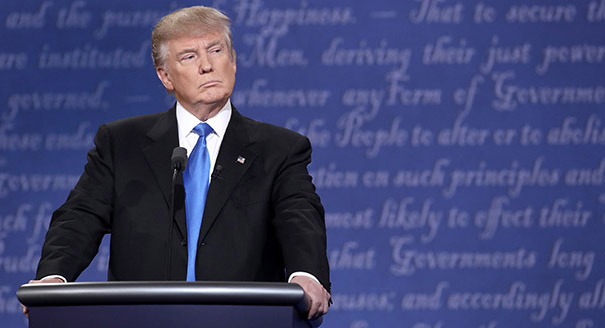
Beijing believes President-elect Trump will be more isolationist, but recent announcements from the incoming administration indicate otherwise, which could lead to a dangerous misalignment of expectations.
Source: ChinaFile
ChinaFile: Donald J. Trump, president-elect of the United States, spent much of his antagonistic campaign blaming China for many of America’s economic ills, and repeatedly making thinly veiled threats of a U.S. trade war with Beijing. How should Trump engage with the carefully selected leaders of the Chinese Communist Party? And how might they respond?
Paul Haenle: President-elect Donald Trump needs to move quickly to clarify his approach to the Asia-Pacific. Unlike secretary Clinton, Trump does not have a track record on how he views U.S. interests and policy objectives in the region. Foreign observers have naturally followed his campaign rhetoric closely to gleam insights into what types of policies he might pursue once in office. But the emerging articulations of Trump’s vision for the Asia-Pacific contrast strongly with many of Trump’s campaign promises. The result is a potentially dangerous gap in expectations.
Beijing has concluded that Trump’s transactional, businessman predispositions will lead him to be less inclined to inject human rights and values into his policies and dialogue with China. This may be so. But Chinese are also convinced that Trump’s election signals the ushering in of a period of American isolationism in which Washington will retreat from the world, including from Asia, and abandons its allies. This prospect is warmly welcomed in Beijing. Some Chinese scholars have gone a step further even by contemplating strategic opportunities for Beijing in the South China Sea or in their relations with Southeast Asian states as a consequence of American withdrawal. There is an overarching expectation that Trump’s election will mean less strategic pressure on China in the region.
China may be in for a rude awakening. In the last two days, the policy pronunciations that have emerged from Trump’s advisors paint a very different picture of the president-elect’s Asia policy. In an article for Foreign Policy, Alexander Gray and Peter Navarro liken Trump’s vision for the region to Ronald Reagan’s “peace through strength” strategy, wherein a robust U.S. military presence in the Pacific, strong support for Taiwan as a “beacon of democracy,” and U.S. alliances as “bedrocks of stability in the region,” are key components. To support such objectives, the advisors suggest Trump will seek to repeal defense sequestration, rebuild the U.S. Navy, and stand up to Chinese aggression in the South China Sea.
Gray and Navarro’s “peace through strength” vision sounds quite different from the expectation of U.S. retrenchment that many Chinese developed over the course of the campaign. Paraphrasing former Singaporean Prime Minister Lee Kuan Yew, the authors of the article assert that U.S. military presence in the Asia-Pacific is essential to promote U.S. liberal values and serves as a critical source of regional stability. They criticize the Obama administration’s weak implementation of the military component of its “pivot” policy, precisely the aspect Beijing perceives as being most hostile to China, and explain that despite Trump’s suggestions that America’s allies were not contributing their fair share to sustain U.S. security commitments, his commitment to U.S. allies was unquestionable.
The potential danger is that Beijing’s expectations about Trump’s China policy—that he will pay less attention to the Asia-Pacific and place less emphasis on U.S. alliance relationships—may not come to fruition. This could result in the relationship beginning on an uneasy or negative footing. Former President George W. Bush, who I worked for on the National Security Council staffs, always operated from a principle of “no surprises,” which he believed was a key stabilizing feature in the relationship with China. In that spirit, the first thing the Trump administration can do to promote a positive and constructive U.S.-China relationship is provide a clear articulation of his China and Asia policy in order to allow countries in the region to set realistic expectations for where and how they will be able to work with the new U.S. administration, and areas where policymakers will need to address and manage differences.

Former Maurice R. Greenberg Director’s Chair, Carnegie China
Paul Haenle held the Maurice R. Greenberg Director’s Chair at the Carnegie Endowment for International Peace and is a visiting senior research fellow at the East Asian Institute, National University of Singapore. He served as the White House China director on the National Security Council staffs of former presidents George W. Bush and Barack Obama.
Recent Work


Paul Haenle, Xue Gong, Ngeow Chow Bing, …

Paul Haenle, Chong Ja Ian
Carnegie does not take institutional positions on public policy issues; the views represented herein are those of the author(s) and do not necessarily reflect the views of Carnegie, its staff, or its trustees.

Despite public disputes over trade and immigration, the strategic partnership’s foundations remain sturdy.

Sameer Lalwani
It signals a new era of tech diffusion and warfare.

Steve Feldstein

With its public finances in shambles, the far right polling at 35 percent ahead of the 2027 presidential election, and a growing protest movement, is France’s crisis a threat to the EU’s geopolitical awakening?

Rym Momtaz, ed.

Russia’s AI-driven propaganda campaigns operate in a fragmented, chaotic, and often illogical manner. That’s not necessarily a problem for the Kremlin, though: It’s much easier to mimic genuine public debate that way.

Ilya Klishin

Ahead of a tough winter for Ukraine, Donald Trump’s swing back toward Russia bodes ill. But instead of panicking, Kyiv’s European allies are focusing on action.
Rym Momtaz