

Article
C. Raja Mohan, Darshana M. Baruah
{
  "authors": [
    "C. Raja Mohan"
  ],
  "type": "legacyinthemedia",
  "centerAffiliationAll": "dc",
  "centers": [
    "Carnegie Endowment for International Peace",
    "Carnegie India"
  ],
  "collections": [],
  "englishNewsletterAll": "ctw",
  "nonEnglishNewsletterAll": "",
  "primaryCenter": "Carnegie India",
  "programAffiliation": "SAP",
  "programs": [
    "South Asia"
  ],
  "projects": [],
  "regions": [
    "South Asia",
    "Pakistan",
    "India"
  ],
  "topics": [
    "Foreign Policy"
  ]
}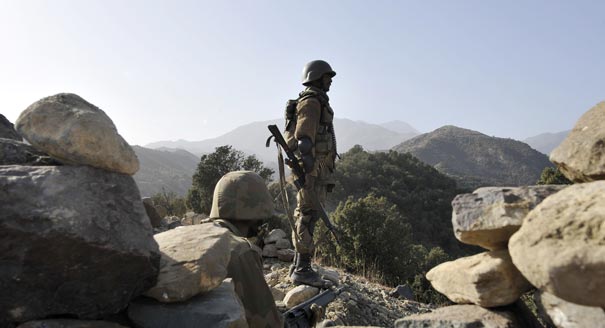
Source: Getty
New Delhi should not rule out change in Pakistan’s civil-military relations and examine if those changes can facilitate a more productive engagement with Islamabad.
Source: Indian Express
An official announcement from the Pakistan Army on Monday that General Raheel Sharif has begun his farewell calls before his pending retirement next Tuesday has brought an extended drama to a close. Some in Delhi might keep their fingers crossed and wait to see if there are additional twists to this tale. For months now there has been speculation about a possible second term of three years for the army chief. There was visible public pressure on Prime Minister Nawaz Sharif to extend his tenure.
Pakistan’s prime ministers have the formal right to “appoint” army chiefs, but did not seem to enjoy the power to “terminate” their services. Having risked a lot during his earlier tenure to affirm the right to hire and fire the army chiefs, PM Sharif has refrained from rushing into a decision that could cost him his current office. When he boldly replaced General Pervez Musharraf in October 1999 after the failed Kargil putsch by the army chief in the summer of that year, PM Sharif found himself in a prison and then a near-decade-long exile in Jeddah, Saudi Arabia. Given that background, it is quite remarkable that PM Sharif avoided giving an extension to General Sharif.
It is not clear if General Sharif is leaving unconditionally or a deal has been struck between the army chief and the PM in which the latter had to give some to make sure General Sharif walks out of the door. We are also not sure if General Sharif is fading away into real retirement or might have some rewards awaiting him.
A year ago, General Sharif grandly announced that he is not seeking an extension of his term at the end of November. That won him many kudos among those in the West who propagated the idea that he was a no-nonsense professional soldier — not interested in politics but only in promoting the interests of Pakistan. But then they said it about all of General Sharif’s recent predecessors, including Pervez Musharraf and Ashfaq Kayani. Musharraf stayed in power for nearly a decade and it took much pressure from Washington to make him shed the uniform in 2007. Kayani stuck around and got a second term of three years under President Asif Ali Zardari in 2013.
That General Sharif was not really keen to step down was evident in the mysterious public campaign demanding his extension. For cynics, this is no mystery and they see the hand of the all-powerful Inter Services Intelligence. The ISI is also seen as unleashing former cricket captain and the leader of the party, Pakistan Tehreek-e-Insaf, who has launched public protests demanding the resignation of Prime Minister Sharif. Imran Khan’s latest justification in preventing PM Sharif from completing his five-year term are the allegations of corruption against the Sharif family that were revealed in the so-called Panama Papers. Although Imran’s dharna has fizzled out, the judiciary has stepped in to deal with the case on a fast-track. The next round of hearings is set for November 30, a day after General Sharif is supposed to retire. If the courts find PM Sharif guilty, he will be disqualified from holding political office.
The civilians have rarely won the battle against the army in Pakistan. That fact alone makes the exit of General Sharif an important landmark, assuming the departure was unconditional. Sceptics, however, would say the on-time retirement of General Sharif will make no difference to the reality of the army’s dominance over the national security politics in Pakistan.
Rather than accept such determinism, Delhi should not rule out change in Pakistan’s civil-military relations and examine if those changes can facilitate a more productive engagement with Islamabad. Delhi’s default position has been to stay away from Pakistan’s internal politics. Some policymakers in Delhi argue that it is not worth supporting the civilian leaders, who have no power to address issues of concern to Delhi such as cross-border terrorism. Others have pointed to the dangers of India empowering the army by appearing to intervene against it. Only a handful in Delhi insist that India can benefit over the long term by supporting the civilians against the military in Pakistan.
Delhi may have an opportunity to revisit these arguments this week. Unlike his predecessors, Prime Minister Narendra Modi, however, has not been bound by conventional wisdom on Pakistan. Over the last two and a half years, he has repeatedly sought to alter the terms of engagement with Pakistan, especially on Kashmir and terrorism.
Modi has also refused to remain silent on Pakistan’s internal developments. Over the last few months, Modi has flagged concerns on Gilgit-Baltistan, Pakistan occupied Kashmir, Balochistan and Sindh. More important, Modi has also begun to speak directly to the people of Pakistan on a shared agenda of fighting terrorism and poverty. As it gets a full sense of the politics surrounding General Sharif’s succession, Delhi must be prepared to signal public support to civilian rule over the military in Pakistan.
This article was originally published in the Indian Express.
Former Nonresident Senior Fellow, Carnegie India
A leading analyst of India’s foreign policy, Mohan is also an expert on South Asian security, great-power relations in Asia, and arms control.
Recent Work

C. Raja Mohan, Darshana M. Baruah


Alexander Gabuev, Paul Haenle, C. Raja Mohan, …
Carnegie does not take institutional positions on public policy issues; the views represented herein are those of the author(s) and do not necessarily reflect the views of Carnegie, its staff, or its trustees.
Lee’s tour shows how Seoul is reorganizing its diplomacy away from Pyongyang and toward industrial networks and the geography of the compute economy.

Darcie Draudt-Véjares
Most migrants may have left Ceuta, but the effects may linger.


Alejandro Martin Rodriguez, Sarah Yerkes
There is a transnational far-right populist movement that links middle powers in a global movement that extends well beyond Trump.

Christopher S. Chivvis, Rohan Mukherjee, Milan Vaishnav

When faced with fuel shortages in the past, Central Asian governments could always count on additional supplies from Moscow. That safety net no longer exists.

Galiya Ibragimova

Saied’s main accomplishment has been to destroy a decade’s worth of democratic progress.
Sarah Yerkes