

Paper
Christopher S. Chivvis, Rohan Mukherjee, Milan Vaishnav
{
  "authors": [
    "Milan Vaishnav"
  ],
  "type": "legacyinthemedia",
  "centerAffiliationAll": "dc",
  "centers": [
    "Carnegie Endowment for International Peace"
  ],
  "collections": [],
  "englishNewsletterAll": "ctw",
  "nonEnglishNewsletterAll": "",
  "primaryCenter": "Carnegie Endowment for International Peace",
  "programAffiliation": "SAP",
  "programs": [
    "South Asia"
  ],
  "projects": [],
  "regions": [
    "South Asia",
    "India"
  ],
  "topics": [
    "Political Reform",
    "Democracy"
  ]
}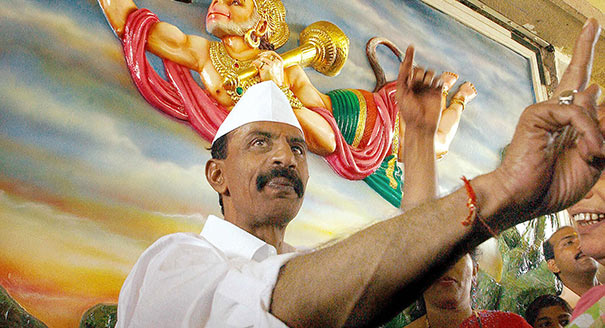
Source: Getty
Arun Gawli’s political rags-to-riches story reads more like a screenplay for a summer Bollywood blockbuster than the bio-sheet of a rising politician.
Source: Scroll.in
“God brought me into this profession,” proclaimed Arun Gawli, sporting a white Gandhian topi that so many Indian politicians regularly don. The year was 1997 and Gawli was still adjusting to his new incarnation as aspiring politico and head of a budding new political party, the Akhil Bharatiya Sena (ABS). Headgear notwithstanding, Gawli was no ordinary neta.
Known as the “Daddy” who ruled Dagdi Chawl, a slum in the heart of teeming Mumbai once home to many of the city’s blue-collar mill workers, Gawli was one of the most feared gangsters in India’s “Maximum City.” The son of migrants from central India who traded life in rural Madhya Pradesh for metropolitan Mumbai, Gawli dropped out of primary school to work as a milkman so that he could support his impoverished family in the big city.
Hailing from a family of country shepherds, Gawli struggled to find his way in Mumbai, but he eventually found his place toiling among the city’s mills, where he hooked up with a local gang charged with protecting goods being smuggled to Mumbai by the notorious mobster Dawood Ibrahim. Gawli quickly moved up the ranks, making a name for himself as a force to be reckoned with in the central Mumbai lanes of Byculla. Following an internecine gangland spat, Gawli went from serving Dawood Ibrahim to allegedly ordering hits on the mobster’s men.
In no time, Dagdi Chawl became ground zero for Mumbai’s notorious underworld.
From his fortress-like compound, Daddy dispensed patronage, protection, and even justice to local residents. Journalists who came to interview Gawli wrote of the hundreds of men and women— unemployed youth, aging widows, aspiring gangsters, and established politicians—who queued up on a daily basis in front of the iron gates of Gawli’s compound just for a few minutes of face time in the hopes of being showered with Daddy’s munificence. They came seeking building permits, ration cards, welfare payments, employment—all things the state was meant to provide but was either unable or unwilling to.
As Gawli’s stature grew, the Shiv Sena – an influential regional political party – brought him into their fold. The Sena was founded in the late 1960s as a platform for espousing the rights of native Maharashtrians, many of whom chafed at the influx of migrants who had relocated to Mumbai in search of economic opportunity. Founded by media-savvy former news cartoonist Bal Thackeray, the Sena quickly emerged as a political force in Mumbai and other urban centers in the state thanks to the popularity of its “sons of the soil” propaganda and the network of social service provisions its cadres established to serve destitute locals.
Even while functioning as a mainstream political party, the Sena instilled within its members an organisational ethos of “direct action,” a euphemism for threatening force and occasionally using it. Gawli’s arrangement with the Sena was never well defined, but in media interviews he sketched the basic understanding: “The netas come to the underworld during elections. To fix voters. They also come for funds. Since they seek help they also have to help when it comes to fixing the police.”
Thackeray, in turn, openly claimed Daddy as the party’s mascot: “If they [Muslims] have Dawood, we [Hindus] have Gawli. These [referring to Gawli and fellow gangster Amar Naik] are amchi muley.”
Eventually, Gawli was put behind bars for his misdeeds.
When the police came to Dagdi Chawl to arrest him, Gawli was hiding inside the drawer of a bed, gun in hand. While in jail in the late 1990s, Gawli and the Shiv Sena abruptly parted ways. As to why, rumors of all sorts made the rounds: that Gawli had ordered the murder of several Shiv Sena lawmakers, including a godson of Bal Thackeray’s; that Thackeray grew wary of Gawli’s rising prominence; and that Daddy had out-grown his existence as a mere hired gun in the employ of overbearing political masters.
For decades (if not longer), mafia groups in Mumbai had maintained links to politics, although the biggest dons typically chose to live on the periphery of the electoral spotlight rather than on its center stage. After severing ties with the Shiv Sena, Gawli broke with tradition and floated the ABS as his personal vehicle for seizing political power. The party’s ideology was unclear; its primary objectives seemed to be to counter the Shiv Sena while providing Gawli a means to promote his personal interests.
Explaining his foray into politics, Gawli stated that he was only doing “what the public demanded” and that, like any good servant of the people, he “had no choice but to bow to their desire.” In a more honest moment, Gawli would admit to a more selfish motivation: protection. “I am not afraid of any rival,” he once remarked to a journalist. “My only fear is that the police may get me.”
Having decided to join active politics, Gawli quickly mimicked the Sena’s modus operandi of setting up a network of shakhas (branches), often directly adjacent to the Sena’s own operations, from which he and his party-mates could dispense social services and burnish their credentials as selfless Robin Hoods.
After a series of frustrating failures in local elections, Gawli managed to get his eldest daughter, Geeta, elected to the Mumbai municipal corporation in 2002. He finally hit pay dirt himself when he won election to the Maharashtra state assembly in 2004, representing urban Chinchpokli. Gawli’s wife, Asha, was his campaign manager and effectively represented her husband’s constituency in his stead; he spent much of his term in jail on murder charges. “Violence and non-violence have their own place in society,” Gawli once remarked. “It all depends on the situation.”
Gawli’s political rags-to-riches story reads more like a screenplay for a summer Bollywood blockbuster than the bio-sheet of a rising politician.
Yet within just a few years, Gawli successfully completed a surprising transition from gangster hired by politicians, who was booked in more than three dozen criminal cases involving murder and extortion, to a political player in his own right.
In making this leap, Gawli was far from alone. One government commission after another convened over the past few decades has lamented the well-trodden career transition from lawbreaker to lawmaker; a 2002 government of India white paper noted that it was a “disgrace” that “several hardened criminals who may have many cases of murder, rape and dacoity against them are actually occupying the seats” in Parliament and the various state assemblies.
What explains the sudden change of heart experienced by Gawli and others like him who traded on their criminal reputations to run for political office? Why did criminals with lengthy rap sheets, who were once content to contract with political parties but remain squarely in the background, take the plunge and enter the political foreground?

Director and Senior Fellow, South Asia Program
Milan Vaishnav is a senior fellow and director of the South Asia Program and the host of the Grand Tamasha podcast at the Carnegie Endowment for International Peace. His primary research focus is the political economy of India, and he examines issues such as corruption and governance, state capacity, federalism, and electoral behavior. He also conducts research on the Indian diaspora.
Recent Work
Christopher S. Chivvis, Rohan Mukherjee, Milan Vaishnav


Sophia Besch, Eric Ciaramella, Steve Feldstein, …
Carnegie does not take institutional positions on public policy issues; the views represented herein are those of the author(s) and do not necessarily reflect the views of Carnegie, its staff, or its trustees.

An overwhelming victory by a far-right-wing party in a small state in eastern Germany will have major repercussions for Chancellor Friedrich Merz’s coalition.

Judy Dempsey

With the growth in points of friction between the great powers, organizations like the SCO will continue to play a role in the strategic adaptation of the smaller powers caught between them.

Temur Umarov
Xi, Putin, and other regional leaders are back-slapping in Bishkek, but the SCO has yet to answer the most serious questions about continental Asia's economic future.

Evan A. Feigenbaum

The greater threat to Zelensky comes not from Fedorov alone, but from the convergence between the former defense minister’s political campaign and the anti-corruption investigations moving ever closer to the presidential administration.

Balázs Jarábik
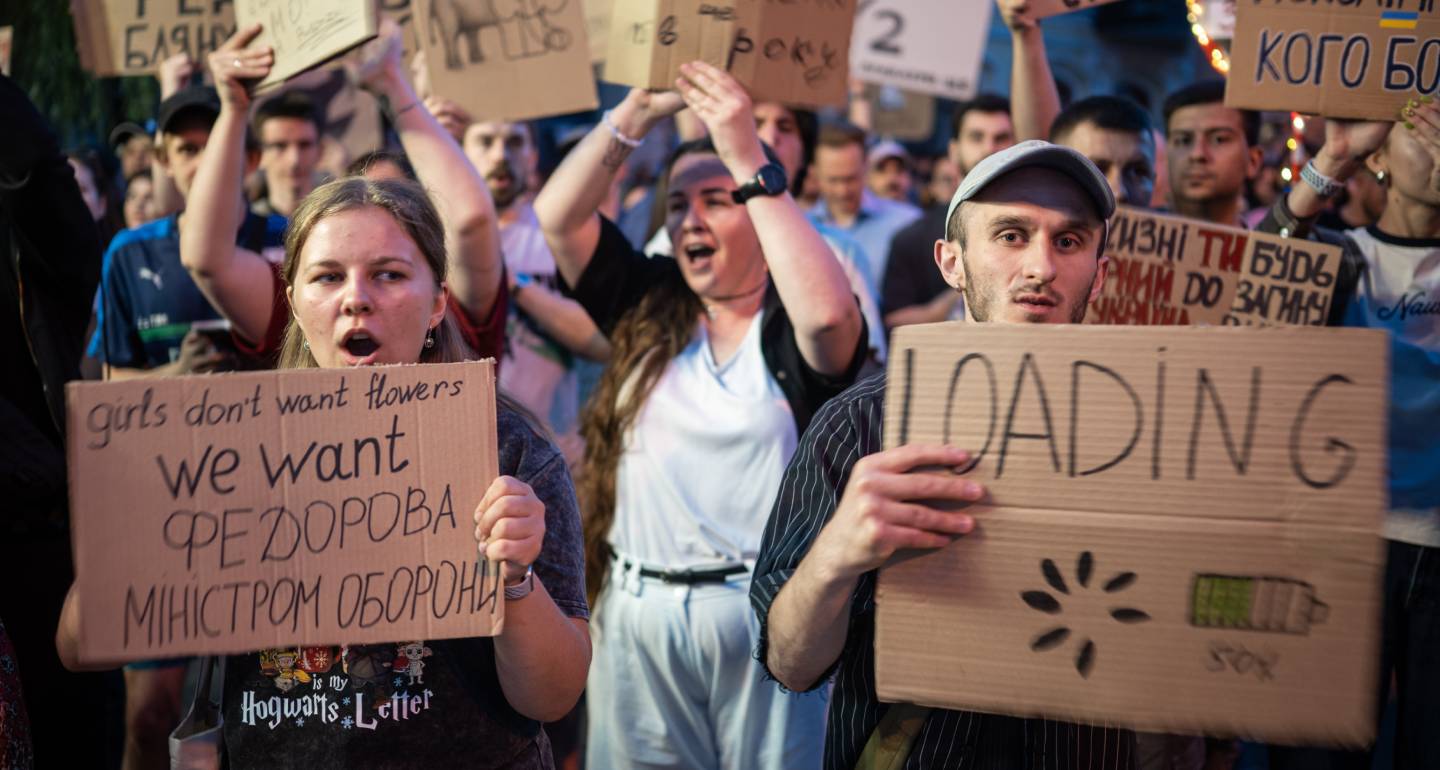
With his public call for new elections in Ukraine, ex-defense minister Mykhailo Fedorov has opened Pandora’s box.

Konstantin Skorkin