

Paper
Christopher S. Chivvis, Rohan Mukherjee, Milan Vaishnav
{
  "authors": [
    "Milan Vaishnav"
  ],
  "type": "legacyinthemedia",
  "centerAffiliationAll": "dc",
  "centers": [
    "Carnegie Endowment for International Peace"
  ],
  "collections": [],
  "englishNewsletterAll": "ctw",
  "nonEnglishNewsletterAll": "",
  "primaryCenter": "Carnegie Endowment for International Peace",
  "programAffiliation": "SAP",
  "programs": [
    "South Asia"
  ],
  "projects": [],
  "regions": [
    "South Asia",
    "India"
  ],
  "topics": [
    "Political Reform",
    "Democracy"
  ]
}
Source: Getty
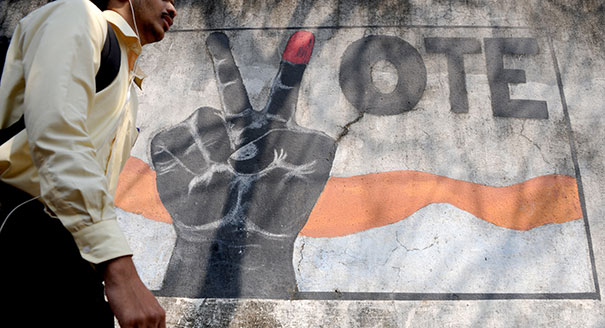
There is a dramatic mismatch between what ails political finance in India and the government’s “reform” measures. The budget presentation and its new amendments have made political funding less transparent.
Source: Hindustan Times
One of the most intriguing elements of this year’s Budget presentation was the pitch for political finance reform. On the heels of demonetisation, analysts cheered the news as exactly the sort of follow-on measure needed if the reality of anti-corruption policy was to catch up with the government’s lofty rhetoric. After all, here was a government using its might to tackle an issue that few administrations want to acknowledge, much less legislate on. Two months later, the government’s big political funding reform push has ended not with a bang, but a whimper. Ironically, this is because the government has succeeded, rather than failed, to enact its proposals.
Today, India’s political finance regime is plagued by three major infirmities. First, there is a steady torrent of undocumented cash that lubricates the activities of both parties and candidates. Second, there is virtually no transparency regarding political contributions. In the majority of instances, we are ignorant about the identities of both the giver and the receiver. Third, political parties are not subject to any form of independent audit, which renders their stated accounts both fictional and farcical.
Against this backdrop, what has the government chosen to do? For starters, it has lowered the limit for cash donations to political parties from Rs. 20,000 to Rs. 2,000. It has insisted that corporations too refrain from cash giving, requiring them to donate via cheque or digital payment. The Finance Bill also introduced the concept of an “electoral bond,” by which corporations can purchase time-limited bearer bonds from scheduled banks and transfer those bonds to registered bank accounts of political parties. While these funds will flow through the banking system (rather than under the table), corporations are neither obliged to disclose their purchases nor are parties required to report their deposits. At the 11th hour, the government belatedly attached two amendments to the Finance Bill. The first eliminates the cap on corporate giving (which previously stood at 7.5% of a corporation’s average net profits over the previous three years) while the second abolishes the provision that firms must declare their political contributions on their profit and loss statements.
It should be clear by now that there is a dramatic mismatch between what ails political finance in India and the government’s “reform” measures. On the plus side, the Modi administration—true to its post-demonetisation ethos—has taken steps to clamp down on cash in politics. While its efforts are noteworthy, they would merit greater acclaim if the government had scrapped cash donations altogether, insisting that political parties embrace the new “Digital India.” Furthermore, while the government has lowered the cash limit to Rs. 2,000, it has not touched the disclosure threshold, which remains at Rs. 20,000. Politicians are already privately joking that the new cash cap will easily be gamed; the only difference is that their chartered accounts will demand a raise.
The big loser here is the public. With the stated intention of improving “transparency in electoral funding,” the government has accomplished precisely the opposite objective. Consider the fact that corporations can now legally give unlimited sums to political parties who, in turn, can accept unlimited sums of money—all without having to disclose a single rupee. This money will now be subject to a digital paper trail, but this is explicitly meant to be off-limits to the media, civil society, and the general public.
The danger in what has transpired is that the government can claim victory; it can tell those who have not read the fine print that it has struck a bold assault on a major weakness of Indian democracy. Yet, after the bill’s passage, public disclosure remains a distant dream. There is complete silence on the Central Information Commission’s ruling that parties are subject to the Right to Information (RTI) Act and, in the meantime, the government has opened up the floodgates to special interests. And it has done so under the cloak of the Finance Bill, thereby completely sidestepping the need for Rajya Sabha approval, and with last-minute amendments that were airdropped.
Sadly, we have seen this movie before: last year the government, with the connivance of the Congress Party, used the Finance Bill to retroactively amend the Foreign Contributions Regulations Act (FCRA) to evade a Delhi High Court judgment which found the Congress and the ruling Bharatiya Janata Party guilty of accepting foreign contributions. While the Modi government has been shy to comment on last year’s brazen manoeuver, it has embraced this year’s changes by intimating that the alterations merely nudge India toward the political funding system that prevails in democracies like the United States. As if the latter’s record on this score is something that should be celebrated, rather than condemned.
This article was originally published in the Hindustan Times.

Director and Senior Fellow, South Asia Program
Milan Vaishnav is a senior fellow and director of the South Asia Program and the host of the Grand Tamasha podcast at the Carnegie Endowment for International Peace. His primary research focus is the political economy of India, and he examines issues such as corruption and governance, state capacity, federalism, and electoral behavior. He also conducts research on the Indian diaspora.
Recent Work


Christopher S. Chivvis, Rohan Mukherjee, Milan Vaishnav



Sophia Besch, Eric Ciaramella, Steve Feldstein, …
Carnegie does not take institutional positions on public policy issues; the views represented herein are those of the author(s) and do not necessarily reflect the views of Carnegie, its staff, or its trustees.

Ex-president Gurbanguly Berdimuhamedov remains interested in politics, but his son Serdar, Turkmenistan’s current president, is becoming increasingly independent and willing to break with his father’s legacy. If their covert rivalry goes too far, both risk losing power.

Galiya Ibragimova

A notable degree of participative democracy has firmly arrived in Europe. But to have more far-reaching impact, democratic deliberation needs to move into a radically new phase.

Richard Youngs

Economic recovery has brought Sri Lanka a modicum of stability, but domestic strains and great-power rivalry could test how long it lasts.

Avinash Paliwal
Today’s global democratic recession is partly rooted in a common perception that democracies have a delivery problem, with many citizens in both autocracies and democracies alike now believing that strongmen can achieve better governance outcomes. But a study of four countries in Africa reveals that democratic-leaning governments have demonstrated better governance performance than autocratic governments.


Sarah Yerkes, Natalie Triche, Amr Hamzawy

Fatima El Mansouri is the country’s first female prime minister. She’s also a privileged insider in a largely ceremonial position.
Sarah Yerkes