{
  "authors": [],
  "type": "other",
  "centerAffiliationAll": "dc",
  "centers": [
    "Carnegie Endowment for International Peace",
    "Malcolm H. Kerr Carnegie Middle East Center"
  ],
  "collections": [],
  "englishNewsletterAll": "menaTransitions",
  "nonEnglishNewsletterAll": "",
  "primaryCenter": "Carnegie Endowment for International Peace",
  "programAffiliation": "MEP",
  "programs": [
    "Middle East"
  ],
  "projects": [],
  "regions": [
    "Middle East",
    "Iran"
  ],
  "topics": [
    "Political Reform"
  ]
}
Source: Getty
Other
Tracking Iran’s Presidential Election
Iran’s presidential election is scheduled to be held on May 19.
Link Copied
Published on May 8, 2017
Iranian presidential elections are notable for being unfree, unfair, and unpredictable. All candidates are carefully vetted by the conservative Islamic Guardian Council, whose twelve members are either directly or indirectly selected by 77-year-old Supreme Leader Ayatollah Ali Khamenei, the most powerful man in the country. Women and religious minorities have never been permitted to run—only Shiite Muslim males deemed sufficiently loyal to revolutionary principles. Freedom House scores Iran only 17 out of 100 in terms of freedom and 3 out of 12 in terms of its electoral process.
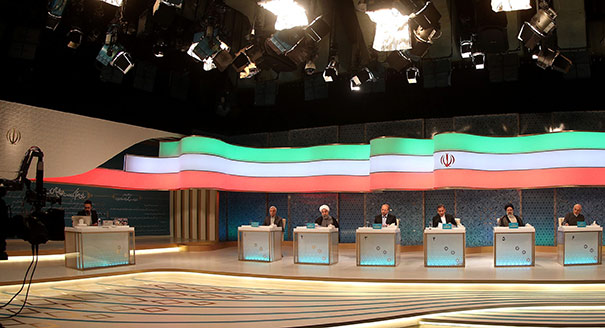
Yet within these strict confines, Iranian presidential elections are often competitive and revealing of popular sentiment. In debates (televised live) and on the campaign trail, candidates attempt to appeal to people’s political, social, and above all, economic concerns and discontents. Given that an incumbent has won every Iranian presidential election since 1979, Hassan Rouhani is the clear favorite. If no candidate wins a 50 percent majority of the people who actually vote (the ‘victory threshold’ line in the graph below) in the election’s first round on May 19, the top two competitors will face a second-round run-off one week later (May 26).
— Karim Sadjadpour
To better view the tracking chart on your mobile device, please turn your phone sideways and reload the page.
About the Poll
All polling data on this site were collected by Hosein Ghazian starting May 3, 2017. Ghazian established his first polling company, Ayandeh, in the 1990s in Iran and has worked with international polling organizations such as Gallup and Zogby International. In 2002, he was arrested by the government and eventually forced to leave the country. In 2013, Ghazian’s polls accurately predicted the late-hour surge and presidential victory of Hassan Rouhani.
Conducting polls in states ruled by authoritarian governments presents unique challenges. This poll is provided as is, and Carnegie accepts no responsibility or liability for the accuracy or reliability of the data. The bios were prepared by Senior Fellow Karim Sadjadpour and Junior Fellow Mariam Ghanem of Carnegie’s Middle East Program.
Updates
Thursday, May 18
“Iranian elections are designed to produce maximum drama before the vote, and minimum drama (and change) after the vote.” Read More >
—Karim Sadjadpour
Thursday, May 18
With just one day before Iran’s May 19 presidential election, the final tracking poll conducted by independent Iranian pollster Hosein Ghazian projects that Hassan Rouhani has 63 percent support among likely voters, while his main challenger hardline cleric Ebrahim Raisi only has 32 percent. Although Rouhani is well above the 50 percent majority needed for outright victory in the first round, Ghazian’s poll also revealed that 16 percent of Iranians remain undecided about how to vote, while 20 percent do not wish to disclose their preferred candidate.
Ghazian’s poll differs dramatically from a poll conducted by the Iranian Revolutionary Guards news agency, Fars News, which gave Raisi a 3 percent advantage. The belief that Raisi is the preferred choice of the Revolutionary Guards and Supreme Leader Ayatollah Ali Khamenei has many Rouhani supporters feeling nervous. International election observers are strictly forbidden in Iran, and improprieties are difficult to prevent in smaller towns and provinces whose precincts are often overseen by Iranian security forces.
Iranian elections are designed to produce maximum drama before the vote, and minimum drama (and change) after the vote. Given the ferocity of this election, however, and the dramatic difference between independently-conducted and state-controlled polls, allegations of fraud by the losing side are possible. The big question is whose votes will count most on Friday: Iran’s electors or the Islamic Republic’s protectors? Stay tuned.
—Karim Sadjadpour
Tuesday, May 16
After the withdrawal of Tehran mayor Mohammad Bagher Qalibaf, Iran’s May 19 presidential election is essentially now a two-man race between incumbent President Hassan Rouhani and hardline cleric Ebrahim Raisi. While Rouhani currently appears to enjoy a sizable lead—above the 50 percent threshold needed to secure a first-round victory—it is important to note that around 50 percent of the Iranian electorate remains either undecided about whom they will vote for or will not reveal their choice. What’s more, competing polls from Iranian-government-controlled polling outfits in Iran show the gap between them much smaller. This voter uncertainty, combined with the possibility of electoral fraud, means the race continues to be unpredictable in the final days.
—Karim Sadjadpour
Monday, May 15
Tehran mayor Mohammad Bagher Qalibaf announced on May 15 that he is withdrawing from the presidential race in favor of hardline cleric Ebrahim Raisi. The two candidates were virtually tied (each receiving around 20 percent support of those who planned to vote) and Qalibaf largely outshined Raisi in three presidential debates. Given Raisi is considered the preferred choice of Iran’s hardline clerical and military establishment, Qalibaf likely felt pressured to resign. It is unclear, however, whether Qalibaf voters will flock to Raisi or to first-place incumbent President Hassan Rouhani. Tomorrow’s poll numbers will reveal more.
— Karim Sadjadpour
The Candidates
Hassan Rouhani, 68
Centrist President Hassan Rouhani is running for his second term in 2017. Rouhani delivered on his main campaign promise—the 2015 nuclear deal—but both citizens and conservative opponents argue that the economic benefits have not trickled down to society.
Ebrahim Raisi, 56
Uncharismatic conservative cleric Ebrahim Raisi is considered the preferred choice of Iran’s hard-line establishment. He oversees Iran’s largest, multi-billion-dollar religious foundation. In 1988, as the public prosecutor of Tehran, Raisi was implicated in the execution of thousands of political prisoners.
Mohammad Bagher Qalibaf, 55
Longtime Tehran mayor Mohammad Bagher Qalibaf is considered among Rouhani’s strongest challengers. A conservative former commander of the Islamic Revolutionary Guard Corps and a licensed pilot, Qalibaf has run twice for president, finishing fourth in 2005 and second in 2013.
Mostafa Mir-Salim, 69
Conservative candidate Mostafa Mir-Salim is a French-educated engineer and served as the minister of culture in the mid-1990s. He has been absent from Iranian politics for the last two decades and has a low public profile.
Eshaq Jahangiri, 60
Eshaq Jahangiri is the first vice president to Hassan Rouhani. His candidacy is meant to advance Rouhani’s campaign, and it is anticipated he will eventually withdraw in favor of Rouhani.
Mostafa Hashemitaba, 70
Little-known Independent candidate Mostafa Hashemitaba was the former vice president to the late Akbar Hashemi Rafsanjani and served as the minister of heavy industries in the early 1980s. He finished tenth in Iran’s 2001 presidential election.
Carnegie does not take institutional positions on public policy issues; the views represented herein are those of the author(s) and do not necessarily reflect the views of Carnegie, its staff, or its trustees.
More Work from Carnegie Endowment for International Peace
Ex-president Gurbanguly Berdimuhamedov remains interested in politics, but his son Serdar, Turkmenistan’s current president, is becoming increasingly independent and willing to break with his father’s legacy. If their covert rivalry goes too far, both risk losing power.
A notable degree of participative democracy has firmly arrived in Europe. But to have more far-reaching impact, democratic deliberation needs to move into a radically new phase.
Sergei Kiriyenko used Russia’s parliamentary vote to further hone his strategy of corporate mobilization that is designed to maximize votes for United Russia.