

In The Media
David Rothkopf
{
  "authors": [
    "David Rothkopf"
  ],
  "type": "legacyinthemedia",
  "centerAffiliationAll": "",
  "centers": [
    "Carnegie Endowment for International Peace"
  ],
  "collections": [],
  "englishNewsletterAll": "",
  "nonEnglishNewsletterAll": "",
  "primaryCenter": "Carnegie Endowment for International Peace",
  "programAffiliation": "",
  "programs": [],
  "projects": [],
  "regions": [
    "North America",
    "United States"
  ],
  "topics": [
    "Economy",
    "Climate Change",
    "Security",
    "Foreign Policy"
  ]
}
Source: Getty
The opposite of knowledge is ignorance. But the willful disregard of knowledge—regardless of motive—is stupidity.
Source: Washington Post
“Hello, you have reached the United States of America. We’re sorry no one is here to take your call right now. We have taken leave of our senses and are unsure when they’ll return. Please try again in three-and-a-half years.”
If America had a voice-mail message to the world, this would be it. We are running an experiment in exploring the consequences of suddenly having the world’s most important power go absent without leave on the world stage.
Some of the signs of U.S. withdrawal have made international headlines. But some of the ways we are abandoning our leadership role are less visible. For example, few things are more directly associated with American leadership than our standing as a source of innovation, research, and scientific and technological expertise. Yet, President Trump — who has struggled to successfully conceive or maintain many policy initiatives — has shown remarkable steadfastness in his campaign against science.
George W. Bush had the War on Terror. Donald Trump has the War on Truth.
In the past month, the last few scientists have exited the White House Office of Science and Technology Policy’s (OSTP) Science Division. The OSTP is staffed at approximately a third of the level it was during the Obama administration; President Trump has yet to name a head of the office. Last week, the State Department’s top science and technology adviser, Vaughan Turekian, resigned amid a swirl of rumors that Secretary of State Rex Tillerson was planning on shuttering his entire science and tech operation. There have been a number of non-scientist appointments in posts with major scientific elements, including the appointment of Samuel Clovis to be undersecretary in charge of the Agriculture Department’s research, education and economic efforts. Clovis, who has virtually no science background, will oversee efforts on vital issues ranging from the spread of diseases to the effects of pesticides.
Clovis, like many in the administration, is a climate-change “skeptic.” So, too, is Scott Pruitt, the head of the Environmental Protection Agency. As giant chunks of Antarctica snap off the continent’s ice pack and weather patterns continue to confirm the conclusions of 97 percent of the scientific community that anthropogenic climate change is real, Trump has surrounded himself with people such as Clovis and Pruitt who simply disregard the facts, putting all of us at risk.
Last week, the Union of Concerned Scientists released a study on the track record of the administration during its first six months entitled “Sidelining Science from Day One.” The study condemns the Trump team for “eroding the ability of science, facts, and evidence to inform public policy decisions” and asserts “emerging patterns reveal tactics to diminish the role of science in our democracy.”
Speaking of the need for qualified scientists in top jobs, Arati Prabhakar, the former head of the Defense Advanced Research Projects Agency (DARPA), put it succinctly when she told me, “These positions demand deep expertise and thoughtful leadership. Anything less risks the future.”
Of course, it is not just science under siege. More broadly the administration attacks facts and evidence wherever they do not suit their policy views. All evidence-based communities are under attack — the intelligence community, law enforcement, think tanks and journalists. Attacks come in all forms — disregard for data, ad hominem attacks on the messengers and their motives, deflections and false analogies.
The opposite of knowledge is ignorance. But the willful disregard of knowledge — regardless of motive — is stupidity. That is because those who battle facts are at war with reality. It is an unwinnable proposition. Furthermore, specialized knowledge, particularly that of scientists, is essential if we are to do what leaders must, anticipate change, understand its consequences and harness the opportunities it presents. Trump, in waging a systematic campaign to rid the government of the experts and ideas he sees as threats to his agenda, has done more than just usher in a Golden Age of Stupidity. He is unwittingly asking a question it doesn’t take an expert to figure out: “What happens when you lobotomize the world’s leading power?”
We, too, need to understand the deadly certain consequences of what Trump is choosing to risk. It reminds me of an experiment my father, a scientist, once conducted. In his last years, he was tormented by kidney failure, a legacy of his suffering as a child in Nazi Austria. Dialysis was demeaning and debilitating. So, he went to his doctor and said, “Let’s see what would happen if we skip dialysis for a couple weeks.” The doctor said, “You will surely die.” My dad said, “The only way we can be sure of the outcome is if we test the theory.” To borrow a Hemingway phrase he favored, the outcome was never in doubt.
He passed away days later.
This article was originally published in the Washington Post.
Former Visiting Scholar
David Rothkopf was a visiting scholar at the Carnegie Endowment as well as the former CEO and editor in chief of the FP Group.
Recent Work
David Rothkopf
David Rothkopf
Carnegie does not take institutional positions on public policy issues; the views represented herein are those of the author(s) and do not necessarily reflect the views of Carnegie, its staff, or its trustees.

To remain effective, organizations need to master new media and legitimacy markers to make a once-in-a-century shift.

Renée DiResta, Rachel Kleinfeld, Margot Treadwell

Congress needs to step up and make EXIM a low-carbon financing powerhouse.
Jesse Young

The ninety-three-year-old Biya’s absence and refusal to name a vice president threaten to upend domestic and regional stability.

Lesley Anne Warner

With the growth in points of friction between the great powers, organizations like the SCO will continue to play a role in the strategic adaptation of the smaller powers caught between them.

Temur Umarov
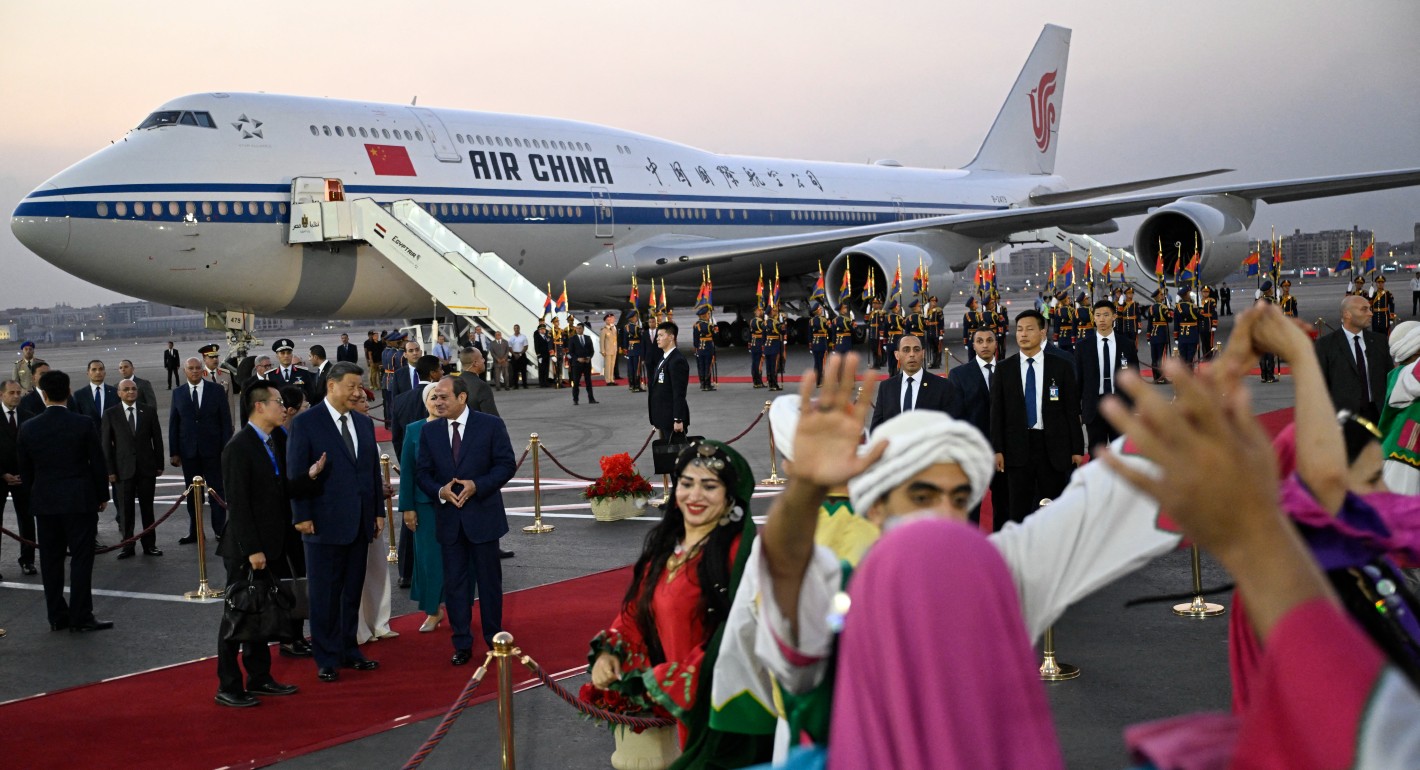
Amid celebrations of bilateral ties was a deeper focus on stability in the Middle East.

Amr Hamzawy