

Article
C. Raja Mohan, Darshana M. Baruah
{
  "authors": [
    "C. Raja Mohan"
  ],
  "type": "legacyinthemedia",
  "centerAffiliationAll": "dc",
  "centers": [
    "Carnegie Endowment for International Peace",
    "Carnegie India"
  ],
  "collections": [],
  "englishNewsletterAll": "ctw",
  "nonEnglishNewsletterAll": "",
  "primaryCenter": "Carnegie India",
  "programAffiliation": "SAP",
  "programs": [
    "South Asia"
  ],
  "projects": [],
  "regions": [
    "Asia",
    "South Asia",
    "India",
    "East Asia",
    "China"
  ],
  "topics": [
    "Foreign Policy",
    "Security"
  ]
}
Source: Getty
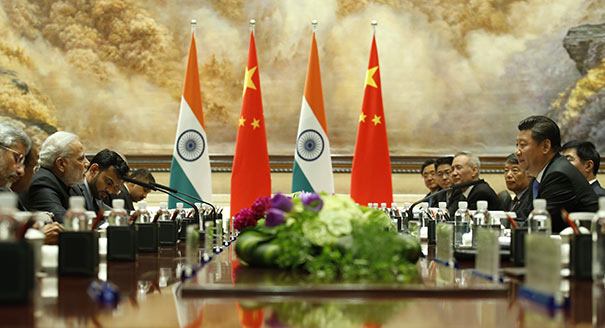
One of the unintended consequences for China from the Doklam crisis would be an India that is forced to think far more strategically about coping with China’s power.
Source: Indian Express
Whatever the eventual outcome in Doklam, the current stand-off is bound to significantly alter Indian perceptions of China. For one, the political goodwill in India towards China that was constructed over the last three decades will be increasingly difficult to sustain in the coming years. For another, India, which long resisted the idea of balancing China, is likely to move inevitably in that direction.
It took a lot of bold moves, including those by Atal Bihari Vajpayee as the foreign minister in the late 1970s and Rajiv Gandhi as the prime minister in the late 1980s, for the Indian elite to overcome the sense of Chinese betrayal in 1962. While leaders like Vajpayee and Rajiv Gandhi understood the imperatives of normalising relations with China, there was entrenched resistance in the political class and in the bureaucracy, armed forces and the security agencies that would take many years to overcome. Indian business too has been deeply fearful of engaging China.
The slow but definitive normalisation of relations was aided immensely by the pragmatism in Beijing, especially that of Deng Xiaoping, whose emphasis was on creating a peaceful external environment for the economic modernisation of China. But as China’s power grew rapidly, Deng’s successors have abandoned that pragmatism in favour of assertiveness. The current generation of leaders in Beijing believes China can now shape its external environment rather than merely adapt to it. As the newly predominant power in Asia, China may now see no reason to defer to Indian sensitivities.
The signals of China’s new approach to India were evident since 2008 when China opposed the nuclear exemption for India at the Nuclear Suppliers Group. Thanks to strong support to India from then-US President George W. Bush, China backed off. Meanwhile, tensions on the border began to rise as the PLA improved the military logistics in Tibet. China’s embrace with Pakistan has grown tighter and Beijing’s penetration of South Asia deeper over the last decade.
On its part, the UPA government in Delhi downplayed the differences with Beijing and underlined the prospects for collaboration with China in the quest for a multipolar world. The Narendra Modi government had a taste of Chinese pressures in September 2014 when PLA’s incursions into Ladakh coincided with President Xi’s visit to India. Modi’s followed his success in defusing this crisis by a strong effort to expand economic ties on a practical basis. But the Chinese actions — brazen opposition to India’s membership to the NSG, the reluctance to support international sanctions against known terrorists in Pakistan, and most recently the aggressive posture in the Doklam crisis — have dashed hopes for a positive turn in bilateral ties.
If Modi, as the strongest leader since Rajiv Gandhi, presented a rare opportunity to reconstruct Sino-Indian relations, Xi seems utterly uninterested. Sensible statecraft must, however, try and temper the pessimism of analytics with optimism about political agency. Hence, the unprecedented restraint in Delhi’s language and its patient calls for a dialogue to resolve the Doklam crisis in the face of Chinese threats and demands for unilateral Indian concessions.
India sees no reason to pick up a needless quarrel with a neighbour and rising power like China. But Beijing might be terribly wrong in presuming that Delhi would simply fold up under pressure. Pushed to a corner, India has every incentive to simply dig in. If China sees itself as an irresistible force today, India could well turn out to be that immovable object. There will be no happy ending for this confrontation.
China appears to have been carried away by the success of its recent coercive diplomacy in East Asia and the South China Sea. Unlike China’s East Asian neighbours, India has the capacity to absorb pressures from Beijing. With limited economic interdependence with China, Delhi can bear the costs of a severed commercial relationship. If India could turn its back on the dominant powers of the West for many decades during the Cold War, it could do that with China again.
China is also wrong to believe that asymmetry in power potential will automatically lead to surrender. China could learn from Pakistan’s refusal to submit to the widening strategic gap with India. Beijing’s haughty and unpleasant diplomacy in the current crisis will eventually lead to the conviction in Delhi that strategic defiance of China must prevail over the temptations for appeasement.
One of the consequences of power asymmetry is the pressure on the weaker power to turn to balancing strategies. Until now, India has deeply resisted walking down that road in the expectation that a reasonable accommodation of interests with China is possible. If China makes it clear there is no room for compromises, India will have to turn to both internal and external balancing of China.
One of the unintended consequences for China from the Doklam crisis would be an India that is forced to think far more strategically about coping with China’s power. For nearly a century, sentimentalism in Delhi about Asian solidarity and anti imperialism masked the more structural contradictions with China. Beijing’s approach to the Doklam crisis could well help bury those illusions.
This article was originally published in the Indian Express.
Former Nonresident Senior Fellow, Carnegie India
A leading analyst of India’s foreign policy, Mohan is also an expert on South Asian security, great-power relations in Asia, and arms control.
Recent Work

C. Raja Mohan, Darshana M. Baruah


Alexander Gabuev, Paul Haenle, C. Raja Mohan, …
Carnegie does not take institutional positions on public policy issues; the views represented herein are those of the author(s) and do not necessarily reflect the views of Carnegie, its staff, or its trustees.

The acknowledgment has sparked fears of a new arms race with China and Russia.

Chris O’Meara
Smaller powers cannot go it alone, but Canadian history shows that integration with the United States will not always be benign.
Paul Samson

The European Commissioner for Trade is headed to China. But after President Xi’s bridge-building visit to Washington, can a more isolated EU overcome Beijing’s stranglehold on critical raw materials? Who will blink first?

Rym Momtaz, ed.

The summit may be remembered as a fatal blunder, when Washington, Beijing, and the AI industry collectively chose ceremony over action.

Jeffrey Prescott

European NATO countries are wrestling with the possibility of U.S. disengagement from the alliance. With the continent’s security increasingly uncertain, governments must restore the credibility of their collective defense.



Hans-Dieter Lucas, Adam Thomson, Pierre Vimont