Narendra Modi rose to power partly on the basis of his discourse, a notion referring not only to the themes he has highlighted in his speeches but also to his oratorical style. As Chief Minister of Gujarat, he attacked Congressmen politically, but also personally by coining acronyms and formulas. He arraigned the inaction of Manmohan Singh by calling him “Maun (silent) Mohan Singh”. He also presented himself as the protector of Gujarat against the Centre in a graphic manner. He claimed that he was “the chowkidar” of the state’s treasury, guarding it from the greed of the Congress. And he added: “Earlier, this money used to get swallowed. Maaru koi vhalu-dahalu nathi (I don’t have near and dear ones). The six crore Gujaratis are my family and their happiness is mine”.
In the same vein, he accused the Nehru-Gandhi family of cultivating an old anti-Gujarati prejudice. In 2012, he declared: “Historically, the Nehru Parivar doesn’t like any Gujarati leader. They treated Sardar Vallabhbhai Patel badly. They treated Morarji Desai badly. Now it’s my turn to be targeted by them.”
Simultaneously, Modi presented himself as an aam admi, a common man, in contrast to the Nehru-Gandhi family whom he associated with the political elite. During the 2013-14 Lok Sabha election campaign, after becoming the BJP’s prime ministerial candidate, he elaborated on this theme by emphasising his background as a former chaiwala (teaboy).
Last but not the least, as CM, Modi repeatedly attacked the Centre for its lack of economic dynamism, compared to Gujarat. For instance, after his 2012 victory, he delivered an address in this vein at the BJP headquarters in New Delhi:
Brothers and sisters, I came here today to attend the NDC (National Development Council) meeting, and in the meeting, I put my point before the Prime Minister and said that it is the country’s misfortune that [in] the post that you are, [in] the place from where you are speaking, an atmosphere of despair is being created in the country. Whatever you are saying is taking the country to the bottom of deep despair.
As Prime Minister, Narendra Modi’s discourse was bound to change since he was not any more a provincial challenger fighting the establishment, but the ruler of the country. However, some constants remained, as is evident from the data base on which this article relies. This data set comprises 720 interventions by Modi (either in English or translated from the Hindi) representing 1.6 million words covering the period 2010-17 (until July 31).
When compared to later public interventions, the three words that Modi used in greater proportions as CM were “gentleman”, “lady” and “friend”, in that order. The three words overrepresented in his 2013-14 election campaign speeches were “friend”, “Congress” and “BJP” — in that order again. Finally, the three overused words in his speeches as PM were “our”, “cooperation” and “India” (overused in comparison to the lexicons of his two predecessors whose speeches, too, we have processed).
This Correspondence Analysis maps the distribution of Modi’s vocabulary based on co-occurring features, i.e., sets of words frequently mentioned together in his speeches from 2010 to 2017. The six clusters of words we generated are displayed. Two topics are linked to economic matters: the grey category clusters broad developmental vocabulary, and the purple one refers to local access to infrastructure and commodities. The green topic displays foreign policy lexicon, and the red one is associated with emotions, decision-making and technical-cum-procedural issues. The light blue cluster draws on ideology and culture, while the dark blue one points to leading political figures and ceremonial matters. Mapping originally from the Indian Express.
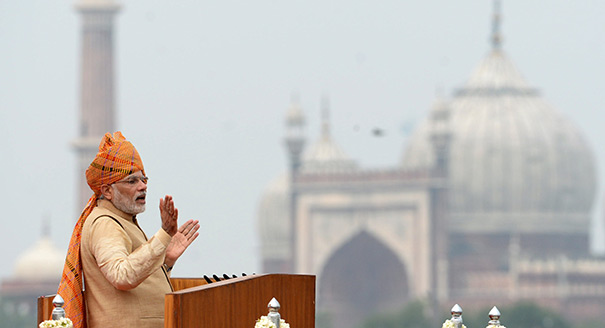
But among Modi’s speeches, the Red Fort addresses represent a specific genre.
Independence Day speeches of Prime Minister Modi and his two immediate predecessors, Manmohan Singh and Atal Bihari Vajpayee, that we have scrutinised show the speeches to be a codified political ritual in which the unity of the nation is always emphasised. The computer-assisted classification of content words enable us to outline two main themes woven around the ideas of sovereignty and economic development. Additionally, the two first-person plural pronouns (“we” and “our”) are the two most overrepresented function words found in Independence Day speeches as compared to other political interventions. August 15 speeches thus appear as a political genre calling for performative collective action and devotional stances for the people of India.
However, despite the codified and ceremonial-based nature of Independence Day speeches, the ones made by Narendra Modi between 2014 and 2016 are very specific to him. They are part of the Modi mould and do exemplify the main features of his oratorical identity. When compared to Manmohan Singh’s and Vajpayee’s Independence Day speeches, the three words overused by Modi have been “sister”, “brother” and “team”. This trilogy is very revealing of his attempt at establishing a personal connection with India’s citizens — something also evident from his monthly radio address, Mann ki Baat.
By contrast, the three overused words by Manmohan Singh in his Red Fort addresses over 10 years were “our”, “growth” and education”; Vajpayee’s podium was made of “shall”, “Kashmir” and “India”.
Modi’s rhetorical technique is inherent in populism, a version of politics that crystallises when a leader tries to relate directly to “his” nation, circumventing institutions in the worst-case scenarios. Words like “sister” and “brother” suggest that the variant of this type of discourse that Modi prefers is family-oriented. This approach is in tune with the organic view of society prevailing among Hindu nationalist ideologues. For them, social divisions are secondary and need to be downplayed in order to promote unity. Modi, therefore, always claimed that he represented 6 crore Gujaratis.
As PM, he suggested a privileged relationship with Indians through hailing them and addressing them directly. Accordingly, words like “you”, “brother”, “sister”, “friend”, “people”, and “mother” best define Modi’s language. They are typically found in short, action-oriented sentences, often either exclamatory or interrogative. Speeches by him frequently rely on references to himself, while the abundant use of numerals, past tenses and the third person singular show his emphasis on economic achievements, personalisation of power, and story-telling. The following is an example taken from his 2015 Independence speech:
Lo and behold! The great strength of the Team India of 125 crore Indians and their resolve! Within a certain time limit, the coal was auctioned and now almost Rs 3 lakh crore would be accruing to the national exchequer. Brothers and sisters, just ask yourselves whether corruption was rooted out or not? Whether the middlemen were ousted or not? Whether the door was shut in the face of the wealth-stealers of India or not? I did not make any speech in this regard. I just did it.
Modi approaches the question of economic improvement from a non-technical angle. He prefers to use words such as “poor”, “electricity”, “rupee”, “money” and “village”, while Manmohan Singh favoured terms such as “growth”, “development”, “policy”, or “institution”.
While his skills as an orator has contributed to Modi’s rise to power in a manner not significantly different from Indira Gandhi’s brand of populism in the early 1970s, in his case, the use of social media, holograms, and body language at large also need to be factored in — and deserve more research.
Jaffrelot’s core research focuses on theories of nationalism and democracy, mobilization of the lower castes and Dalits (ex-untouchables) in India, the Hindu nationalist movement, and ethnic conflicts in Pakistan.
Jean-Thomas Martelli
Jean-Thomas Martelli is a Doctoral Candidate at King’s India Institute, King’s College London, and a sessional lecturer in Sciences Po Paris. He tweets @jtmartelli.
Carnegie does not take institutional positions on public policy issues; the views represented herein are those of the author(s) and do not necessarily reflect the views of Carnegie, its staff, or its trustees.
More Work from Carnegie Endowment for International Peace
China’s political future will be shaped between now and next October. As the Communist Party enters its intense “campaign season” to prepare for a major political transition in 2027, reading Beijing's actions and responses may become more difficult as domestic politics weigh on its behavior more than usual.
Putin’s conservative staffing policies and search for ever greater control have cemented parliament’s transformation into a bureaucratic appendage of the executive branch.
Ex-president Gurbanguly Berdimuhamedov remains interested in politics, but his son Serdar, Turkmenistan’s current president, is becoming increasingly independent and willing to break with his father’s legacy. If their covert rivalry goes too far, both risk losing power.
A notable degree of participative democracy has firmly arrived in Europe. But to have more far-reaching impact, democratic deliberation needs to move into a radically new phase.