Source: Hill
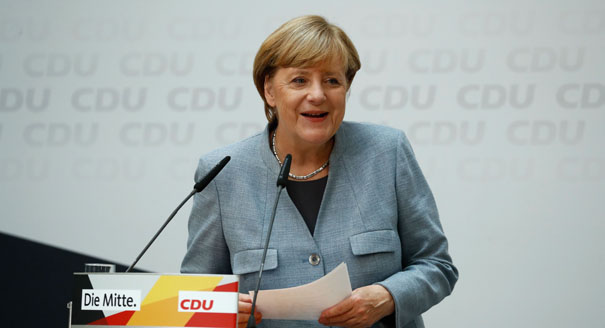
For a country that highly values and is accustomed to steady governance and predictable politics, the decision this month by the Free Democratic Party to walk away from coalition talks with Angela Merkel came as a shock in Germany. Ever since the outcome of the federal elections in September, which produced the most fragmented German Bundestag in decades, it has been clear that forming a new governing coalition would not be straightforward. Weeks went by, deadlines were missed, the tone between the likely coalition parties grew sharper, but few predicted no deal at all.
This unexpected breakdown of the coalition talks risks thrusting Germany into unprecedented political territory, and the rest of Europe into prolonged political uncertainty with some serious potential ramifications. A key factor will be how long it will take for Germany to form a new stable government, as there is little doubt it eventually will. Three main scenarios seem possible now.
The first one is resumed coalition talks. In a public address German President Frank Walter Steinmeier, urged the parties to resume talks and reminded them of the responsibility that they received from voters on Election Day. He is expected to encourage the Free Democratic Party to fall in line and try persuade the Social Democratic Party to give up its strong post-election opposition to another potential “grand coalition.” Whether this will aid Merkel’s coalition efforts remains to be seen.
The second scenario is a minority government led by the Christian Democratic Union. Unprecedented on the federal level in Germany and counterintuitive to the German preference for stability, this option would require Merkel’s Christian Democratic Union and its sister party, the Christian Social Union, to form a government with either the Green Party or the Free Democratic Party, the very party that just walked away from the talks. Both options lack a majority in the Bundestag and would depend on votes from other parties to pass legislation. In an interview, Merkel seemed skeptical about this option. The German population is with her on that one as only 29 percent are in favor of this unprecedented scenario
This leaves Germany with a third scenario, namely holding new elections. With 63 percent of German citizens supporting this idea, this may seem the most likely outcome. However, unlike in many other Western democracies, the German constitution does not make this option straightforward, keeping the history of the unstable Weimar Republic in mind. It is a lengthy complicated process that also risks benefiting the far-right populist party Alternative für Deutschland. Merkel, on the other side, has carefully signaled her preference for this option.
Regardless of the outcome, for the time being, we will see a Germany that is inward focused and consumed with its domestic political affairs. Merkel’s ability to exert strong leadership in Europe and at the international stage has been hampered and will be limited since she will need to focus on forming a coalition or campaigning for new elections. The passive German leadership we have seen in the lead up to September’s elections, focused on managing issues but avoiding new initiatives, may thus continue for several months to come. German foreign policy is on autopilot and with it are pressing issues, such as Brexit, Russia and Ukraine. While this means no major changes, it also means zero initiatives from Berlin.
For the rest of the continent, the situation means that any European Union reform efforts will be put on the backburner for the time being. The election of French President Emmanuel Macron, earlier this year significantly raised the prospect of a strong French-German tandem on forging a deeper fiscal and political union. This momentum, however, is now dissipating and any negotiations, which were never going to be easy in the first place, will have to be shelved until possibly next spring. With elections for the European Parliament lurking around the corner in 2019, the window of opportunity for such crucial reform talks slowly but surely shrinks, making them even more complex.
At a time when Europe is struggling with the rise of populism across the continent, Germany has so far been a beacon of relative political calm. A return to the normal state of German politics seems distant, and we have to reconcile Germany’s “new normal.” A new government in Berlin will eventually emerge but for Europe this means that precious time and opportunity will be lost as we wait to find out its exact composition.
This article was originally published in the Hill.