

Commentary
- +11
Cornelius Adebahr, Dan Baer, Rosa Balfour, …
{
  "authors": [
    "Erik Brattberg"
  ],
  "type": "other",
  "centerAffiliationAll": "dc",
  "centers": [
    "Carnegie Endowment for International Peace",
    "Carnegie Europe"
  ],
  "collections": [
    "Transatlantic Cooperation",
    "European Defense in a New Transatlantic Context"
  ],
  "englishNewsletterAll": "ctw",
  "nonEnglishNewsletterAll": "",
  "primaryCenter": "Carnegie Endowment for International Peace",
  "programAffiliation": "EP",
  "programs": [
    "Europe"
  ],
  "projects": [],
  "regions": [
    "Western Europe",
    "Europe",
    "North America",
    "Iran"
  ],
  "topics": [
    "Security",
    "Military",
    "Foreign Policy"
  ]
}
Source: Getty
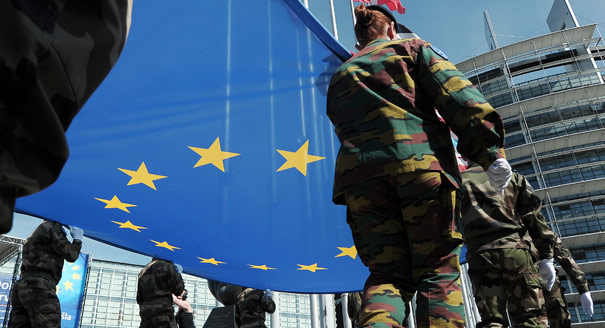
Over the past year, European defense collaboration has arguably made more progress than in the past decade.
Source: German Marshall Fund
Over the past year, European defense collaboration has arguably made more progress than in the past decade. Significantly, unlike past attempts to deepen European defense, there seems to be both genuine political will and a sense of urgency this time around. Although many of the current initiatives date back several years, the election of Donald Trump has raised questions about the continued military reliance on the United States, and Britain’s exit from the EU means less internal opposition to ambitious EU defense proposals. Meanwhile, France’s new president Emanuel Macron has turned out to be a strong proponent of deeper EU defense collaboration. Even NATO seems to welcome a stronger European pillar. Gone are the age-old theological debates about EU versus NATO. Today, it is widely recognized that both organizations play crucial and complementary roles in providing for European security. Recent European defense initiatives, such as Permanent Structured Cooperation (PESCO) and the European Defence Fund (EDF), have the potential to make a distinct contribution to transatlantic security. But success also requires that they are correctly implemented and sufficiently integrated with NATO efforts to avoid duplication. As European capitals contemplate further steps to move forward on European defense collaboration, it is essential that they take into account viewpoints from the other side of the Atlantic.
This policy brief was originally published by the German Marshall Fund.
Former Director, Europe Program, Fellow
Erik Brattberg was director of the Europe Program and a fellow at the Carnegie Endowment for International Peace in Washington. He is an expert on European politics and security and transatlantic relations.
Recent Work



Cornelius Adebahr, Dan Baer, Rosa Balfour, …

Erik Brattberg, Philippe Le Corre, Paul Stronski, …
Carnegie does not take institutional positions on public policy issues; the views represented herein are those of the author(s) and do not necessarily reflect the views of Carnegie, its staff, or its trustees.

Despite public disputes over trade and immigration, the strategic partnership’s foundations remain sturdy.

Sameer Lalwani
It signals a new era of tech diffusion and warfare.

Steve Feldstein

With its public finances in shambles, the far right polling at 35 percent ahead of the 2027 presidential election, and a growing protest movement, is France’s crisis a threat to the EU’s geopolitical awakening?

Rym Momtaz, ed.

Russia’s AI-driven propaganda campaigns operate in a fragmented, chaotic, and often illogical manner. That’s not necessarily a problem for the Kremlin, though: It’s much easier to mimic genuine public debate that way.

Ilya Klishin

Ahead of a tough winter for Ukraine, Donald Trump’s swing back toward Russia bodes ill. But instead of panicking, Kyiv’s European allies are focusing on action.
Rym Momtaz