

Article
C. Raja Mohan, Darshana M. Baruah
{
  "authors": [
    "C. Raja Mohan"
  ],
  "type": "legacyinthemedia",
  "centerAffiliationAll": "dc",
  "centers": [
    "Carnegie Endowment for International Peace",
    "Carnegie India"
  ],
  "collections": [],
  "englishNewsletterAll": "ctw",
  "nonEnglishNewsletterAll": "",
  "primaryCenter": "Carnegie India",
  "programAffiliation": "SAP",
  "programs": [
    "South Asia"
  ],
  "projects": [],
  "regions": [
    "India",
    "Southeast Asia",
    "South Asia"
  ],
  "topics": [
    "Foreign Policy"
  ]
}
Source: Getty
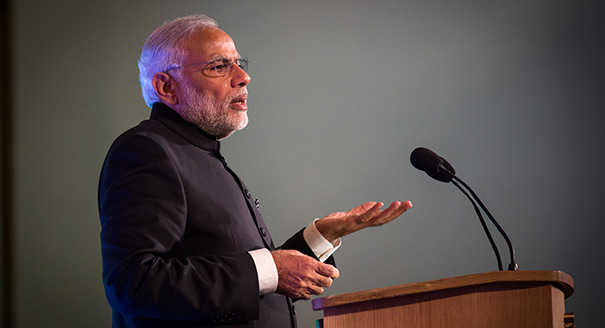
Prime Minister Narendra Modi’s trip to Singapore focuses on three increasingly interconnected themes—the strategic, economic, and technological.
Source: Indian Express
Prime Minister Narendra Modi arrives in Singapore this week to focus on three increasingly interconnected themes — the strategic, economic and technological. On all three, there is a new dynamism to the east of India and Singapore is at the heart of it. The PM has an opportunity to demonstrate that India is alive and ready to seize the new opportunities in Asia on the three fronts.
Geopolitical issues will be in focus when the PM delivers the keynote address at the Shangri La Dialogue, the annual conclave in Singapore that brings together the region’s defence ministers and senior military officials. The Dialogue, organised by the London-based International Institute of Strategic Studies (IISS) with the support of the Singapore government, offers Modi just the right platform to articulate the definitive perspective from Delhi on India’s interests and role amidst the unfolding regional power shift.
At the centre of the new turbulence is the rapid deterioration in US-China relations since Donald Trump occupied the White House in January 2017. Reacting to China’s relentless militarisation of the South China Sea, Washington last week uninvited Beijing from the world’s largest maritime exercises, called RimPac, held every two years.
Although Washington and Beijing appear to have stopped at the precipice of a trade war last week, there is no sign of an early resolution of the economic disputes between the world’s two largest economies. The current conflict is not limited to the question of trade deficits but has also enveloped the high technology sector, which has seen growing interdependence between US and Chinese companies in recent decades.
On the political front, President Donald Trump’s on-again, off-again summit with Chairman Kim Jong-un of North Korea in Singapore on June 12 promises to unfreeze the political order in the Korean Peninsula that has been in deep chill since the early 1950s. Trump has accused Beijing of throwing a monkey wrench into the US efforts to resolve the nuclear dispute with North Korea. China, apparently, is quite anxious of being cut out of a political settlement in the Korean Peninsula brokered by the US.
As in the Korean Peninsula, so in Southeast Asia the turmoil in great power relations is challenging the comforting certitudes of the past. The region had benefited immensely from traditional security cooperation with the US and the deepening economic engagement with a rising China in recent decades. The uncertain trajectory of US-China relations has cast a dark cloud over ASEAN’s benign economic and political environment of the last three decades.
Much of the region to the east of India is scrambling to adapt to the new dynamic between China and the US. Since the end of the Cold War, the ASEAN has sought to draw India into the region as a stabilising force. But it has been disappointed by the tentativeness of India’s defence diplomacy in the region at the bilateral as well as multilateral levels. For nearly two decades, the Shangri La Dialogue had provided a useful venue for the Indian defence establishment to engage its counterparts in Asia. Yet Delhi’s participation in this forum has turned out to be erratic and grudging.
The PM needs to signal that his participation in the Shangri La Dialogue is the harbinger of Delhi’s sustained high-level security engagement with the region. Modi must also bridge the gap between Delhi’s rhetoric on being a “net security provider” in the region and the lack of concrete matching actions.
The Trump Administration’s approach to trade has sent shivers down the spine of Asia that has taken the logic of globalisation for granted. As the region seeks to secure its interests through consolidation of trade agreements with other nations, it finds India a frustrating interlocutor. Delhi is widely seen in the region as a spoiler in the trade negotiations.
To be sure, the issues at hand are complex. But the PM needs to assure the region India is flexible and prepared to bring the negotiations to an early closure. Concluding the long-pending review of the Comprehensive Economic Cooperation Agreement with Singapore could send out a positive signal to its Asian partners.
Finally, Modi’s visit is likely to see a big move towards the formal integration of the digital payments systems of the two countries. Once it is done, Indian holders of the “RuPay” cards will be able to make financial transactions in Singapore. Similarly, residents of Singapore could use the local NETS cards to make purchases in India and its e-commerce portals.
India’s overly complex regulations, however, prevent the full realisation of the potential for digital financial connectivity between India and Singapore. They also limit the possibilities for a greater alignment between the expansive innovation ecosystem in Singapore and the technology hubs in India. When he addresses the entrepreneurs in Singapore later this week, the PM needs to reassure them that India will significantly improve the policy environment for innovation in India and discard the bureaucratic defensiveness about global engagement on advanced technologies.
An India that misses the current opportunities for technological advancement will inevitably diminish its ability to shape the regional economic, political and military order. After all, the pace and effectiveness of adaptation to the current technological revolution will define the future power hierarchy in Asia.
This article was originally published in the Indian Express.
Former Nonresident Senior Fellow, Carnegie India
A leading analyst of India’s foreign policy, Mohan is also an expert on South Asian security, great-power relations in Asia, and arms control.
Recent Work

C. Raja Mohan, Darshana M. Baruah


Alexander Gabuev, Paul Haenle, C. Raja Mohan, …
Carnegie does not take institutional positions on public policy issues; the views represented herein are those of the author(s) and do not necessarily reflect the views of Carnegie, its staff, or its trustees.

While the EU and European governments are embracing the much-lauded middle-power moment, this entails three difficult conundrums.

Richard Youngs
The middle power moment will not be defined by sovereign states alone, and California stands out for its potential contributions to international cooperation.


Ian Klaus, Stewart Patrick

Much has been said of the changes Brussels is trying to make to the EU enlargement process. Here’s why gradual integration might—or might not—be the answer.

Dimitar Bechev
Economic recovery has brought Sri Lanka a modicum of stability, but domestic strains and great-power rivalry could test how long it lasts.
Avinash Paliwal

Despite a new textbook, an influx of Russian teachers and managers, and an end to the teaching of Ukrainian, the Kremlin is unlikely to have “reprogrammed” locals.

Konstantin Skorkin