

Commentary
- +3
Marwan Muasher, Amr Hamzawy, Rain Ji, …
{
  "authors": [
    "Yasmine Farouk"
  ],
  "type": "commentary",
  "centerAffiliationAll": "dc",
  "centers": [
    "Carnegie Endowment for International Peace",
    "Malcolm H. Kerr Carnegie Middle East Center"
  ],
  "collections": [],
  "englishNewsletterAll": "menaTransitions",
  "nonEnglishNewsletterAll": "",
  "primaryCenter": "Carnegie Endowment for International Peace",
  "programAffiliation": "MEP",
  "programs": [
    "Middle East"
  ],
  "projects": [],
  "regions": [
    "Middle East",
    "Saudi Arabia",
    "Gulf"
  ],
  "topics": [
    "Political Reform",
    "Democracy",
    "Foreign Policy"
  ]
}
Source: Getty
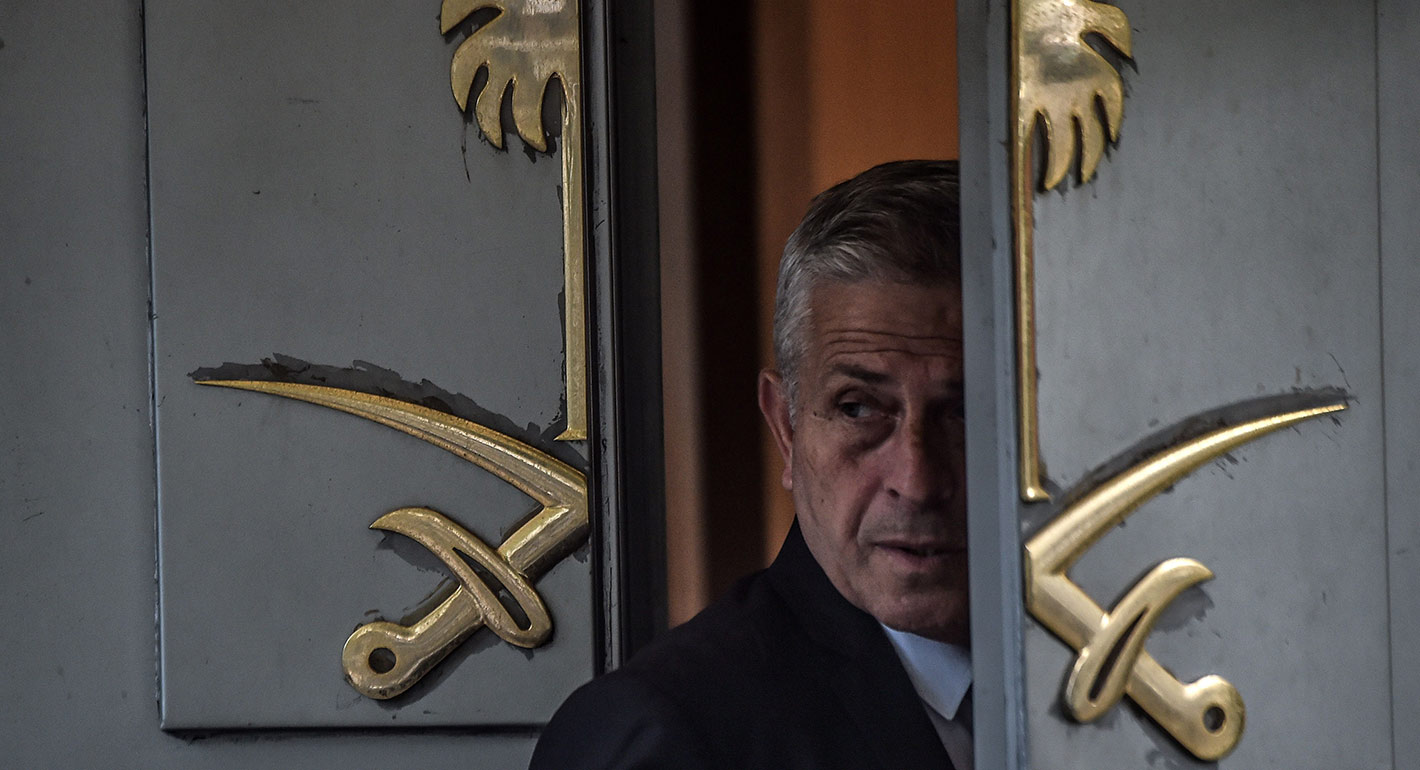
Jamal Khashoggi vanished in Istanbul. But the key to understanding the Saudi reaction to his disappearance lies in Riyadh.
It is impossible to understand Saudi Arabia’s response to the recent disappearance of Saudi journalist Jamal Khashoggi without taking into account the complicated politics swirling around Riyadh and Crown Prince Mohammed bin Salman. Domestic politics now leave the kingdom most vulnerable to a harsh U.S. response.
Riyadh’s reaction has been bewildering and, for many, infuriating. It started with the Saudi consulate’s denial of any knowledge of Khashoggi’s fate. When the story refused to blow over, the crown prince raised discussions of Saudi-led investigations and “cooperation with the Turkish government” while vehemently denying any Saudi responsibility. The official Saudi press agency also published a warning that any international sanctions could lead to retaliatory sanctions. This threat was not just aimed at the United States; it was also meant for Saudis living in the country and abroad.
Crown Prince Mohammed and Riyadh may feel this harsh stance is necessary to fend off internal threats to the kingdom and his rule. In the past, despite immediate support from regional allies, domestic political opponents have used the kingdom’s international crises to double down on activism. These opponents have capitalized on having the attention of an international community that is otherwise rarely critical of Saudi rulers—leading to domestic violent and nonviolent mobilization inside the kingdom in the wake of the Gulf War, 9/11, the U.S. invasion of Iraq, and the Arab Spring. In those instances liberal, Islamist, Shia, and political activists seized on royal anxiety and international scrutiny to demand political reforms and human rights.
For the Saudi royals who resent Crown Prince Mohammed’s iron fist, this is the first opportunity to strike at his grip on power. Last winter, he imprisoned many of them in Riyadh’s Ritz-Carlton Hotel on charges of corruption, in what one royal (the billionaire Prince Alwaleed bin Talal) later called “a misunderstanding.” Since he began accumulating power in 2015, the crown prince has systematically and successfully changed the top leadership of all the country’s security and military institutions. But in Saudi Arabia, personal loyalty is more important than institutions, and the crown prince’s image as untouchable and all-powerful has been tainted. Historical loyalties in the kingdom are built on layers of tribal connections and personal favor, and now it is unclear whether one year of clearing the decks was enough to ensure loyalty to the crown prince.
While the 2017 purges were dramatic and harsh, they did not threaten family cohesion. King Salman’s legitimacy remains untouched, and the crown prince’s power comes from ensuring its legacy. However, the Khashoggi situation may result in U.S. penalties that target the defense and economic resources that the regime uses to maintain its power and secure itself against domestic instability and regional threats. The entire family will be threatened by any punishments resulting from this international scrutiny.
While this crisis may shake the bin Saud family, it likely will not lead to dramatic political or regime change. Saudi activists and dissidents, including Khashoggi himself, have seldom demanded regime change. But the crown prince’s position is less secure. He could be unseated in a possible scenario resembling what he did with his own predecessor, former crown prince Mohammed bin Nayef, who in turn replaced former crown prince Muqrin bin Abdulaziz. Such a transition may be violent, given that the current crown prince is now far more powerful than his predecessors and acts more like a de facto king. As such, a coup might look more like King Saud’s removal from power in 1964 but could be even more turbulent.
At a minimum, the crown prince’s influence in domestic and foreign policy circles will be limited in the short run. The Khashoggi crisis will also affect foreign and domestic politics. In regional terms, the kingdom will have to offer concessions to Turkey in exchange for an honorable exit from this fiasco. Whether such concessions would be financial resources to boost the Turkish economy or political and military assets in Syria remains to be seen.
Within Saudi Arabia, symbolic political reforms and financial gifts have been customarily used during crises to reinvigorate the royal family’s traditional legitimacy. These gestures are usually accompanied by media campaigns and propaganda to reinforce the strongman image of the king and the crown prince as vanguards against outside pressure, while also highlighting Saudi Arabia’s international importance. While these reforms generally tend to come before a wave of worse repression, in the short term, they may divert attention from the crisis.
The United States should take advantage of Saudi Arabia’s vulnerable position and capitalize on the king’s personal involvement to ask for concessions such as serious negotiations in Yemen and the dismissal of death penalties hanging over the heads of certain Saudi activists. Riyadh may be more amenable to these steps in return for Washington’s willingness to reconsider potentially harsh Magnitsky Act sanctions, which allow the U.S. government to punish human rights abuses. Both sides have an interest in repairing the damaged U.S.-Saudi relationship.
Unless the United States acts soon, domestic threats in Saudi Arabia will ease off. When that happens, Riyadh will feel more comfortable. But Washington must be deft. If it puts too much pressure on Saudi Arabia, there will be side effects: higher oil prices due to market instability and emboldened, hostile Iranians and Houthis. What’s more, the kingdom could conceivably use its regional media empire, money, and universal Islamic outreach to disrupt U.S. policies in the Middle East and in Africa.

Former Nonresident Scholar, Middle East Program
Yasmine Farouk was a nonresident scholar in the Middle East Program at the Carnegie Endowment for International Peace.
Recent Work


Marwan Muasher, Amr Hamzawy, Rain Ji, …
Yasmine Farouk
Carnegie does not take institutional positions on public policy issues; the views represented herein are those of the author(s) and do not necessarily reflect the views of Carnegie, its staff, or its trustees.

Funding Ukraine remains a priority for European leaders. As Russia’s war of aggression heads into another winter, two feasible options to mobilize support for Kyiv should be fast-tracked.


Vladyslav Rashkovan, Gregory P. Wilson

While the EU and European governments are embracing the much-lauded middle-power moment, this entails three difficult conundrums.

Richard Youngs
The middle power moment will not be defined by sovereign states alone, and California stands out for its potential contributions to international cooperation.


Ian Klaus, Stewart Patrick

Ex-president Gurbanguly Berdimuhamedov remains interested in politics, but his son Serdar, Turkmenistan’s current president, is becoming increasingly independent and willing to break with his father’s legacy. If their covert rivalry goes too far, both risk losing power.

Galiya Ibragimova

A notable degree of participative democracy has firmly arrived in Europe. But to have more far-reaching impact, democratic deliberation needs to move into a radically new phase.
Richard Youngs