

Article
C. Raja Mohan, Darshana M. Baruah
{
  "authors": [
    "C. Raja Mohan"
  ],
  "type": "legacyinthemedia",
  "centerAffiliationAll": "",
  "centers": [
    "Carnegie Endowment for International Peace",
    "Carnegie India"
  ],
  "collections": [],
  "englishNewsletterAll": "",
  "nonEnglishNewsletterAll": "",
  "primaryCenter": "Carnegie India",
  "programAffiliation": "",
  "programs": [],
  "projects": [
    "Security Studies"
  ],
  "regions": [
    "South Asia",
    "India"
  ],
  "topics": [
    "Foreign Policy"
  ]
}
Source: Getty
Today as a rising China projects its economic and military power into the Indian Ocean, any strategy for regional balance would necessarily involve the economic and military development of the Andaman and Nicobar Islands.
Source: Indian Express
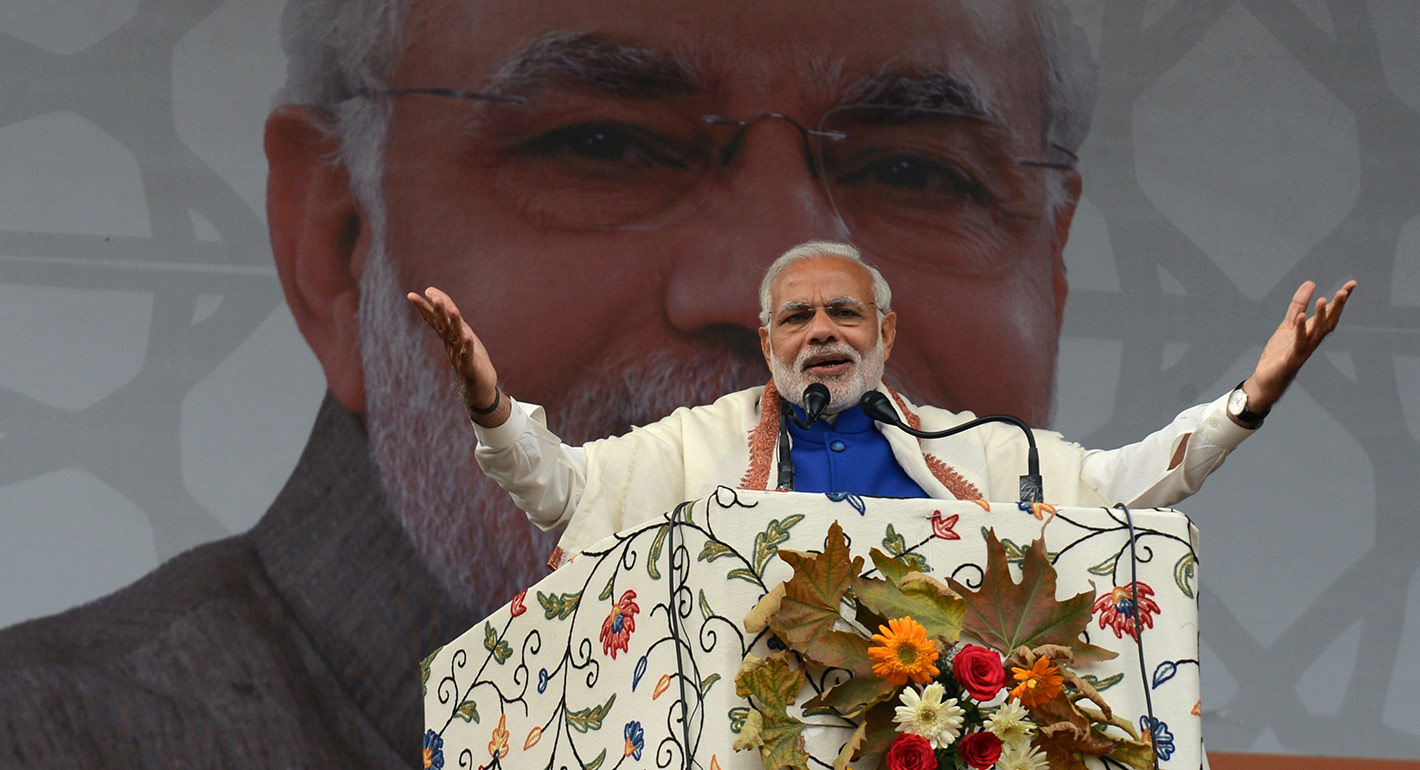
Prime Ministers of India rarely travel to the Andaman and Nicobar Islands. Narendra Modi’s visit to the islands over the weekend is only the fourth over the last many decades. Indira Gandhi and Rajiv Gandhi visited in 1984 and 1986 respectively and Manmohan Singh went there in early 2005 to review the tsunami relief operations.
For political Delhi, the island chain was at best a remote outpost acquired by default from the departing British Raj. That attitude filtered down the entire system of governance in Delhi. For India’s continentalist security establishment, weighed down by difficult land borders to the north and the west, the Indian Ocean is a distant domain. The nation’s island territories — the Andaman and Nicobar Islands to the east and the Lakshadweep to the west — barely figure on Delhi’s mental map.
Modi’s visit will hopefully begin to change India’s national narrative on the Andamans. Three imperatives beckon. The first is about history. Modi’s decision to time his visit with the 75th anniversary of Subhas Chandra Bose flying the tricolour in Port Blair has helped highlight the role of Andaman and Nicobar Islands in India’s freedom struggle. But it should also draw attention to the complexities of India’s pre-Independence engagement with the world in the 20th century.
The PM’s immediate political motivation may be seen as part of the BJP’s strategy to claim the non-Nehruvian legacy of the Indian National Congress. But the focus on Bose inevitably draws attention to the fragmented response of the national movement to the Second World War. The Indian National Congress, led by Mahatma Gandhi, refused to support the British war effort and opposed the mobilisation of Indian resources to defeat the Axis powers. The Communist Party of India, which initially declared Second World War as an “inter-imperialist war”, chose to actively support the war effort when Nazi Germany invaded Soviet Russia in 1941. Bose, in contrast, chose to align with Berlin and Tokyo to fight the British colonial rule. His Azad Hind government in Port Blair was founded on imperial Japan’s occupation of the Andaman Islands. Japan’s support for Bose was part of Tokyo’s mobilisation of Asian nationalism against European colonial powers.
Today it is not a question of judging the different political choices that the Indian leaders made during the War. All of them were for early Indian liberation from the British rule. But they saw the relationship between ends and means somewhat differently. They certainly did not agree on the appropriate balance between the struggle for independence and the larger question of defeating fascism.
Rather than sweep this complex story under the carpet, India must take a dispassionate look at these divisions. Delhi should also reflect on how the political split diminished emerging India’s leverage with the great powers. The Muslim League’s unreserved support for the War gave it considerable leverage in the domestic politics of undivided India and translated after Partition into enormous goodwill for Pakistan with Britain, US and the West.
Second, the story of Bose, Japan and the Azad Hind government underlines the enduring geopolitical significance of the Andaman Island chain and its waters. In the 17th and 18th centuries, they were the site of contestation between European colonial powers — Portugal, the Netherlands, France and Britain. After the Napoleonic wars in Europe, the Indian Ocean turned into a British Lake through the 19th century.
Britain, which occupied the islands at the end of the 18th century in search of a permanent military base, put them on the back burner in the 19th. From a potential platform for power projection, the islands became a penal colony for the Raj. The challenge for Britain came this time from the first Asian great power in the modern age — Japan. The imperial Japanese forces raced through Malaya, ousted Britain from Singapore, Burma and the Andaman Islands.
It took the combined efforts of the British Empire , the US and nationalist China to reverse Japanese aggression. After the Second World War, the partition of India and the Cold War between America and Russia, the Andamans became marginal to the new geopolitics. Today as a rising China projects its economic and military power into the Indian Ocean, any strategy for regional balance would necessarily involve the economic and military development of the Andaman and Nicobar Islands. As in the Second World War, so in the current juncture, it would involve considerable cooperation between India and its major strategic partners.
That in turn leads us to the third imperative — of ending the deliberate isolation of the island chain and promoting economic development, tighter integration with the mainland, strengthening military infrastructure, regional connectivity and international collaboration. The Modi government has initiated some important steps in that direction, including on internet connectivity, visa liberalisation, tourism, building new ports, agreements for cooperation with neighbouring countries in South East Asia.
Finally, any large-scale development would inevitably raise questions about preserving the pristine environment of the Andamans and protecting its vulnerable indigenous populations. As the NDA government seeks to accelerate economic development and enhance the military potential of the Andamans, there will be many challenges ahead. But none of them are unique to India.
As it tries to turn the outpost in the Andamans into a strategic hub, Delhi can draw much from the wealth of international experience on the sustainable transformation of fragile island territories.
This article was originally published in the Indian Express.
Former Nonresident Senior Fellow, Carnegie India
A leading analyst of India’s foreign policy, Mohan is also an expert on South Asian security, great-power relations in Asia, and arms control.
Recent Work

C. Raja Mohan, Darshana M. Baruah


Alexander Gabuev, Paul Haenle, C. Raja Mohan, …
Carnegie does not take institutional positions on public policy issues; the views represented herein are those of the author(s) and do not necessarily reflect the views of Carnegie, its staff, or its trustees.
Lee’s tour shows how Seoul is reorganizing its diplomacy away from Pyongyang and toward industrial networks and the geography of the compute economy.

Darcie Draudt-Véjares
Most migrants may have left Ceuta, but the effects may linger.


Alejandro Martin Rodriguez, Sarah Yerkes

There is a transnational far-right populist movement that links middle powers in a global movement that extends well beyond Trump.



Christopher S. Chivvis, Rohan Mukherjee, Milan Vaishnav

When faced with fuel shortages in the past, Central Asian governments could always count on additional supplies from Moscow. That safety net no longer exists.

Galiya Ibragimova

Saied’s main accomplishment has been to destroy a decade’s worth of democratic progress.
Sarah Yerkes