

Article
Zaha Hassan
{
  "authors": [
    "Zaha Hassan"
  ],
  "type": "commentary",
  "centerAffiliationAll": "dc",
  "centers": [
    "Carnegie Endowment for International Peace",
    "Malcolm H. Kerr Carnegie Middle East Center"
  ],
  "collections": [],
  "englishNewsletterAll": "menaTransitions",
  "nonEnglishNewsletterAll": "",
  "primaryCenter": "Carnegie Endowment for International Peace",
  "programAffiliation": "MEP",
  "programs": [
    "Middle East"
  ],
  "projects": [],
  "regions": [
    "North America",
    "United States",
    "Middle East",
    "Israel",
    "Palestine",
    "Levant"
  ],
  "topics": [
    "Political Reform",
    "Democracy"
  ]
}
Source: Getty
U.S. judges recently accepted an appeal that clears the way for the courts to hear claims against tax-exempt American organizations and prominent donors involved in Israeli settlements.
The plaintiffs in Al-Tamimi v. Adelson are Palestinian villagers and Palestinian-Americans who allege that several Israeli and U.S. tax-exempt organizations and individuals have been involved in genocide, land theft, and trespass in the occupied Palestinian territories.
The defendants include casino magnate Sheldon Adelson, known for his financial support for Israeli settlements in the occupied West Bank. Also named in the complaint is American Friends of Bet El Yeshiva Center, a U.S. tax-exempt organization formerly headed by U.S. Ambassador to Israel David Friedman, an organization that the family foundation of the U.S. president’s adviser and son-in-law Jared Kushner has supported financially in the past. Neither Friedman nor Kushner is named as a defendant in the case.
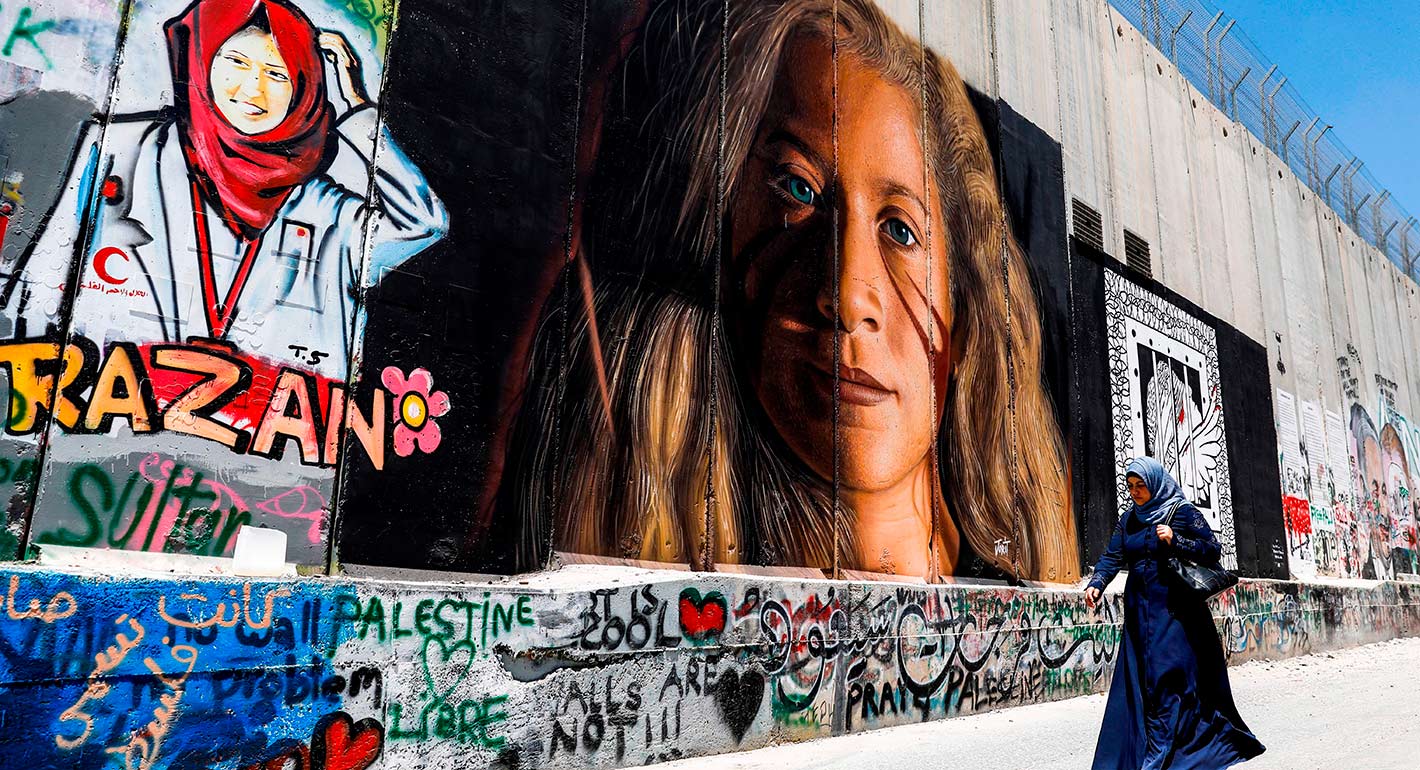
The lead plaintiff is the father of Ahed Tamimi, the sixteen-year-old Palestinian girl who gained international notoriety after she was sentenced to eight months in prison for slapping an Israeli soldier. Tamimi said the solder had trespassed on her property only hours after another soldier shot her younger cousin with a rubber-coated metal bullet at close range, resulting in the loss of part of his skull.
The case almost ended abruptly when a judge dismissed the plaintiffs’ claims in August 2017, asserting that the matter was outside the court’s purview. But the appeals court found that not all the issues at stake were political and beyond the court’s jurisdiction. Its ruling came down to two pivotal questions: whether the court would have to determine who held sovereignty over the territory in question, and whether the judges were empowered to hear claims of genocide allegedly committed by Israeli settlers funded by the defendants.
The court found that the executive branch of the U.S. government has exclusive authority to determine matters of sovereignty. Nonetheless, the judges ruled that it was possible that the trial court could adjudicate all the claims without intruding on the powers of the executive branch over foreign affairs.
The case may move forward on the genocide claims as well as the trespass and property theft claims, if the plaintiffs can prove their property ownership without having a U.S. court weigh in on who holds sovereignty over the land in question. The plaintiffs are asking for $1 billion in damages, though the hurdles in this complicated, politically charged case will be high.
Beyond a payout, the litigation will likely reveal a great deal about how Israeli and U.S. individuals and tax-exempt organizations, including corporate foundations, are involved in settlement construction in the occupied Palestinian territories, as well as how settlements violate the human rights of Palestinians.
What’s more, the information revealed in the case may be useful in potential cases filed against U.S. tax-exempt entities to strip them of their charitable status. One report by the Israeli newspaper Haaretz found that these charities’ activities included everything from providing air conditioning for settlements to paying families of settlers convicted of terrorism against Palestinians. Over nearly a decade, it is estimated that more than $200 million worth of U.S. tax-exempt donations have been sent to further Israel’s settlement enterprise.
Whatever the outcome of the Al-Tamimi litigation, the case will undoubtedly shed light on such activities and will receive U.S. media attention, given the defendants’ prominence and close connections to the President Donald Trump’s administration.
Senior Fellow, Middle East Program
Zaha Hassan is a human rights lawyer and a senior fellow at the Carnegie Endowment for International Peace.
Recent Work
Zaha Hassan
Zaha Hassan, Charles H. Johnson
Carnegie does not take institutional positions on public policy issues; the views represented herein are those of the author(s) and do not necessarily reflect the views of Carnegie, its staff, or its trustees.

AI capabilities are moving fast. Most institutions—including governments—can’t keep up.


Anton Leicht, Scott Singer

The Bureau of Industry and Security needs to adjust its focus and practices to maintain its position as the U.S. government’s primary champion of international technological competition.

Geoffrey Irving
Despite myriad challenges and occasional stumbles, the new Hungarian government is moving ahead with energy and conviction to uproot years of illiberalism and corruption and rebuild Hungarian democracy.

Thomas Carothers

European Commission President Ursula von der Leyen is about to give her annual address on the state of the EU. Here’s what she won’t—but should—say.

Rym Momtaz
It is improbable that Israel’s forthcoming elections will alter much in terms of how the country thinks about security.

Nathan J. Brown