• Research
  • Emissary
  • About
  • Experts
Carnegie Global logoCarnegie lettermark logo
DemocracyIran
  • Donate
{
  "authors": [
    "Aaron David Miller",
    "Richard Sokolsky"
  ],
  "type": "legacyinthemedia",
  "centerAffiliationAll": "",
  "centers": [
    "Carnegie Endowment for International Peace"
  ],
  "collections": [],
  "englishNewsletterAll": "",
  "nonEnglishNewsletterAll": "",
  "primaryCenter": "Carnegie Endowment for International Peace",
  "programAffiliation": "",
  "programs": [],
  "projects": [],
  "regions": [
    "North America",
    "United States"
  ],
  "topics": [
    "Political Reform",
    "Foreign Policy"
  ]
}

Source: Getty

In The Media

Marie Yovanovitch Got Smeared. Where Was Mike Pompeo?

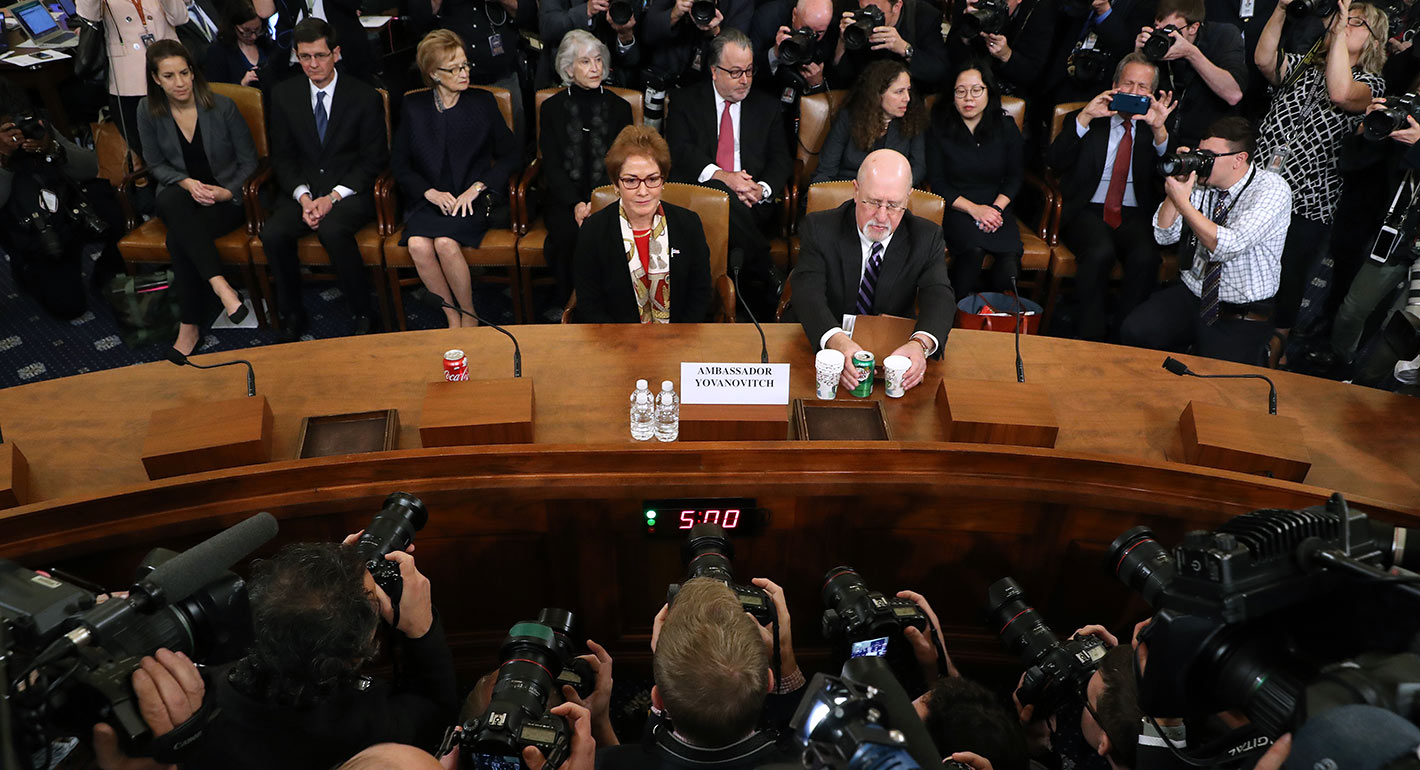
The testimony by former U.S. Ambassador to Ukraine Marie Yovanovitch and President Trump’s threatening tweets provide a window into the administration’s preternaturally destructive campaign to politicize the State Department, undermine U.S. diplomacy, and smear the reputations of career State Department officers.

Link Copied
By Aaron David Miller and Richard Sokolsky
Published on Nov 18, 2019

Source: CNN

Friday's testimony by former US Ambassador to Ukraine Marie Yovanovitch and President Donald Trump's threatening tweets -- sent while she was testifying -- provide a devastating window into the administration's preternaturally destructive campaign to politicize the Department of State, undermine US diplomacy, and smear the reputations of career State Department officers for upholding the oath they take to defend the Constitution and American national interests.

Together, we have over 50 years of service at the State Department under both Republican and Democratic administrations and have never experienced anything like the travesty that's now taking place. Here are our takeaways.

McCarthyism redux

Not since the McCarthy era of the 1950s has there been as determined a campaign to undermine and discredit career State Department officials. Back then, some 81 officials were forced out of the department amidst charges of disloyalty as alleged communist sympathizers. Secretary of State John Foster Dulles refused to stand up for his people then. And now, Secretary of State, Mike Pompeo is also not backing up his team in what former Deputy Secretary of State William Burns has described as an act of "profound political cowardice."

But today's attacks are worse than McCarthy's: they are being actively orchestrated by the President of the United States, who has shown nothing but contempt for the State Department, diplomacy, and America's professional diplomats.

Trump tweets

Trump's tweet on Friday in the middle of Ambassador Yovanovitch's testimony is an unprecedented and real-time demonstration of his cruel campaign to destroy the career of an outstanding public servant doing her job.

"Everywhere Marie Yovanovitch went turned bad," Trump wrote on Twitter. "She started off in Somalia, how did that go? Then fast forward to Ukraine, where the new Ukrainian President spoke unfavorably about her in my second phone call with him".

Not only could this tweet be interpreted as witness intimidation, it seeks to validate Trump's earlier remarks on a call with the President that Ambassador Yovanovitch was "bad news," and builds on his threatening language that she "will be going to go through some things."

Never before, in our experience or frankly in the history of US foreign policy, has a President publicly sought to intimidate a career public civil servant. Indeed, Representative Jim Himes (D-CT) noted that the President's action could be seen as "witness tampering" and might even form the basis of one of the articles of impeachment.

Where's Pompeo?

Three career foreign service officers have now testified before Congress in public impeachment inquiry hearings -- in direct defiance of both the White House and the Department of State. They are alone and exposed. Secretary of State Mike Pompeo has failed to discharge his duty to support, protect and defend the Department or these dedicated professionals.

Ambassador Yovanovitch did testify that she was told that in various meetings with the president before her dismissal in May, Pompeo did argue that she should be kept in place. But it's significant that Pompeo issued no public statement supporting her or rejecting the smear campaign launched against her.

Indeed, she was told that the reason no statement was issued was the concern that it might be "undermined," presumably a reference to potential tweet or remark by the President. At the very least, Pompeo enabled the smear campaign to go unchallenged, acquiesced in the Giuliani back channel effort with Ukraine and failed to say a word in defense of Bill Taylor, George Kent or Marie Yovanovitch. These are breathtaking acts of craven political cowardice and beneath the dignity of any secretary of state.

Hollowing out State Department

In her testimony, Ambassador Yovanovitch spoke of the threat to US diplomacy and the hollowing out of the State Department. From the beginning of the administration, the White House has marginalized its diplomats, cut its programs and failed to fill critical vacancies, especially for Assistant Secretaries of State. Applications to the foreign service are down and political appointees for Ambassadors are up.

Senior Foreign Service officers are retiring early. Morale has never been lower.

Bottom line: the country may be too big to ruin. But the State Department is vulnerable.

We believe that given time, the Department will recover. But the real shame and travesty of the moment is that this administration seems to be doing everything it possibly can to ensure it doesn't.

This article was originally published by CNN.

About the Authors

Aaron David Miller

Senior Fellow, American Statecraft Program

Aaron David Miller is a senior fellow at the Carnegie Endowment for International Peace, focusing on U.S. foreign policy.

Richard Sokolsky

Nonresident Senior Fellow, Russia and Eurasia Program

Richard Sokolsky is a nonresident senior fellow in Carnegie’s Russia and Eurasia Program. His work focuses on U.S. policy toward Russia in the wake of the Ukraine crisis.

Authors

Aaron David Miller
Senior Fellow, American Statecraft Program
Aaron David Miller
Richard Sokolsky
Nonresident Senior Fellow, Russia and Eurasia Program
Richard Sokolsky
Political ReformForeign PolicyNorth AmericaUnited States

Carnegie does not take institutional positions on public policy issues; the views represented herein are those of the author(s) and do not necessarily reflect the views of Carnegie, its staff, or its trustees.

More Work from Carnegie Endowment for International Peace

  • India and a Changing Global Order: Foreign Policy in the Trump 2.0 Era
    Research
    India and a Changing Global Order: Foreign Policy in the Trump 2.0 Era

    Trump 2.0 has unsettled India’s external environment—but has not overturned its foreign policy strategy, which continues to rely on diversification, hedging, and calibrated partnerships across a fractured order.

      • Sameer Lalwani
      • +6

      Milan Vaishnav, ed., Sameer Lalwani, Tanvi Madan, …

  • Commentary
    Carnegie Politika
    Lukashenko’s Bromance With Trump Has a Sell-By Date

    Lukashenko is willing to make big sacrifices for an invitation to Mar-a-Lago or the White House. He also knows that the clock is ticking: he must squeeze as much out of the Trump administration as he can before congressional elections in November leave Trump hamstrung or distracted.

      Artyom Shraibman

  • Indian Prime Minister Narendra Modi, wearing an orange cap, and the Chief Minister of Uttar Pradesh, Yogi Adityanath, dressed in saffron robes, are greeting supporters of the Bharatiya Janata Party (BJP) during a roadshow ahead of the Indian General Elections in Ghaziabad, Uttar Pradesh, India, on April 6, 2024.Trump raises hands behind a lecternCarney speaking on stage
    Collection
    The Middle Power Moment?

    The world has entered an era of upheaval—a period of heightened geopolitical rivalry, deepening political polarization, quickening technological change, glaring economic inequality, accelerating environmental crises, and eroding respect for international law. This moment of disruption and fluidity is also one of opportunity, however. It provides openings for middle powers, both established and emerging, to exercise unaccustomed agency and influence the future of global order.

    Carnegie scholars are analyzing middle power responses to this moment of upheaval and assessing whether—and under what conditions—these states can contribute to practical problem solving. They are asking critical, concrete questions: What countries, precisely, are we talking about when we refer to middle powers? In what issue areas do their priorities converge and diverge, including across North-South divides? In what domains can middle powers pack a punch, rather than produce a whimper? Are they willing to shoulder actual burdens and responsibility? Finally, how can middle powers assert themselves globally, without running afoul of or threatening their relations with the United States or China?

  • Mullin with his hand raised, taking an oath
    Commentary
    Emissary
    Can Mullin Revive FEMA?

    Restoring competence and trust to the anemic, neglected disaster recovery agency is a matter of national security.

      • Sarah Labowitz
      • Debbra Goh

      Sarah Labowitz, Debbra Goh

  • Worker pushing machinery toward a car frame
    Commentary
    Emissary
    Europe’s New Industrial Policy Can Learn From U.S. Mistakes

    Although the IAA often differs from the IRA, European policymakers can still take note of the U.S. act’s shortcomings.

      Milo McBride

Get more news and analysis from
Carnegie Endowment for International Peace
Carnegie global logo, stacked
1779 Massachusetts Avenue NWWashington, DC, 20036-2103Phone: 202 483 7600Fax: 202 483 1840
  • Research
  • Emissary
  • About
  • Experts
  • Donate
  • Programs
  • Events
  • Blogs
  • Podcasts
  • Contact
  • Annual Reports
  • Careers
  • Privacy
  • For Media
  • Government Resources
Get more news and analysis from
Carnegie Endowment for International Peace
© 2026 Carnegie Endowment for International Peace. All rights reserved.