

Q&A
Dara Massicot, Aaron David Miller, Andrew S. Weiss
{
  "authors": [
    "Aaron David Miller"
  ],
  "type": "legacyinthemedia",
  "centerAffiliationAll": "",
  "centers": [
    "Carnegie Endowment for International Peace"
  ],
  "collections": [],
  "englishNewsletterAll": "",
  "nonEnglishNewsletterAll": "",
  "primaryCenter": "Carnegie Endowment for International Peace",
  "programAffiliation": "",
  "programs": [],
  "projects": [],
  "regions": [
    "North America",
    "United States",
    "Middle East",
    "Israel"
  ],
  "topics": [
    "Political Reform",
    "Foreign Policy",
    "Global Governance"
  ]
}
Source: Getty
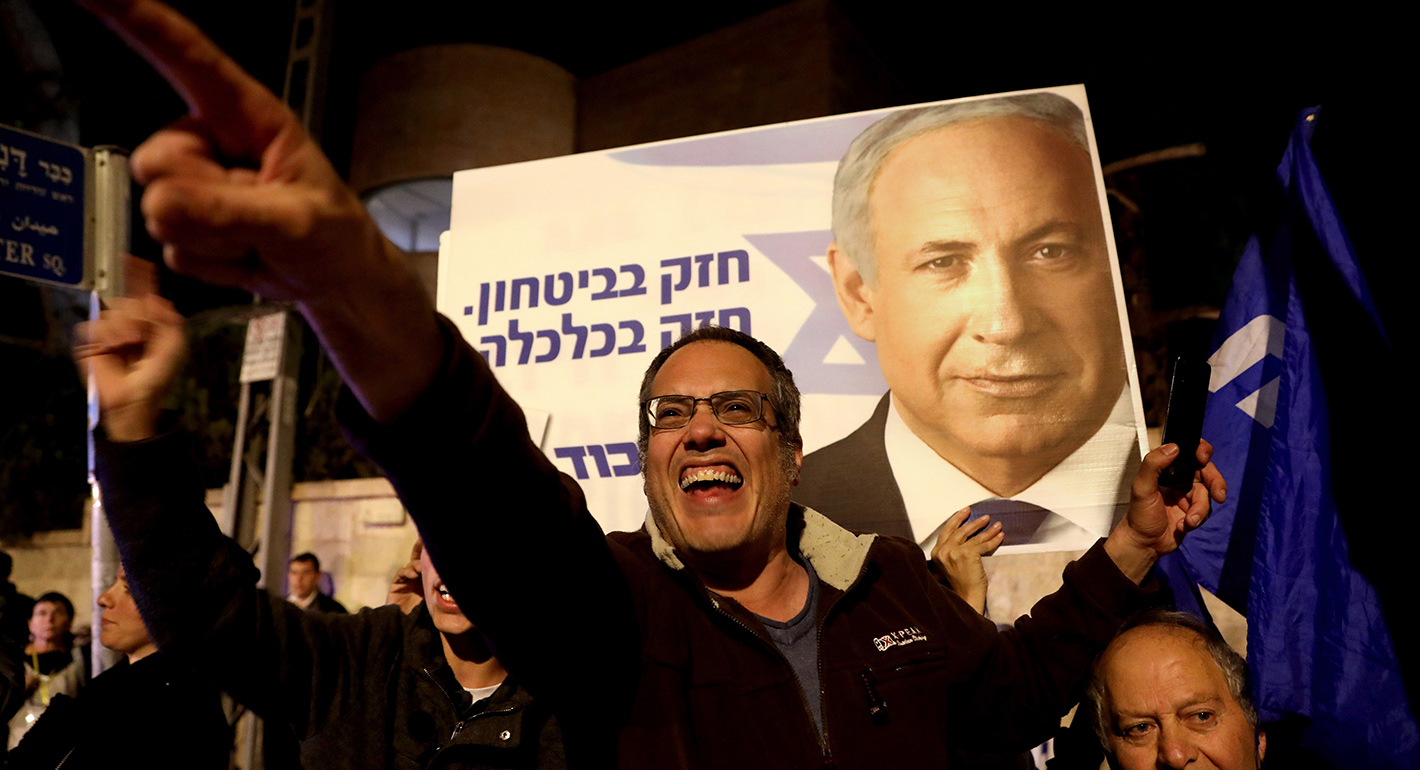
Prime Minister Netanyahu was indicted on charges of bribery, fraud, and breach of trust, but many Israelis have a hard time imagining politics without him.
Source: NPR
In March, Israel will hold its third election in barely a year. While that may presage the beginning of the end of the Benjamin Netanyahu era, it's likely going to be a fairly long and painful goodbye.
Prime Minister Netanyahu was indicted last month on charges of bribery, fraud and breach of trust. But he will keep trying to maneuver to remain prime minister for as long as he can and avoid a trial and conviction.
Many Israelis have a hard time imagining politics without him. That he remains such a potent figure is a testament not only to his popularity among the Likud base. It also reflects the rightward shift that now encompasses the majority of the country and that Netanyahu has come to symbolize.
That shift has decimated the Israeli left and given way to a divide between the right and center right — represented mainly by Netanyahu's conservative Likud party and the center-right Blue and White party led by Benny Gantz, a former military chief. Neither was able to form a government in the September election.
Despite his indictments, Netanyahu has been allowed to remain in power because Israeli law says only a conviction can compel a sitting prime minister to resign. (A separate issue of whether a newly elected prime minister under indictment can form a government is awaiting a legal ruling.)
That Netanyahu remains relevant even now with all his travails reflects the turn to the right among a majority of Israelis and the perception that he remains both an effective prime minister and spokesman for their views.
But Netanyahu's staying power stems from more than that. He commands respect, even fear, among his party's elite.
Likud will have a leadership primary at the end of this month. Although former Cabinet minister Gideon Saar is expected to challenge him, Netanyahu is likely to prevail. Saar believes Netanyahu is dragging the party down and will open the door to a Gantz victory. Still, Likud has had only four leaders since the party was formed in 1973. It is not in the party's DNA to topple its chiefs.
Moreover, Netanyahu maintains steadfast support from his right-wing coalition partners — religious and pro-settlement Zionist parties — that have allowed Likud to dominate national politics for the better part of the past four decades.
The Israeli right has become the dominant force in national politics following the failure of the Oslo peace process during the 1990s and the 2000 Palestinian uprising known as the second intifada, especially Palestinian suicide attacks, and the strengthening of Islamist organizations Hezbollah and Hamas in the wake of Israel's withdrawals from Lebanon in 2000 and Gaza in 2005. Demographic changes have also favored religious Jewish voters in elections. These factors combined have gutted the once-powerful Labor Party that guided the country through its first three decades.
That Netanyahu remains relevant even now with all his travails reflects the turn to the right among a majority of Israelis and the perception that he remains both an effective prime minister and spokesman for their views.
But can he lead Likud to victory in March and form a government? It would be foolish to rule it out. Yet it is hard to see Netanyahu's prospects improving. One recent poll even projects that in a national election, Saar would bring in more seats for a right-wing coalition than Netanyahu, even though it predicts neither would be able to form a government.
Gantz, meanwhile, has held his own. As a former military chief of staff who wants to be prime minister, there is something of the strong, silent and authentic Yitzhak Rabin, the late Israeli statesman, about him. He's more of a listener than a talker. A recent poll gives Gantz's Blue and White party a six-seat margin over Likud.
It's worth noting two of Likud's previous electoral losses have been to ex-chiefs of staff: Rabin in 1992 and Ehud Barak in 1999. Gantz has the security beat covered, perhaps to a fault. His tough bomb Gaza "back to the Stone Age" campaign videos either reflected Gantz's true hawkish nature or were designed to counter Netanyahu's campaign or paint the incumbent as a leftist.
Maybe the cumulative effect of Netanyahu's indictments, the public's holding him responsible for forcing yet another election and his two consecutive failures to form governments have finally caught up with the politician the press has dubbed "The Magician." There just may be no more rabbits in the hat, and likely none from Netanyahu's good friend President Trump, to save him.
Former Defense Minister Avigdor Lieberman — considered kingmaker in recent elections — publicly declared last week he would support a pardon for Netanyahu if the leader left politics.
Should Gantz best Netanyahu in March elections, no one should expect transformational magic in Israeli politics or a quick solution to the Palestinian situation. Gantz's views on peace issues are largely unknown, but one thing is clear: His first priority will likely be to try to heal the divisions among Israelis, not take on a peace agreement between Israelis and Palestinians.
Surrounding himself with a coalition including several former generals, Gantz seems to represent the old right. It is a more statesman-like version of Likud, in the words of one Israeli journalist, pushing for civility, national unity, rule of law and a militant patriotism that puts security and defense first without foreclosing the possibilities of a peace agreement with the Palestinians.
Should Gantz prevail, it would be a major accomplishment if he could just restore a measure of civility, unity, good governance and respect for rule of law to Israeli political life. In doing so, he would begin to repair the damage of the roller-coaster that has been the Netanyahu years.

Senior Fellow, American Statecraft Program
Aaron David Miller is a senior fellow at the Carnegie Endowment for International Peace, focusing on U.S. foreign policy.
Recent Work


Dara Massicot, Aaron David Miller, Andrew S. Weiss

Sophia Besch, Eric Ciaramella, Steve Feldstein, …
Carnegie does not take institutional positions on public policy issues; the views represented herein are those of the author(s) and do not necessarily reflect the views of Carnegie, its staff, or its trustees.

Before the next wave of EU enlargement takes place, the union needs to grapple with thorny questions of how power is distributed among its members.


Emil Sondaj Hansen, Ditte Brasso Sørensen

The real test may come after the leaders leave the room.



Sheena Chestnut Greitens, Oriana Skylar Mastro, Yukon Huang, …

The Horn of Africa countries are among those facing a new security calculus.


Andrew Leber, Lesley Anne Warner

The European far right might fail to steer EU policy in the direction Russia wants, but they will create enough chaos inside Europe to benefit the Kremlin.

Dimitar Bechev

The new U.S.–Denmark–Greenland agreement will help Washington exert political, economic, and financial dominance under the guise of security. Yet, it acknowledged Copenhagen’s and Nuuk’s sovereignty on the island.

Marc Pierini