

Other
Kim Ghattas
{
  "authors": [
    "Kim Ghattas"
  ],
  "type": "legacyinthemedia",
  "centerAffiliationAll": "dc",
  "centers": [
    "Carnegie Endowment for International Peace",
    "Malcolm H. Kerr Carnegie Middle East Center"
  ],
  "collections": [
    "Decoding Lebanon"
  ],
  "englishNewsletterAll": "menaTransitions",
  "nonEnglishNewsletterAll": "",
  "primaryCenter": "Carnegie Endowment for International Peace",
  "programAffiliation": "MEP",
  "programs": [
    "Middle East"
  ],
  "projects": [],
  "regions": [
    "Middle East",
    "Lebanon",
    "Levant"
  ],
  "topics": [
    "Political Reform",
    "Economy",
    "Civil Society",
    "Foreign Policy"
  ]
}
Source: Getty
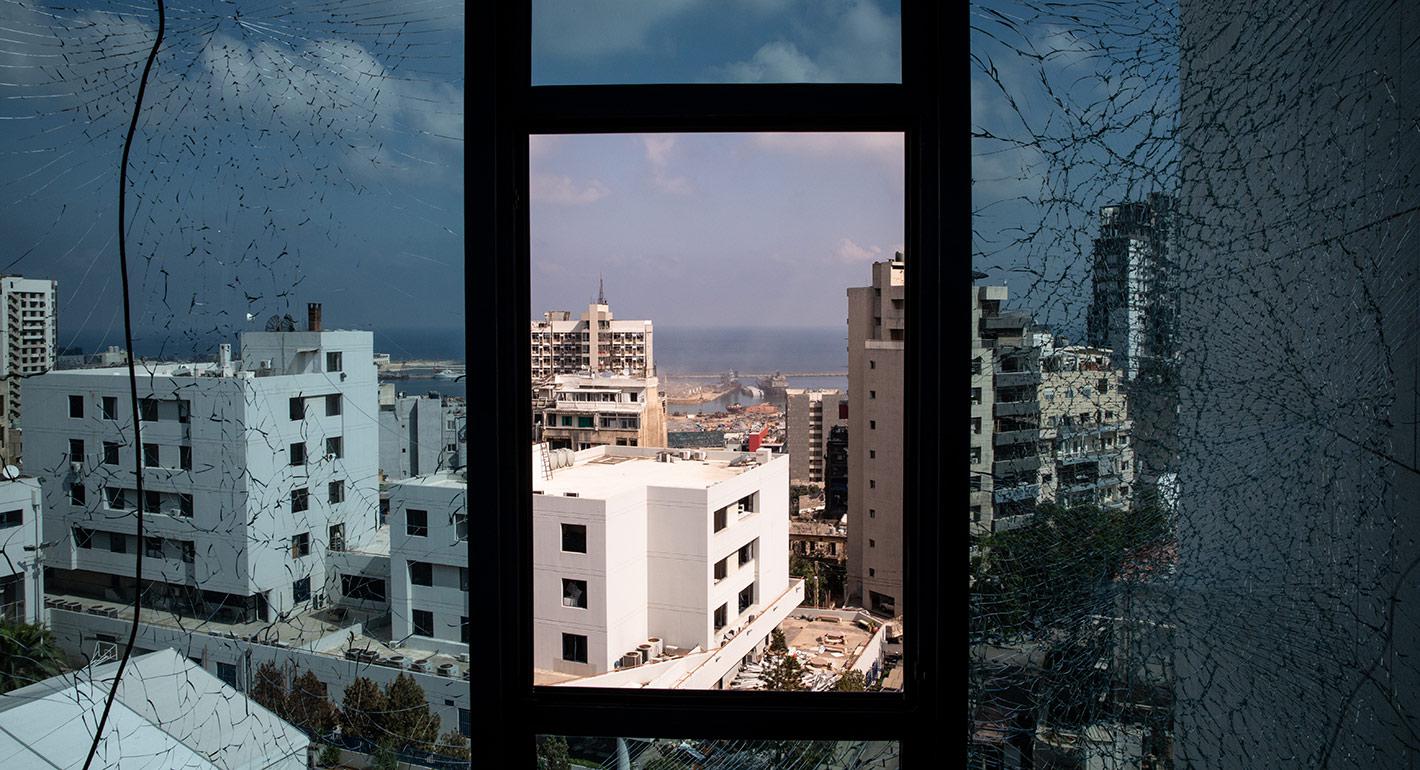
The seismic event felt like an earthquake and an air raid wrapped into one. None of us in Lebanon have ever experienced anything like it.
Source: Guardian
Two days later, and we are still counting the dead, accounting for the living and digging for the buried alive.
Two days later, and every waking hour, every sleepless minute is punctuated by the sound of broken glass: cracked window panes crashing, shards being swept, piles of shattered glass dumped on street corners. More glass, more shards in our hearts.
Two days later, and no minister or government official has even apologised to the Lebanese people. None have bothered to visit hospitals to meet the wounded, or surveyed the damage to residential neighbourhoods.
More than 150 people died, 500 are still missing, 4,000 people are injured and 300,000 have been left homeless. But no one has resigned and the blame game has started. Apparently, no one is responsible for what was essentially a declaration of war against the Lebanese people.
Much of the questioning so far has focused on what started the initial fire that set off the explosion at the Beirut port on Tuesday. The more important question is: why were 2,750 tons of ammonium nitrate, offloaded in odd circumstances from a troubled Russian-leased vessel in 2014, left in storage at the port for six years? Port authorities, the judiciary and most likely others higher up all knew about this ticking time bomb left in the middle of a city of 2 million people.
Two days later, and the blind rage is swelling. “Today we mourn, tomorrow we clean, the day after tomorrow, we hang them.” This is but one of the messages doing the rounds in Beirut, in a country that has been hostage to a corrupt political establishment and a cabal of warlords for four decades. Pictures of guillotines and nooses are spreading on social media. Softly spoken friends who play guitar and sew their own clothes have confessed: “I never understood how anyone could kill a fellow human being, but today, I could kill, I want to murder them.”
The seismic event felt like an earthquake and an air raid wrapped into one. None of us in Lebanon have ever experienced anything like it, none of us have ever seen this type of utter devastation or can yet truly grasp the extent of what has befallen us and our beloved city, although we have been through more than any life could hold.
If you’re in your mid-40s in Lebanon, you’ve lived through 15 years of war, two Israeli invasions, 30 years of Syrian occupation, several rounds of economic collapse and currency devaluation, two Israeli bombing campaigns, a revolution, a wave of political assassinations that decimated the ranks of progressives, and, since the end of 2019, another wave of protests demanding the departure of the corrupt political elite – the same warlords who ran the war and then made the peace so they and their friends could continue to fill their pockets.
The revolution precipitated a financial and economic crisis, which was years in the making then compounded by the coronavirus pandemic and the lockdowns. And yet, we were still holding on, miraculously, not thanks to our leaders but despite them, thanks to private initiatives, incredible individuals running aid organisations, hospitals, clinics, schools, universities, the fabric that makes the country what it is: a place of incredible community that explains why, despite all the hurt, so many of us are unwilling to give up on Lebanon.
Our resilience is a blessing and a curse. We find ways to cope but it means we circumvent problems, we find solutions to everything but it means we don’t uproot the cause of the rot. We don’t want to die so we live by any means, we rebuild every time, as best as we can, but we’ve been unwilling to admit that we’ve been building on shaky foundations.
How much more can one country and one people take? Is this a turning point? And if so, towards what? Full revolt and true change for a new beginning or total helplessness and defeat?
In February 2005, Lebanon’s former prime minister Rafik Hariri was assassinated with 1,000kg of explosive that blew up his convoy, killing another 22 people and devastating the newly rebuilt seafront area in Beirut. The assassination was blamed on Lebanon’s then overlords in Damascus, and the swell of anger and massive protests over two months put an end to 30 years of Syrian military occupation. But they left behind an entrenched system that enabled Lebanon’s leaders to continue pillaging the country for the benefit of themselves or their friends in Damascus.
This includes Hezbollah, which has only grown stronger since then as a Lebanese political party and militant group. Much of the anger today is also directed at them – speculation is rife that the ammonium nitrate was theirs, to use for bomb-making, or that the fire started when an Israeli airstrike targeted a Hezbollah weapons cache at the port. Although criminal negligence is the mostly likely explanation, people are loth to fully discard the other theories just yet. Either way, Hezbollah is also part of the system of corruption that is sinking the country. Those who want to save their neck in the face of the growing popular rage may try to direct the anger solely at Hezbollah, but we must not forget that the group cannot function in Lebanon without the direct or indirect collusion of most of the political establishment, who seem too happy to cut deals and protect each other.
That is why the mantra that has dominated the protests since October has been, “All of them means all of them.” And it’s why this feels like a turning point of a different magnitude, one that could topple the leadership, or at least tie the hands of the cabal of corrupt leaders, bring about new government or give birth to a new system, a new social contract.
Much remains unanswered about the details of Tuesday’s events. But what is clear is that those who allowed this to happen cannot be the ones to investigate it. There must be an international investigation to make sure the full details emerge not only of how the fire started and the explosion was set off, but more importantly to determine how and why the dangerous materials were stored in the port, and the full chain of responsibility.
This is the moment when impunity must finally come to an end in Lebanon. This is the moment for justice, not just for those who died in this disaster but all those who have been killed over the last four decades. Two days later and the Lebanese are doing now what they do best: cleaning up and rebuilding. They’re not waiting for the absent state to help, but they are waiting for justice.

Author of Black Wave and FT contributing editor
Kim Ghattas is an Author of Black Wave and FT contributing editor.
Recent Work
Kim Ghattas
Carnegie does not take institutional positions on public policy issues; the views represented herein are those of the author(s) and do not necessarily reflect the views of Carnegie, its staff, or its trustees.

The Plaza Accord was not an externally imposed punishment of Japan but part of a broader restructuring that Japanese economists and policymakers themselves recognized was necessary. Its effects were undermined, however, when Tokyo responded to the resulting slowdown with policies that exacerbated investment, credit expansion, and the very imbalances the adjustment was intended to resolve.

Michael Pettis

Before the next wave of EU enlargement takes place, the union needs to grapple with thorny questions of how power is distributed among its members.


Emil Sondaj Hansen, Ditte Brasso Sørensen
The real test may come after the leaders leave the room.



Sheena Chestnut Greitens, Oriana Skylar Mastro, Yukon Huang, …

The Horn of Africa countries are among those facing a new security calculus.


Andrew Leber, Lesley Anne Warner

The European far right might fail to steer EU policy in the direction Russia wants, but they will create enough chaos inside Europe to benefit the Kremlin.

Dimitar Bechev