

Article
Dan Baer
{
  "authors": [
    "Dan Baer"
  ],
  "type": "legacyinthemedia",
  "centerAffiliationAll": "dc",
  "centers": [
    "Carnegie Endowment for International Peace"
  ],
  "collections": [],
  "englishNewsletterAll": "democracy",
  "nonEnglishNewsletterAll": "",
  "primaryCenter": "Carnegie Endowment for International Peace",
  "programAffiliation": "DCG",
  "programs": [
    "Democracy, Conflict, and Governance"
  ],
  "projects": [],
  "regions": [
    "East Asia",
    "China",
    "Eastern Europe",
    "Western Europe"
  ],
  "topics": [
    "Political Reform",
    "Foreign Policy"
  ]
}
Source: Getty
China’s failure to commit to reforms to move toward fairer conditions for European firms in the Chinese market, China’s actions in Hong Kong, and its increasing militarization of man-made islands in the South China Sea hardly deserve a fete.
Source: China File
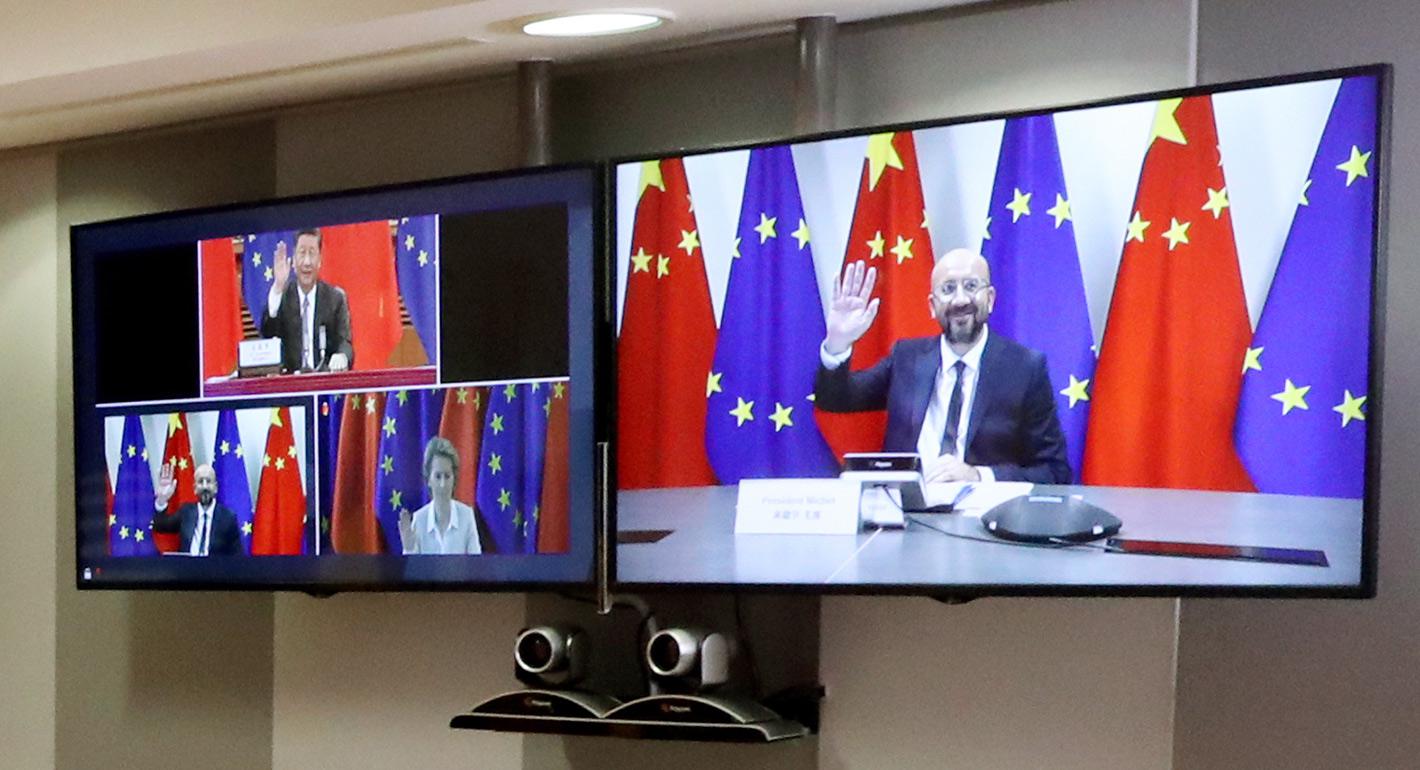
Angela Merkel had hoped to use the German presidency of the EU to host an historic EU-China Summit this month in Leipzig, with Xi Jinping and 27 European heads of state in attendance. Thanks to COVID, the virtual meeting that took place this week was a far less grand affair. But given a thorny agenda and the backdrop of Europe’s rapidly deteriorating public opinion of China, the less-flashy format perhaps better suited the moment. China’s failure to commit to reforms to move toward fairer conditions for European firms in the Chinese market, China’s actions in Hong Kong, its internment of over one million Uighurs in Xinjiang and human rights violations in Tibet, and its increasing militarization of man-made islands in the South China Sea hardly deserve a fete.
EU-China relations continue to be a window into Europe’s efforts to establish itself as a global power. Early in the Trump presidency, Merkel offered a typically matter-of-fact assessment that the days when Europe could count on others were “over to a certain extent,” adding that “we Europeans must really take our fate into our own hands.” While Trump’s damage to the transatlantic relationship has been significant and unnecessary, it’s possible to see Europe’s intensified reflection on its role in global politics as an (unintended) silver lining. As Clement Beaune, French Minister of State for European Affairs, put it last week, “Europeans know that they must once again speak the language of power, without losing sight of the grammar of cooperation.”
This week’s summit focused more on grammar than on language; the main outcome seems to have been agreement to continue to talk. And therein lies the challenge inherent to the European position: Because the Europeans seek changes to China’s bad behavior on trade, climate, human rights, peace, and security, an agreement to continue to talk is a win for the Chinese. For as long as nothing changes, well, nothing changes—and China continues to exploit the unsatisfactory status quo. (The U.S. has also had to respond to this dynamic, and if the transatlantic relationship weren’t so strained, we could perhaps tell our European friends how this movie ends.)
Over the past five years, U.S. and European approaches to China have both changed. In the U.S., there was bipartisan agreement that efforts to invite a rising China into the international system—a consistent approach through the previous three presidential administrations—was not producing its desired outcomes on trade, security, and China’s political evolution. The Trump administration broke with the past, but its erratic approach, defined by Trump’s own oscillations, has imposed costs on American farms and manufacturing without producing commensurate benefits (and while abandoning American values).
Europe’s approach to China, meanwhile, historically has leaned toward trade and climate, approaching security and human rights issues more episodically. Now, Europe is beginning to make a more holistic—and realistic—assessment of China’s rise. Last year, the EU made waves for acknowledging China as a “systemic competitor.” While Europe’s evolution has been more measured than the Trump administration’s, it remains vulnerable to critique for continuing to privilege managing the Europe-China relationship (there is no mention of Xinjiang in the joint statement from Merkel and the presidents of the EU commission and EU Council after the summit) over leveraging Europe’s advantages to drive outcomes.
Interim President
Dan Baer is the interim president of the Carnegie Endowment for International Peace. Under President Obama, he was U.S. ambassador to the Organization for Security and Cooperation in Europe (OSCE) and he also served deputy assistant secretary of state for the Bureau of Democracy, Human Rights, and Labor.
Recent Work


Richard Youngs, Erik Jones, Dan Baer, …
Carnegie does not take institutional positions on public policy issues; the views represented herein are those of the author(s) and do not necessarily reflect the views of Carnegie, its staff, or its trustees.

The Plaza Accord was not an externally imposed punishment of Japan but part of a broader restructuring that Japanese economists and policymakers themselves recognized was necessary. Its effects were undermined, however, when Tokyo responded to the resulting slowdown with policies that exacerbated investment, credit expansion, and the very imbalances the adjustment was intended to resolve.

Michael Pettis

Before the next wave of EU enlargement takes place, the union needs to grapple with thorny questions of how power is distributed among its members.


Emil Sondaj Hansen, Ditte Brasso Sørensen

The real test may come after the leaders leave the room.



Sheena Chestnut Greitens, Oriana Skylar Mastro, Yukon Huang, …

The Horn of Africa countries are among those facing a new security calculus.


Andrew Leber, Lesley Anne Warner

The European far right might fail to steer EU policy in the direction Russia wants, but they will create enough chaos inside Europe to benefit the Kremlin.

Dimitar Bechev