

Commentary
Konstantin Skorkin
{
  "authors": [
    "Konstantin Skorkin"
  ],
  "type": "commentary",
  "centerAffiliationAll": "",
  "centers": [
    "Carnegie Endowment for International Peace",
    "Carnegie Russia Eurasia Center"
  ],
  "collections": [],
  "englishNewsletterAll": "",
  "nonEnglishNewsletterAll": "",
  "primaryCenter": "Carnegie Russia Eurasia Center",
  "programAffiliation": "",
  "programs": [],
  "projects": [],
  "regions": [
    "Eastern Europe",
    "Ukraine"
  ],
  "topics": [
    "Economy"
  ]
}
Source: Getty
Ukrainian President Volodymyr Zelensky sees his growing popularity as proof that he chose the right course when he gave up trying to please all the disparate groups that voted for him in 2019. He is likely to continue his anti-Russian rhetoric and sanctions against domestic enemies.
This spring’s escalation in the Donbas has helped Ukrainian President Volodymyr Zelensky escape the political doldrums. He started the year with plummeting ratings, disarray in the ruling party, and growing pressure from the opposition. Against this backdrop, his sanctions campaign against “enemies of the state” has proven politically expedient.
Decisions that initially appeared rash have gained domestic political value and inspired trust among many in Ukraine, while broad support from Western leaders has also bolstered Zelensky’s position. Yet his reliance on extraordinary measures may solve some problems while creating others. Zelensky’s team is still failing to offer a long-term strategy and strengthen institutions, and instead seeks miraculous improvisations to revive the president’s popularity.
When the Kremlin deployed troops to Ukraine’s borders in March–April 2021, it was guided by its own geopolitical considerations, such as sending signals to the new U.S. administration. However, it unwittingly helped Zelensky. Fears of renewed fighting in Ukraine have increased: the proportion of Ukrainians who believe a Russian attack is imminent rose to 36 percent from 21 percent in December 2018 (this sentiment is particularly strong in western and central Ukraine).
As a result, Zelensky’s ratings, which had taken a nosedive at the beginning of the year, have started growing. Leading polling agencies estimate Zelensky’s support at 28–31 percent, compared to less than 20 percent in February 2021. The president’s ratings are also lifting up those of his party, Servant of the People, which has returned to first place, with a rating of over 20 percent, from second or third place in January–February 2021.
At the same time, sociologists from the Ukrainian Institute of the Future observe that trust in the president has decreased in the Kyiv-controlled section of Donbas, which is becoming an enclave of pro-Russian sentiment. Another concerning factor is that 6 percent of Ukrainians consider it acceptable to take part in armed resistance against the regime.
As Zelensky’s ratings rise, those of opposition parties are falling. Some Ukrainians are being enticed by Zelensky’s new image as a pro-Western statist and an enemy of the oligarchs. Many others are simply becoming disappointed in their representatives.
President Zelensky sees his growing popularity as proof that he chose the right course. He is likely to continue sanctions against domestic enemies and anti-Russian rhetoric (although Russia’s show of force at Ukraine’s borders served as a deterrent to such rhetoric). Zelensky has abandoned the hope of being a “president for all,” and has given up trying to please all the disparate groups that voted for him in 2019. He is now building a new image as a statist, and has reconciled himself to the fact that Ukraine will have enclaves that reject his policy entirely.
In addition to boosting Zelensky’s popularity, the escalation in Donbas increased the importance of law enforcement and security agencies within the Ukrainian government. Along with the main decisionmaking center in the presidential office, the National Security and Defense Council has emerged as another locus of power, responsible for imposing sanctions.
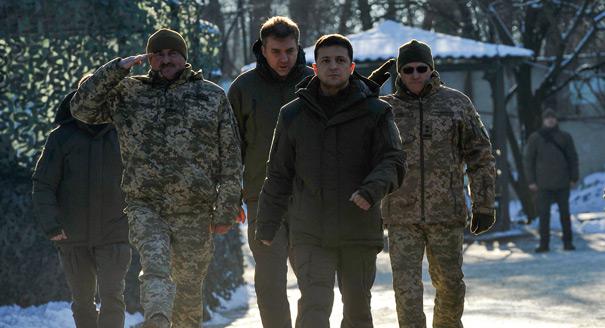
Zelensky made enthusiastic trips to the front line during the crisis, including in the company of European politicians—growing into his new role as the head of the national defense effort, and rehabilitating himself after past visits to troops as “convincer in chief,” when he argued with soldiers who didn’t want to leave their positions during the disengagement of forces.
The president has reactivated contacts with NATO and signed a decree on a national cooperation program with the alliance for 2021. Zelensky said that he expects a “powerful signal” from NATO in the summer that would confirm the alliance’s intention to accept Ukraine as a member. Ukraine’s chances of actual NATO accession are illusory, but there will be more public activity and signaling.
Another positive development for Zelensky was a visit by representatives of the new U.S. administration, Secretary of State Antony Blinken and Under Secretary Victoria Nuland. While they criticized Kyiv’s slowness in conducting reforms and its personnel policy, they also promised Ukraine and Zelensky support in the standoff with Russia.
It is clear that Zelensky has already started preparing for his reelection campaign: one sure sign is the growing pressure by the regime on potential rivals.
Opposition Platform–For Life leader Viktor Medvedchuk has been accused of treason for his involvement in the development of gas deposits in Crimea. The sanctions against Medvedchuk have been effective, depriving him of his assets and his television “megaphone,” convincing Zelensky that he is right to use extraordinary measures. The situation has also shown, however, that Zelensky cannot count on Ukrainian courts to do his bidding: having failed to flee to Russia—an outcome upon which Zelensky may have been counting—the Kremlin-backed Medvedchuk was put under house arrest rather than jailed.
The presidential administration has also resumed its quarrel with Kyiv Mayor Vitali Klitschko, one of Zelensky’s main challengers in future elections. The administration is once again pushing to separate the positions of mayor and head of the municipal administration. Left with only the former, Klitschko would lose much of his authority. While the actions against Medvedchuk can be attributed to the military standoff at the border, the clash with Klitschko is pure politics, even if Zelensky justifies it as being part of the fight against corruption.
It seems that President Zelensky has found his stride, and the escalation at the border has legitimized his actions in the eyes of many Ukrainians. The standoff with Russia paradoxically fuels demand for similar authoritarian methods: media outlets are being accused of receiving foreign financing, and political opponents are finding themselves in the crosshairs of law enforcement and security agencies. The West is so concerned about Russian military activity that it is willing to ignore Ukraine’s behavior as long as Kyiv remains loyal.
Within Ukrainian society, demand for a firm hand outweighs demand for reforms. Zelensky must find a balance between maintaining power and plunging Ukraine back into the autocracy from which it had been trying to escape in recent years.
Zelensky’s penchant for extraordinary measures may help resolve some tactical problems, but is unlikely to end well. The presidential team is still not working on developing state institutions or conducting judicial reform. Focused on improving his ratings, Zelensky is constantly seeking miraculous improvisations that might bring together different parts of the country or mobilize it to stand up to an external enemy.

An independent journalist.
Recent Work
Konstantin Skorkin
Konstantin Skorkin
Carnegie does not take institutional positions on public policy issues; the views represented herein are those of the author(s) and do not necessarily reflect the views of Carnegie, its staff, or its trustees.

If the Russian-speaking community in Latvia cannot articulate their interests without being seen as disloyal, they could end up embracing a pro-Kremlin agenda.

Sergejs Potapkins

The Bureau of Industry and Security needs to adjust its focus and practices to maintain its position as the U.S. government’s primary champion of international technological competition.

Geoffrey Irving
Despite myriad challenges and occasional stumbles, the new Hungarian government is moving ahead with energy and conviction to uproot years of illiberalism and corruption and rebuild Hungarian democracy.

Thomas Carothers

European Commission President Ursula von der Leyen is about to give her annual address on the state of the EU. Here’s what she won’t—but should—say.

Rym Momtaz

Depleted financial reserves and a shrinking tax base mean it is no longer possible to simultaneously deliver high defense spending, price stability, and economic growth.

Alexandra Prokopenko