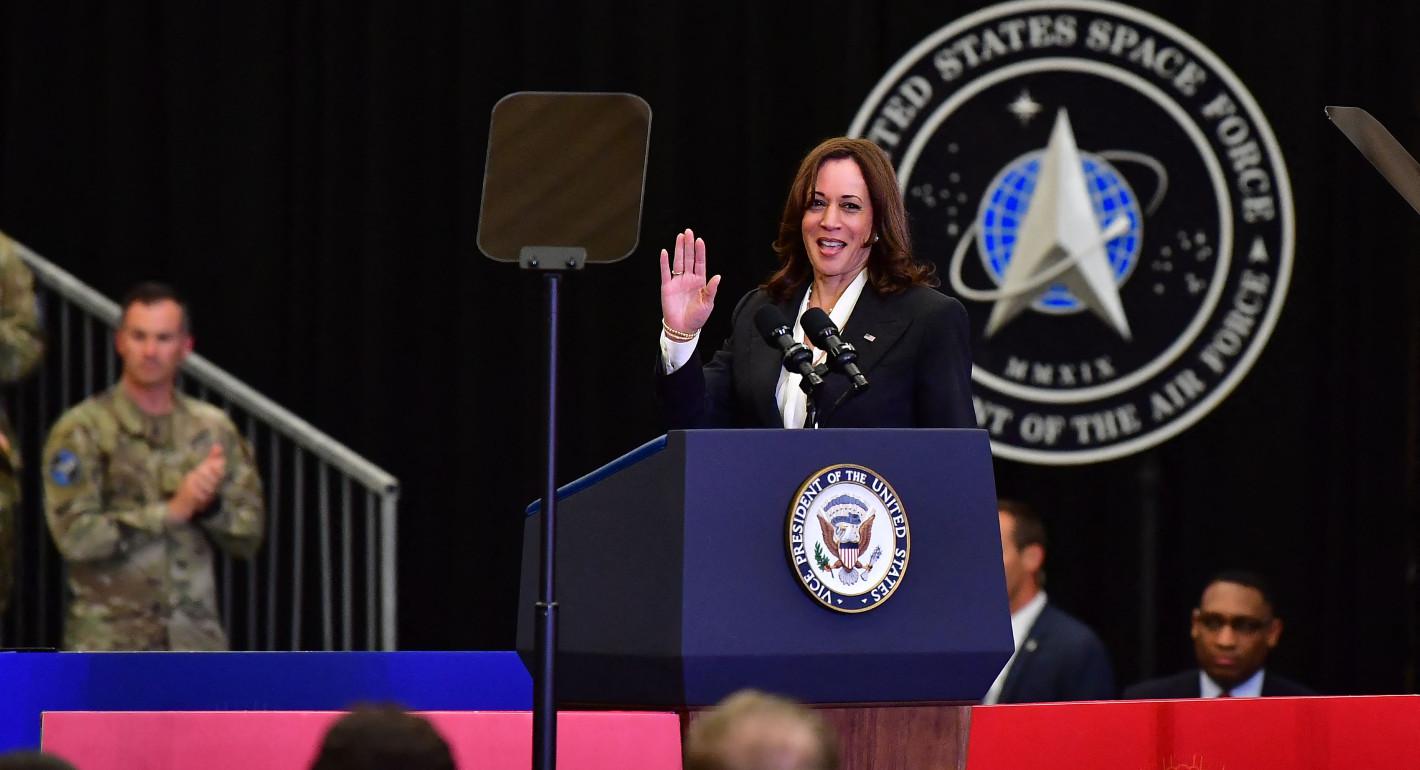
On Monday, the United States became the first country to adopt a voluntary moratorium on the destructive testing of direct-ascent anti-satellite (DA-ASAT) missile systems. These weapons generally involve missiles that launch from the Earth’s surface to destroy a satellite passing overhead. The testing of these weapons—conducted in recent years by China, India, Russia, and the United States—creates debris that can remain in low Earth orbit (LEO) for years if not decades, threatening other satellites. Though there’s no international legal framework prohibiting these types of tests, other countries should follow the United States in voluntarily refraining from destructive, DA-ASAT testing.
Announced by U.S. Vice President Kamala Harris, the declaration eschews these tests on the basis that they “put in danger so much of what we do in space.” Consistent with past U.S. messaging, Harris also described these tests as “reckless” and “irresponsible,” citing Russia’s November test against an old Soviet satellite and China’s 2007 test. Each of those tests has left thousands of debris objects in orbit. India’s 2019 test, though not mentioned in Harris’ speech, created hundreds of debris fragments, with just one trackable piece still in orbit as of this month.
Debris poses a threat to all spacefaring countries and businesses that seek to use Earth’s orbits. The United States has an outsized interest in limiting the amount of debris created by anti-satellite tests, given its reliance on satellites to facilitate daily modern life and overseas military activities. And although the United States did repurpose a missile defense interceptor to destroy a satellite in 2008, it has never stated an intent to field a dedicated DA-ASAT weapon in the post–Cold War era.
In practice, the careful wording of the U.S. moratorium would not entirely foreclose the development of DA-ASAT weapons. The White House notes that the United States has committed “not to conduct destructive, direct-ascent anti-satellite (ASAT) missile testing.” This phrasing does not preclude testing DA-ASAT weapons against simulated orbital targets, which would have latent DA-ASAT applications. Until its November intercept, Russia had conducted these kinds of DA-ASAT tests, which do not produce orbital debris.
While a single nation’s commitment to end destructive DA-ASAT testing won’t slow decades of space militarization, the United States has proactively initiated the development of space sustainability norms. The norm-building process will be inherently collaborative and necessitates international diplomacy. “I call on all nations to join us,” Harris said in her announcement, noting that the United States would “work with other nations to establish this as a new international norm for responsible behavior in space.”
Similar declarations from other states would help affirm this new norm. Washington should focus its efforts on its allies and partners that possess the basic technology and latent expertise that, if combined, could quickly develop DA-ASAT capability. As the United States itself demonstrated in 2008, DA-ASAT technology largely overlaps with certain missile defense concepts. U.S. outreach should focus on allies and partners like France, Israel, and Japan. India (which has conducted a DA-ASAT test) should also be a distinct focus. Japan and India have already affirmed their intent, as part of the Quad, to “consult on rules, norms, guidelines and principles for ensuring the sustainable use of outer space.” These countries should affirm that they will not conduct such tests in the future and join the United States in supporting efforts for an international legal framework banning any deliberate debris-creating events in LEO, including DA-ASAT tests.
Domestic critics of the U.S. declaration might note that Russia and China, which possess DA-ASAT weapons, are unlikely to follow in such an effort and that Washington should have left its options open. This view would be misguided for three reasons. First, this moratorium largely codifies what had already been de facto U.S. policy since 2008. Second, should the United States seek new counterspace capabilities, it is much more likely to find military utility—for both deterrence and coercion—in other types of weapons. DA-ASATs, if used, would be highly escalatory, immediately attributable, and produce irreversible and uncontrollable damage. Indeed, Russian and Chinese views of the utility of these weapons may change as they too continue to develop alternative counterspace capabilities. China is expanding how it uses LEO for new commercial, scientific, and military support purposes that could be jeopardized by new DA-ASAT tests.
Finally, the U.S. declaration casts a spotlight on Beijing’s and Moscow’s refusal to acknowledge DA-ASATs as space weapons, even as the two countries promote a draft binding treaty whose own title aims to prevent “Use of Force Against Outer Space Objects.” While these divergences remain far from resolved, by drawing a clear line against destructive DA-ASAT testing, Washington has clarified the scope of future efforts to define what exactly should be covered in international efforts to prevent an arms race in outer space.