

Commentary
Despite its flop at the box office, the film raises important questions for the climate community to answer.
Leonardo Martinez-Diaz
{
  "authors": [
    "Jonathan Kay"
  ],
  "type": "commentary",
  "centerAffiliationAll": "dc",
  "centers": [
    "Carnegie Endowment for International Peace"
  ],
  "collections": [],
  "englishNewsletterAll": "ctw",
  "nonEnglishNewsletterAll": "",
  "primaryCenter": "Carnegie Endowment for International Peace",
  "programAffiliation": "SAP",
  "programs": [
    "South Asia",
    "Sustainability, Climate, and Geopolitics"
  ],
  "projects": [],
  "regions": [
    "South Asia",
    "India",
    "North America"
  ],
  "topics": [
    "Economy",
    "Climate Change"
  ]
}
Source: Getty
The problem extends well beyond coal supplies.
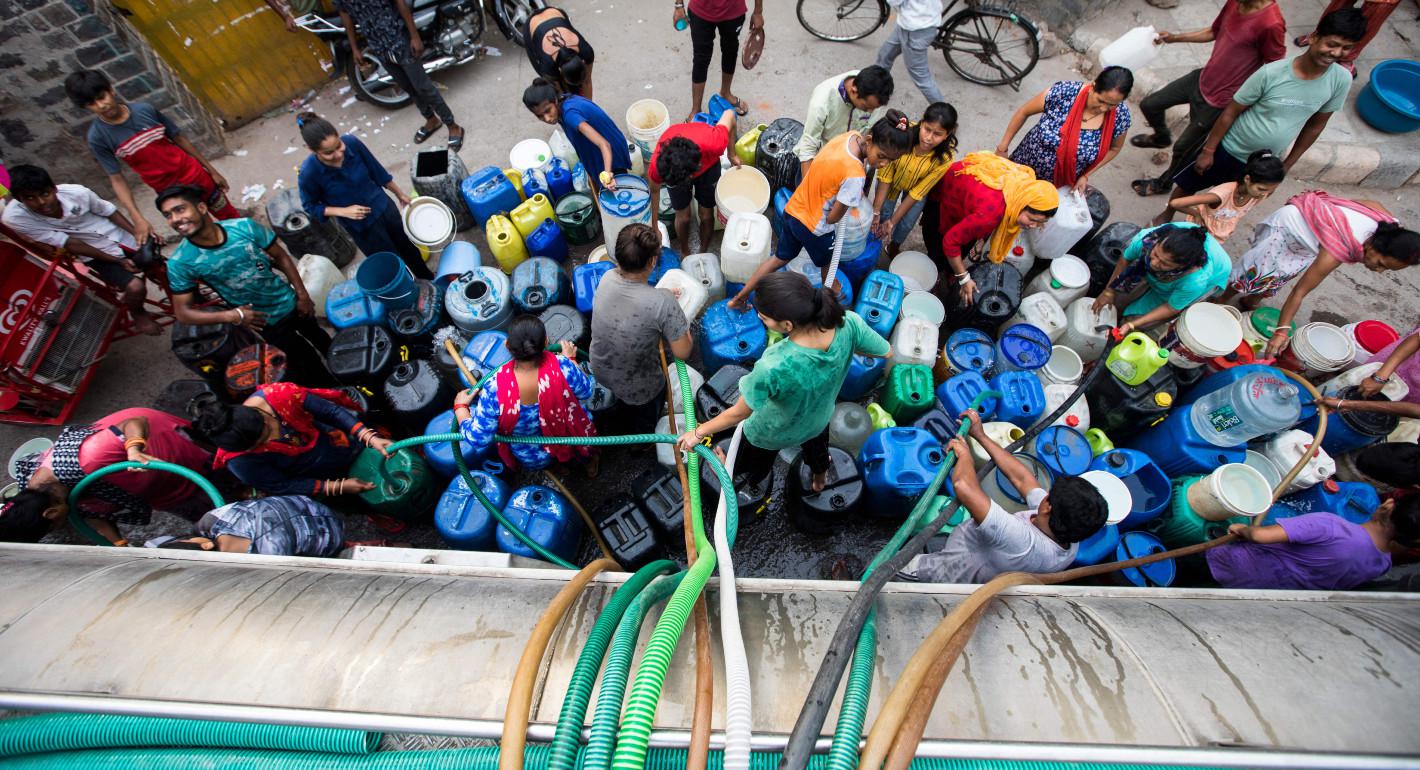
India is experiencing a devastating heat wave, with temperatures reaching as high as 140 degrees Fahrenheit and testing the “limits of human survivability,” according to one UN expert. To make matters worse, soaring electricity demand has outstripped India’s available energy supply, driving widespread power outages across the country. To stop the blackouts, the Indian government is taking steps to dramatically ramp up its use of coal power. But a narrow focus on boosting coal supplies ignores the real drivers of India’s energy shortage and threatens to slow the country’s transition to clean energy, increasing its carbon emissions and making future heat waves even more likely.
Temperatures in March and April were the highest India had seen in over a century, driving unprecedented spikes in energy demand as Indians turned to fans and air conditioning to beat the heat. On paper, India had enough generation capacity to keep these appliances running. While energy demand hit a new record of 201 gigawatts in late April, India’s installed energy capacity is nearly double that, with 236 gigawatts of capacity from coal and natural gas plants alone.
Instead, the problem has been insufficient fuel supplies. India’s energy crisis grew so dire so quickly because many generation companies have been operating with negligible stockpiles of coal—India’s primary power source. At the end of March, as temperatures began to climb, generators had on average only nine days of operating reserves, far below the twenty-four days recommended by the Indian government.
One issue is that power plants have struggled to get access to the coal that India already has on hand. Railway shipments of coal were operating below capacity for months, in part because power plants didn’t choose to commission them. However, once the energy crunch began, delivery trains couldn’t be loaded fast enough to satisfy the generators’ demand. India has since canceled passenger trains in order to repurpose them for coal deliveries. The Indian government has also ordered power generators to secure coal from abroad, setting the country up to import nearly as much coal over the next six months as it did in any of the past six years. Yet both of these actions have been last-minute solutions to problems that should have been prevented in the first place. In truth, the single most important driver of India’s current power crisis is that generation companies lacked the resources and incentives to take such measures early on, before blackouts became unavoidable.
Maintaining reserve margins and importing additional coal—or, for that matter, paying for coal to be delivered at all—are expensive, and many power generators are starved for cash. This is because their primary customers, India’s state power distribution companies (known as discoms) have made it standard operating practice to refuse to pay generators on time in order to deal with their own financial woes.
India’s discoms hemorrhage cash, with more than one-fifth of the electricity they send to households either never paid for at all or lost en route due to poor distribution infrastructure—roughly double the levels in South Asian countries like Bangladesh or Sri Lanka and quadruple the levels in the United States and China. The primary culprits are Indian political parties, which have made a habit of promising free electricity to key constituencies in exchange for votes. In state elections earlier this year, for example, the Bharatiya Janata Party (BJP) promised farmers in Uttar Pradesh free electricity for the next five years, while in Punjab, the Aam Aadmi Party (AAP) rode to victory on the back of its pledge to give away free electricity to every household in the state.
As a result of such tactics, discoms are often unable to charge customers the cost of supplying power, providing them little means or incentive to ensure Indians have steady access to high-quality electricity—particularly when fuel prices are high. The consequences of this dysfunction ripple throughout India’s power ecosystem, beginning with delayed payments to power generators and razor-thin fuel reserve margins.
Dealing with these underlying problems will be a difficult task, but there are plenty of pathways forward. India has begun a recent push to invest in smart meters to better regulate subsidized access to electricity and increase billing efficiency. A more ambitious step would be to simply offer Indians cash payments that they could use to purchase electricity themselves rather than subsidizing power directly, an approach that would result in less direct interference with discoms’ operations from politicians.
But rather than tackle India’s power dysfunction head-on, New Delhi has continued to focus on Band-Aid solutions—including a pledge last week to boost coal production by as much as 100 million metric tons over the next three years by reopening one hundred coal mines previously considered financially unsustainable.
A more comprehensive approach would save costs, cut emissions, and create a grid more resilient to future fuel shortages. More capable discoms would likely make more intelligent use of India’s existing coal capacity, for example, not only through enabling better stockpiling practices among power generators but also through efforts to retire older coal plants in favor of newer plants that can generate more power with less fuel.
Additionally, a narrow focus on increased coal production may risk locking in fossil fuel capacity in cases where renewable energy would offer a cheaper and cleaner solution. A better path would be to ensure that discoms have the financial flexibility and foresight to take a systems-wide perspective to energy planning, seeking out instances where India’s energy needs would be better met by wind and solar power. This would also keep excess investment in coal from undermining the Indian government’s broader agenda for its energy transition, including its ambitious target of reaching 500 gigawatts of renewable energy by 2030.
Indeed, in the long term, one of the best ways of mitigating both extreme heat waves and the power cuts that accompany them will be to reduce India’s carbon emissions. Although India bears little responsibility for historical carbon emissions, as the world’s third-largest emitter today, it has an outsized impact on the future emissions trajectory of the world—and the adverse climate effects experienced by its own citizens. For New Delhi, finding carbon-friendly ways of meeting its energy needs is a necessity, not a luxury.
India’s energy crisis should be a wake-up call. By reforming the discoms, investing in energy resilience, and adopting a systems-wide approach to planning the grid, the Indian government can use this moment of crisis to ensure a safer and cleaner world for its citizens going forward. Sticking with the coal-dominant status quo would only set the country on a course for higher temperatures, higher energy costs, and more frequent blackouts. As India is exposed to increasingly severe impacts from climate change, that will prove to be an increasingly deadly combination.
Jonathan Kay
Former Nonresident Research Assistant, South Asia Program
Jonathan Kay is a nonresident research assistant in the Carnegie South Asia Program. He was previously a James C. Gaither Junior Fellow.
Carnegie does not take institutional positions on public policy issues; the views represented herein are those of the author(s) and do not necessarily reflect the views of Carnegie, its staff, or its trustees.

Despite its flop at the box office, the film raises important questions for the climate community to answer.

Leonardo Martinez-Diaz

Russian strikes are weakening the economy sustaining Ukraine’s war effort. Closing the growing funding gap will require more European support and politically contentious reforms in Kyiv.

Balázs Jarábik
Economic recovery has brought Sri Lanka a modicum of stability, but domestic strains and great-power rivalry could test how long it lasts.

Avinash Paliwal

Policy proposals on sovereign debt must both match the scale of the challenge and be implementable within existing political constraints.

David McNair

For every ruble allocated to social policy, health, and education in 2027, double that amount is earmarked for the army, the police, and the security services.

Alexandra Prokopenko