

Commentary
Judy Dempsey
{
  "authors": [
    "Judy Dempsey"
  ],
  "type": "commentary",
  "centerAffiliationAll": "",
  "centers": [
    "Carnegie Endowment for International Peace",
    "Carnegie Europe"
  ],
  "collections": [],
  "englishNewsletterAll": "",
  "nonEnglishNewsletterAll": "",
  "primaryCenter": "Carnegie Europe",
  "programAffiliation": "",
  "programs": [],
  "projects": [],
  "regions": [
    "Eastern Europe",
    "Ukraine",
    "Western Europe",
    "Germany"
  ],
  "topics": [
    "Security",
    "Military"
  ]
}
Source: Getty
It’s his boss.
On Monday, German Defense Minister Christine Lambrecht resigned after a thirteen-month tenure marked by gaffes, military inexperience, an inability to understand the implications of the war in Ukraine for Germany’s armed forces, and an unsympathetic media. Lambrecht and her former boss, Chancellor Olaf Scholz, had been criticized by their NATO allies for doing too little and too late to support Ukraine—in particular, sending what Ukraine really needs: tanks.
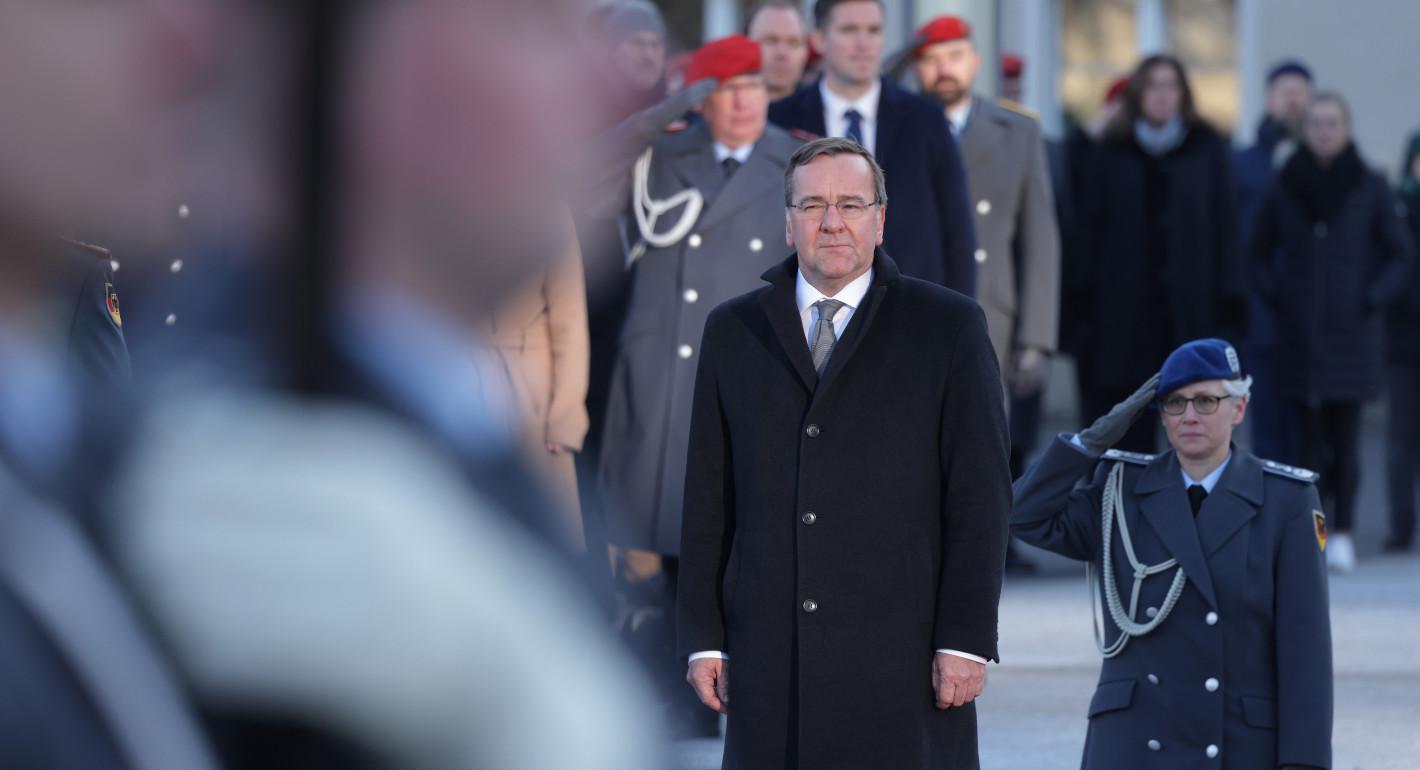
But the new defense minister, Boris Pistorius, will have to grapple with two issues that haunted Lambrecht: a defense ministry with deep structural issues and his own boss’s dithering. To deal with these problems, Pistorius needs to be strong enough to challenge the chancellery in stepping up Berlin’s efforts to defend Ukraine, changing the mindset in the defense ministry, and shaking up the defense industry.
But it’s Scholz, not Pistorius, who makes the decisions about sending weapons to Ukraine. Despite pressure from the United States and several European countries, Berlin has stalled and made excuses, even as it has stepped up to supply weapons and other equipment to Kyiv.
The current clash centers around Germany’s Leopard 2 tanks. Since the tanks are made in Germany, their use in conflict zones requires Scholz’s permission under a long-held policy of not sending military hardware to a conflict zone. Ukraine has repeatedly asked Germany for tanks, and Finland and Poland have requested permission to re-export their stockpiles. Lambrecht had been blamed for not taking a clear line in supporting Ukraine, but it’s Scholz who has never approved sending the tanks.
It is also Scholz who must give the go-ahead to bestow the defense ministry with a new status and a sense of confidence that has been battered over the past several years. Known for its bureaucracy, lack of a strategic military doctrine, and reluctance to embrace modernization, the ministry has a reputation as a lowly, uncelebrated post. Former ministers have described the department as a “snake pit,” a “sack of landmines,” and an “ejector seat.” It is one of the German government’s most unpopular posts.
In addition, the Bundeswehr (armed forces) had become somewhat of a laughingstock over the years. Despite an allocation of more than 56 billion euros in 2021 to the ministry, troops lacked basic equipment and clothing—they didn’t even have thermal underwear when sent to the Baltic States during the winter. More than that, Germany repeatedly failed to meet the agreed NATO target of spending 2 percent of its GDP on defense. These complaints were frequent, yet little action was taken.
But the war in Ukraine is changing these perceptions about the military.
In his seminal speech last February, Scholz announced the Zeitenwende, or “turn around,” by pledging 100 billion euros to the defense ministry and a radical modernization of the armed forces. This was welcome news to both Germans and their allies. But nothing came of these grand announcements.
Lambrecht was blamed for not using the budget to order new equipment, upgrade existing weaponry and provide the troops with essential supplies. But what is forgotten is the immense resistance to change by the ministry’s bureaucracy and the snail’s pace in finalizing procurement contracts, as well as the armaments industry’s lack of responsiveness and competition—factors that also have influenced Germany’s response to the war in Ukraine.
But it was her style and inexperience that got the better of her. She was slammed for taking her son on a trip in a military helicopter in April. This month, against the background of New Year’s celebratory fireworks, Lambrecht said in an Instagram video that the war in Ukraine was an “exciting professional experience.” She resigned two weeks later.
But even with Lambrecht gone, Scholz continues to dither: in a speech at the World Economic Forum in Switzerland on Wednesday, Scholz dodged the tanks topic once again. Why has he been so reluctant to turn his Zeitenwende speech into facts?
For one, his Social Democrats are divided. One faction opposes deliveries of the tanks, saying it will only escalate the war (as if Russia hasn’t been escalating it since February). Another faction clings to Ostpolitik, or “eastern policy,” believing that closer economic and political ties with Russia would lead to a more predictable and stable relationship. Linked to these views are the belief that diplomacy with Russia has to be used to negotiate the end of the war. Yet another faction is pacifist and anti-American.
And there is the lingering perception of seeing Ukraine—and the rest of Eastern Europe—through a Russian prism, as if this region is still part of Moscow’s influence.
Pistorius, a Social Democrat whose last job was interior minister from the state of Lower Saxony, has a reputation for not pulling punches when it comes to training a competent police force and ensuring security. His direct style and his stint in the military during the early 1980s could serve him well in the post.
He’s also very close to Scholz—both hail from the city of Osnabrück —and the chancellor likely will not want his friend to fail, perhaps giving Pistorius more runway to turn things around in the defense ministry.
Pistorius’s first test will come on Friday at a meeting of dozens of Western defense ministers in Germany to discuss Ukraine aid—and where the tank question will certainly be central. But his biggest challenge is his boss. It is Scholz who has to defend his new defense minister by delivering on the promise of Zeitenwende. Perhaps it’s now Scholz who shouldn’t let his friend down.

Nonresident Senior Fellow, Carnegie Europe
Judy Dempsey is a nonresident senior fellow at Carnegie Europe
Recent Work
Judy Dempsey
Judy Dempsey
Carnegie does not take institutional positions on public policy issues; the views represented herein are those of the author(s) and do not necessarily reflect the views of Carnegie, its staff, or its trustees.
They face an uphill climb, but they could draw on a strategy that other diplomats have used in the past.


Shana Tabak, Alejandro Martin Rodriguez

European Commission President Ursula von der Leyen is about to give her annual address on the state of the EU. Here’s what she won’t—but should—say.

Rym Momtaz

Understanding the climatic pain points is necessary for policymakers hoping to minimize the war’s negative environmental consequences.


Alejandro Martin Rodriguez, Joy Arkeh, Sarah Yerkes

Radical-right parties are expected to do well in upcoming elections in four of the EU's biggest member states. If successful, they could prevent the union from addressing key challenges ahead.

Stefan Lehne

The books, podcasts, and films that explain the world it made.

Andrew Leber