

Commentary
Ibrahim Jalal
{
  "authors": [
    "Ibrahim Jalal"
  ],
  "type": "other",
  "centerAffiliationAll": "dc",
  "centers": [
    "Carnegie Endowment for International Peace",
    "Malcolm H. Kerr Carnegie Middle East Center"
  ],
  "collections": [
    "Palestine: The Wars in the War"
  ],
  "englishNewsletterAll": "menaTransitions",
  "nonEnglishNewsletterAll": "",
  "primaryCenter": "Malcolm H. Kerr Carnegie Middle East Center",
  "programAffiliation": "MEP",
  "programs": [
    "Middle East"
  ],
  "projects": [],
  "regions": [
    "Gulf",
    "Levant",
    "Israel",
    "Yemen",
    "Palestine",
    "Middle East",
    "North America",
    "United States"
  ],
  "topics": [
    "Political Reform"
  ]
}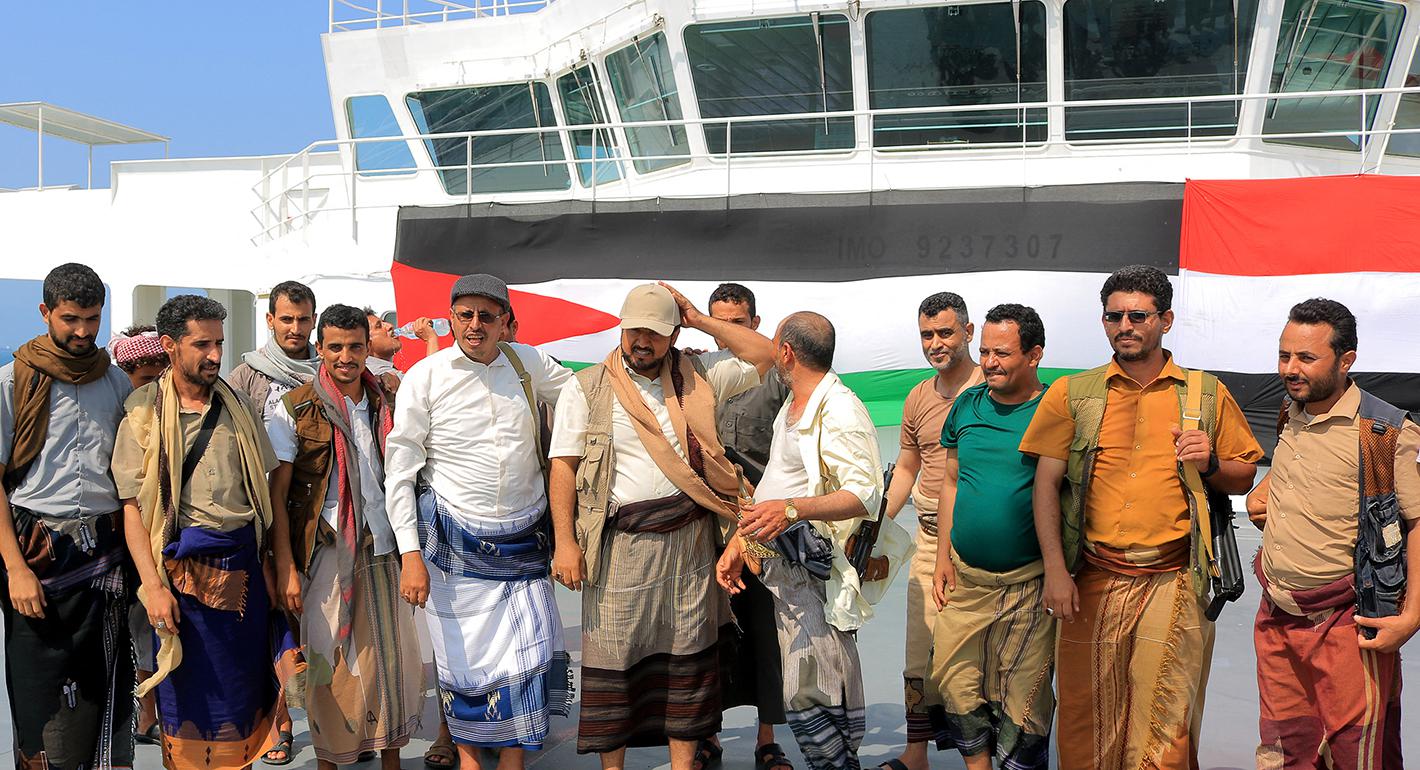
Source: Getty
The best way for Washington to address Ansar Allah’s hindrance of seaborne traffic is to tie maritime security in the region to the Yemeni peace process.
On January 12, a U.S.-led naval and aerial coalition launched its first round of strikes against Ansar Allah (referred to by some as the Houthis). The strikes, which targeted Ansar Allah positions in five Yemeni governorates—including Hodeida, Hajjah, and Sana’a—came in response to the group’s attacks on shipping in the Red Sea. Ansar Allah, which is backed by Iran, has claimed that it will cease such actions only if Israel commits to a ceasefire in its war with Hamas, lifts its sixteen-year siege of Gaza, and allows the unhindered entry of humanitarian aid into the territory.
The United States, which opposes a ceasefire in Gaza—arguing that it would benefit Hamas—determined that a robust response was necessary due to the economic fallout underway. Since launching its attacks on October 19, Ansar Allah has disrupted 30 percent of global seaborne container traffic and at least 12 percent of global maritime trade, which is worth approximately $1 trillion. Increasingly, shipping companies are avoiding the Red Sea and instead sailing around South Africa’s Cape of Good Hope.
U.S. officials claimed that the coalition strikes of January 12 eliminated between 20 and 30 percent of Ansar Allah’s offensive capabilities. Even if true, this is unlikely to make a strategic difference in the behavior and capabilities of the group, given its political aims as well as its concealment of medium and heavy arms in mountain camps and tunnels. To signal its defiance, Ansar Allah launched at least three anti-ship ballistic missiles into the Red Sea shortly after the operation’s conclusion. The second of the three was fired at the destroyer U.S.S. Laboon, but was intercepted. Clearly, the United States and its allies had underestimated Ansar Allah.
Some would say that today’s Ansar Allah maritime challenge is a consequence of international mismanagement of the Yemen conflict in 2018 and failed policies of appeasement and containment. That year, the United States and the United Kingdom imposed the Stockholm Agreement on the internationally recognized Yemeni government, thereby preventing its forces from recapturing Hodeida. That this came after Ansar Allah’s leader Abdul Malek al-Houthi had declared defeat at the hands of government forces in Hodeida meant that the group was able to snatch political victory from the jaws of military defeat. Emboldened, Ansar Allah pivoted from defense to offense, consolidating its rule over the Yemeni capital Sana’a and repressing dissent. It also expanded its territorial control and soon came to pose an active threat to the government’s resource-rich stronghold of Ma’rib, as well as government-held coastal areas beyond Hodeida.
These developments enabled Ansar Allah to, opportunistically, use Israel’s assault on Gaza to achieve both internal and external objectives. Internally, Ansar Allah wanted to reverse the decline in its public support by leveraging pro-Palestinian and anti-intervention sentiments among ordinary Yemenis. After a growing wave of discontent with its rule, as evidenced by public school teachers’ strikes over the non-payment of salaries in August 2023 as well as spontaneous celebrations commemorating the September 26 revolution of 1962 (which ended the Imamate that Ansar Allah seeks, in its own way, to revive), the group sought to shift people’s attention elsewhere. Externally, Ansar Allah wanted to deepen its role within Iran’s Axis of Resistance, boost its regional standing, and project military power.
The United States announced Operation Prosperity Guardian on December 18, but struggled to form a coalition. In an early sign of friction, France, Italy, and Spain joined but then withdrew from the coalition, reportedly over command and control issues as well as the potential for disagreement over the scope and objectives of the mission. And although the United States had intended to form an Arab-Western military coalition, Saudi Arabia, the United Arab Emirates (UAE), and Egypt declined to join. This was not a surprise. The three countries, albeit to varying degrees, disapprove of regional policies by the United States that are purely reactive in nature, have little confidence in U.S. security provisions, and want to avoid being seen as acting in defense of Israel. Riyadh, which is engaged in peace talks with Ansar Allah, and Abu Dhabi, which has largely withdrawn from the Yemeni conflict, had additional reservations, such as a fear that the group would resume cross-border attacks on Saudi Arabia and the UAE.
The United States went on to cobble together a coalition with the United Kingdom, Bahrain, Canada, the Netherlands, Seychelles, and Norway, among other countries. The coalition launched Operation Prosperity Guardian, which consists of defensive maneuvers meant to safeguard shipping in the Red Sea. When the United States deemed such maneuvers insufficient, it assembled a smaller coalition of six countries with the United Kingdom for offensive action, which launched strikes against Ansar Allah targets on January 12. Since then, this coalition has targeted more than 80 sites belonging to Ansar Allah, which the United States has now reclassified as a terrorist group.
Ansar Allah, however, remains undeterred. It has continued its attacks on Red Sea vessels and expanded such operations to the Gulf of Aden, launching more than four anti-ship ballistic missile attacks there. Also, despite Ansar Allah’s initial claim that its attacks targeted commercial vessels owned by or destined for Israel, this was not always the case. For example, although the ships Unity Explorer and Number 9 had no connection to Israel and were not headed there, Ansar Allah still attacked them. Since the start of Prosperity Guardian and coalition strikes, there has been no letup in Ansar Allah’s military operations. In fact, ironically, its bank of targets has grown, with the group stating that U.S. and British vessels are now fair game.
Moreover, it is extremely unlikely that air and naval strikes will significantly degrade Ansar Allah’s capabilities. The United States and the United Kingdom have carried out limited and symbolic action, and questions endure about their identification of high-value military targets. Ansar Allah, with two decades of experience in guerilla warfare, operates decentralized camps and bases. It has suffered limited losses, and may suffer more, but in the group’s eyes the price is worth it. In addition to wanting to strengthen its foothold in the Red Sea, Ansar Allah wants to push the United States out of the region. It shares this wish with Iran, which seeks to establish a presence in the Red Sea and has provided the group with intelligence support through Iranian vessels in the Gulf of Aden. Additionally, Ansar Allah is now able to give teeth to its longstanding anti-American and anti-Israeli ideology.
In short, the United States’ current approach is not working and may even play into Ansar Allah’s, and by extension Iran’s, hands. A better alternative is a multidimensional long-term security strategy that ties maritime security to the Yemeni peace process. This approach would require, on the one hand, redoubling support for the Yemeni government so that its forces can dislodge those of Ansar Allah from Hodeida and consign them to the mountains. And, on the other hand, it would consist of Saudi Arabia, and especially Oman, both of which have increasingly gained the trust of Ansar Allah, enticing the group with offers to break its isolation and bring it into the Arab and international fold.
Despite regional interest in deescalation, the fact that Ansar Allah has gone from launching cross-border attacks on Saudi Arabia and the UAE to disrupting Red Sea shipping makes it a threat to global supply chains and a potential instigator of inflation. In order to reduce pressure on the southern Red Sea front, where Prosperity Guardian warships and submarines have been deployed, Ansar Allah may yet extend its hostile actions to the Arabian Sea. And, even though it has stipulated that it would halt its maritime attacks should Israel alter its Gaza policies, it may in the future find another pretext to resume them.
All this requires the United States and its allies to view the challenge posed to freedom of navigation in the Red Sea through the lens of the Yemeni crisis, and to act accordingly. Otherwise, the current U.S. approach is likely to face recurring setbacks.

Former Nonresident Scholar, Malcolm H. Kerr Carnegie Middle East Center
Ibrahim Jalal was a nonresident scholar at the Malcolm H. Kerr Carnegie Middle East Center. His research explores third-party-led peace processes; maritime security in the Red Sea and Gulf of Aden; the proliferation of non-state actors and its implications on the implementation of peace agreements, post-war security orders, and stabilization efforts; the politics of social assistance in fragile and conflict-affected states; violent extremism; the foreign and defense policies of the Gulf and Western states in Yemen; and the evolving regional security architecture in the Middle East and North Africa. He has worked with the United Nations, the Middle East Institute, the Yemen Policy Center, the Overseas Development Institute, and Sussex University’s Institute of Development Studies.
Recent Work
Ibrahim Jalal
Ibrahim Jalal, Adnan al-Jabarni
Carnegie does not take institutional positions on public policy issues; the views represented herein are those of the author(s) and do not necessarily reflect the views of Carnegie, its staff, or its trustees.

Despite its flop at the box office, the film raises important questions for the climate community to answer.

Leonardo Martinez-Diaz

Reconciliation councils are emerging throughout the country to mediate in intracommunal disputes, many from the war years.
Natacha Danon

In an interview, Rozina Ali discusses her new book on the rise and manifestations of Islamophobia in the United States.

Michael Young

While the EU and European governments are embracing the much-lauded middle-power moment, this entails three difficult conundrums.

Richard Youngs
The civil war in Syria may have ended, but the country continues to serve as a source for the trafficking of illegal substances into and via Jordanian territory.


Armenak Tokmajyan, Laith Qerbaa