

Commentary
While the EU and European governments are embracing the much-lauded middle-power moment, this entails three difficult conundrums.
Richard Youngs
{
  "authors": [
    "Jin Liangxiang",
    "Maha Yahya",
    "Hesham Alghannam"
  ],
  "type": "questionAnswer",
  "centerAffiliationAll": "",
  "centers": [
    "Carnegie Endowment for International Peace",
    "Carnegie China",
    "Malcolm H. Kerr Carnegie Middle East Center"
  ],
  "collections": [
    "Carnegie China Commentaries"
  ],
  "englishNewsletterAll": "",
  "nonEnglishNewsletterAll": "",
  "primaryCenter": "Carnegie China",
  "programAffiliation": "",
  "programs": [],
  "projects": [],
  "regions": [
    "Middle East",
    "East Asia",
    "China"
  ],
  "topics": []
}
Source: Getty
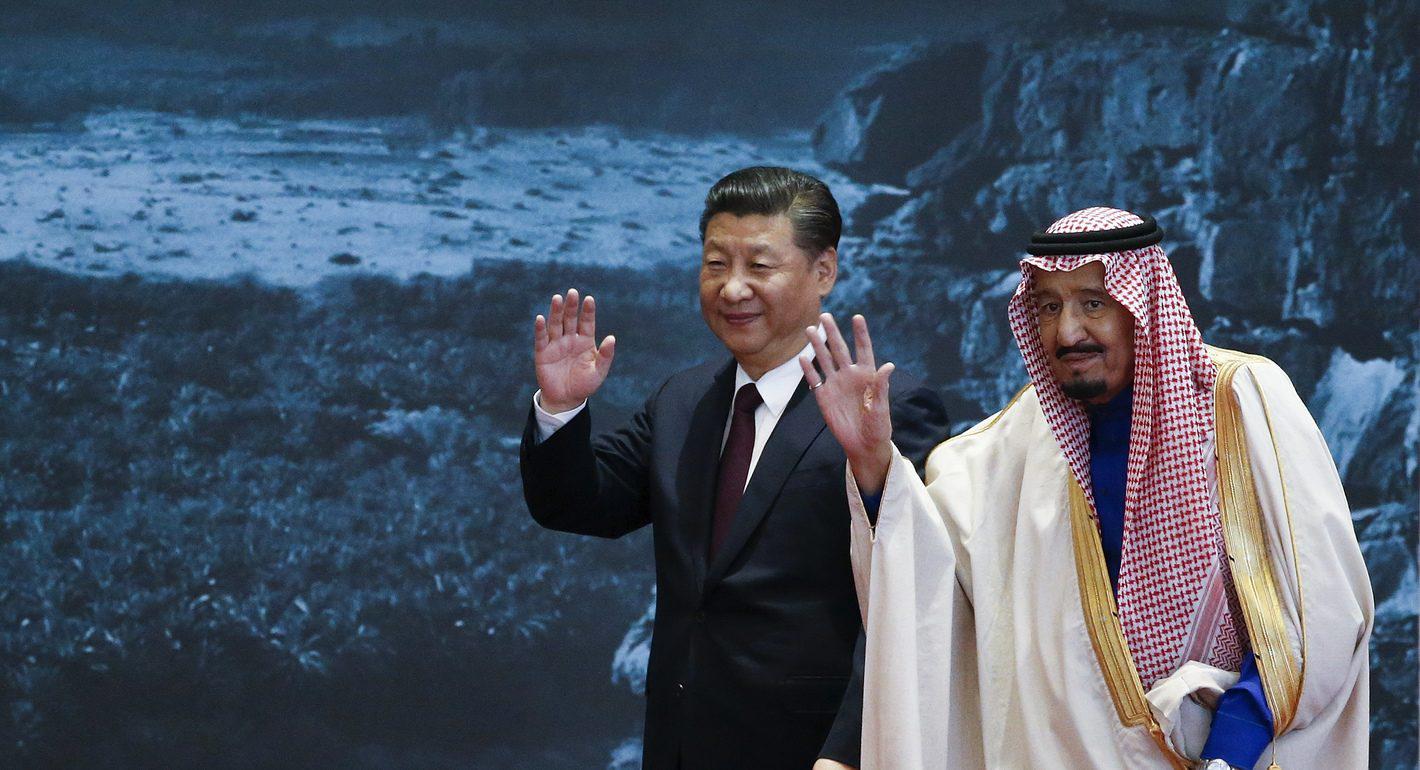
The advantage that China has over other global powers, especially America, is that its foreign policy is closely aligned with those of many of the Middle Eastern countries.
This Q&A was adapted from a Carnegie China live event assessing China–Middle East relations. It has been edited for clarity.
Jin Liangxiang: The Middle East is an important market for China’s products and a major source for Chinese investment. Peace and stability are an important part of China’s Middle East policy. It wants the market to be stable.Also, China cares about its international image as a responsible major country. Arab and Western countries, including the United States, often claim that China should play a responsible role in the Middle East. China is living up to this commitment, but it has a different way of defining its responsibilities.
On regional security issues, China emphasizes common, cooperative, comprehensive, and sustainable security. The American way of promoting security in the Middle East has failed. The Americans say that they will protect Saudi Arabia, but this puts Iran on the other side. Iran is not satisfied with being targeted by the United States. China’s principle is different. [It] thinks that security should be common and comprehensive.
Security issues should be resolved by regional countries themselves. Outsiders can push regional countries to engage in dialogue, particularly by leveraging economic and political capital. That is the way to make peace and security.
Saudi-Iran reconciliation has been very important for the Middle East. There are many conflicts in the region, but tensions between Iran and Saudi Arabia are one of the defining features. By facilitating reconciliation, China has helped maintain a modest degree of stability in the region. It stopped the confrontation between Saudi Arabi and Iran in Lebanon, Iraq, Yemen, Syria, and Bahrain. This has benefited Saudi Arabia greatly. Saudi Arabia has strong interests in reconciliation with Iran because of its ambitious plan for Vision 2030. Without reconciliation, Saudi Arabia cannot realize this agenda. Reconciliation has led many people to see the prospect for stability in the region.
Our friends in Saudi Arabia sometimes complain that China has closer relations with Iran. But when we are in Iran, they ask why we side with Saudi Arabia. Both arguments are wrong. China tries to maintain balanced and good relations with both countries.
Maha Yahya: Dr. Alghannam, having heard what Dr. Jin said, particularly regarding China’s interests in economic stability and stability in the region, what would you say are the key security concerns in the Middle East and how does China fit into the regional security landscape?Hesham Alghannam: First is the ongoing Israeli occupation of Palestinian Arab land, which has escalated tensions in the region and brought it to the brink of a broader conflict beyond Gaza and the West Bank. Second, there is the issue of the spread of nuclear weapons in the region. Israel already possesses nuclear weapons, and Iran is nearing a nuclear capability. This will encourage others, including the Turks and the Saudis, to pursue nuclear armament. Third, the existence of numerous armed nonstate actors backed by Iran poses a threat to Arab states and undermines stability across the region.
Addressing these strategic security challenges requires a comprehensive strategy. For instance, resolving the Iranian nuclear program necessitates addressing Israel’s nuclear capability. Similarly, tackling the proliferation of armed nonstate actors requires addressing the root causes that enable their existence.However, the current approach, such as the NATO-like defense pact proposed by the United States, does not offer comprehensive solutions to ongoing security concerns. While such pacts may enhance Saudi Arabia’s security, they do not address the core security issues.
In contrast, China advocates a different approach to regional security. It emphasizes cooperation between Saudi Arabia and Iran. This approach has led to significant mediation efforts aimed at reconciling the two states.
Unlike the United States, China has shown no interest in establishing military bases in the region until now. China’s political involvement in the region remains limited. However, like the United States, China lacks a comprehensive strategy that addresses the main security challenges in the region, such as the ending the conflict in Gaza.
The advantage that China has over other global powers, especially America, is that its foreign policy is closely aligned with those of many of the Middle Eastern countries. Unlike the United States, China’s foreign policy principles are grounded in values such as respect for sovereignty and territorial integrity, nonaggression, noninterference, mutual benefit, and peaceful existence. China also refrains from interference under the pretext of protecting human rights or promoting democracy. It has avoided employing double standards in international relations. This is how many states in the region view China, so it is not strange that China’s foreign policy is more attractive to leaders in the Middle East.
Jin Liangxiang
Jin Liangxiang is a senior research fellow at Shanghai Institutes of International Studies.

Director, Malcolm H. Kerr Carnegie Middle East Center
Maha Yahya is director of the Malcolm H. Kerr Carnegie Middle East Center, where her research focuses on citizenship, pluralism, and social justice in the aftermath of the Arab uprisings.

Nonresident Scholar, Malcolm H. Kerr Carnegie Middle East Center
Hesham Alghannam is a nonresident scholar at the Malcolm H. Kerr Carnegie Middle East Center.
Carnegie does not take institutional positions on public policy issues; the views represented herein are those of the author(s) and do not necessarily reflect the views of Carnegie, its staff, or its trustees.

While the EU and European governments are embracing the much-lauded middle-power moment, this entails three difficult conundrums.

Richard Youngs

Europe is facing rising populism internally as well as external pressures from Russia, China, Turkey, and the United States.

Dimitar Bechev

The acknowledgment has sparked fears of a new arms race with China and Russia.

Chris O’Meara

The European Commissioner for Trade is headed to China. But after President Xi’s bridge-building visit to Washington, can a more isolated EU overcome Beijing’s stranglehold on critical raw materials? Who will blink first?

Rym Momtaz, ed.

The summit may be remembered as a fatal blunder, when Washington, Beijing, and the AI industry collectively chose ceremony over action.

Jeffrey Prescott