

Commentary
Much has been said of the changes Brussels is trying to make to the EU enlargement process. Here’s why gradual integration might—or might not—be the answer.
Dimitar Bechev
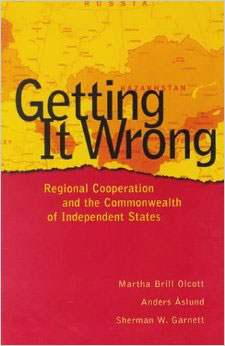
Written by three of the West's leading experts on the former Soviet Union, this book offers a comprehensive assessment of how and why the Commonwealth of Independent States has failed.
Source: Washington

In the void left by the collapse of the USSR, the CIS was to become a superstructure that would coordinate the foreign and security policies of the member states, develop a common economic space, and provide for an orderly transition from the Soviet Union to the post-Soviet phase. In reality, the CIS has failed. For Russia, the CIS has not served as a vehicle for exerting control over its neighbors. As an organization, the CIS has not succeeded at reintegrating the post-Soviet states. The desire of the new nations to assert themselves as independent entities has proven more powerful than their urge to replace the Soviet Union with a new system of collective government.
Written by three of the West's leading experts on the former Soviet Union, this book offers a comprehensive assessment of how and why the CIS has failed.
“The authors of this comprehensive study are all well-respected specialists in the field, and they present a broad-ranging picture of the experiences and problems that have arisen in the former Soviet space.”
—Ronald J. Hill, Department of Political Science, Trinity College, Dublin
“A unique and useful book.”
—Robert Legvold, Foreign Affairs

Former Senior Associate, Director, Russian and Eurasian Program

Former Senior Associate, Russia and Eurasia Program and, Co-director, al-Farabi Carnegie Program on Central Asia
Olcott is professor emerita at Colgate University, having taught political science there from 1974 to 2002. Prior to her work at the endowment, Olcott served as a special consultant to former secretary of state Lawrence Eagleburger.
Sherman W. Garnett
Carnegie does not take institutional positions on public policy issues; the views represented herein are those of the author(s) and do not necessarily reflect the views of Carnegie, its staff, or its trustees.

Much has been said of the changes Brussels is trying to make to the EU enlargement process. Here’s why gradual integration might—or might not—be the answer.

Dimitar Bechev

Trump has promised Belarus a massive potash deal. But Minsk is seeking something greater: restored Western transit and greater room for maneuver from Russia.

Balázs Jarábik

Before the next wave of EU enlargement takes place, the union needs to grapple with thorny questions of how power is distributed among its members.


Emil Sondaj Hansen, Ditte Brasso Sørensen

Minsk clearly expected the dialogue with Washington to yield more results, in particular the lifting of EU sanctions and permission to export potash.

Artyom Shraibman

A summer of escalation in the Black Sea has hurt Ukraine economically and is exacerbating world food security. A truce is needed—as is a broader reframing of Europe’s Ukraine strategy.

Thomas de Waal