

In The Media
Lilia Shevtsova
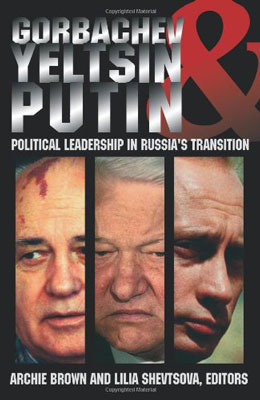
Focusing on Russia's three top leaders since 1985, this book examines their goals, evolving ideas, styles of rule, institution-building, and impacts on policy.
Source: Washington

Archie Brown is Professor of Politics at the University of Oxford and author of The Gorbachev Factor. Lilia Shevtsova is senior associate in the Russia and Eurasia Program at the Carnegie Endowment and author of numerous books, including Yeltsin's Russia: Myths and Reality.
"Four thoughtful academics have given us a very readable guide through the thicket of modern Russian politics. This is one of those books that helps its readers think about a complicated problem by giving them clear, intelligent cues and directions."
—Robert G. Kaiser, author of Russia: The People and the Power and Why Gorbachev Happened
"Indispensable reading for those interested in the transition from Soviet to Russian politics. Students of leadership will be particularly interested in analyses provided by experts with a special sensitivity to the issues of leadership and followership as embedded in the Russian context."
—Barbara Kellerman, Executive Director, Center for Public Leadership, John F. Kennedy School of Government, Harvard University
"Seldom do readers have the good fortune to encounter such informative and well-documented assessments of a major country's leaders. The comparison between Gorbachev and Yeltsin is magisterial. On Putin, the authors succeed in identifying some of the most promising as well as the most worrying of his policies."
—Alfred Stepan, Wallace S. Sayre Professor of Government, Columbia University

Former Senior Associate, Russian Domestic Politics and Political Institutions Program, Moscow Center
Shevtsova chaired the Russian Domestic Politics and Political Institutions Program at the Carnegie Moscow Center, dividing her time between Carnegie’s offices in Washington, DC, and Moscow. She had been with Carnegie since 1995.
Recent Work
Lilia Shevtsova
Lilia Shevtsova
Carnegie does not take institutional positions on public policy issues; the views represented herein are those of the author(s) and do not necessarily reflect the views of Carnegie, its staff, or its trustees.

For every ruble allocated to social policy, health, and education in 2027, double that amount is earmarked for the army, the police, and the security services.

Alexandra Prokopenko

The acknowledgment has sparked fears of a new arms race with China and Russia.

Chris O’Meara

Cargo traffic through Russia’s Northern Sea Route has increased because of the disruption caused by the conflict in the Middle East, the Ukraine war, and U.S.-China tensions.

Mikhail Korostikov
An analysis of traffic accident data suggests that Ukrainian drone attacks caused a material but not disastrous fall in Russian gasoline consumption over the summer.

Sergey Vakulenko

Sergei Kiriyenko used Russia’s parliamentary vote to further hone his strategy of corporate mobilization that is designed to maximize votes for United Russia.

Andrey Pertsev