• Research
  • Emissary
  • About
  • Experts
Carnegie Global logoCarnegie lettermark logo
DemocracyIran
  • Donate
REQUIRED IMAGE
Report

China's Financial Sector: Contributions to Growth and Downside Risks

Link Copied
By Dr. Albert Keidel
Published on Jan 25, 2007

Additional Links

Full Text (PDF)
Program mobile hero image

Program

Asia

The Asia Program in Washington studies disruptive security, governance, and technological risks that threaten peace, growth, and opportunity in the Asia-Pacific region, including a focus on China, Japan, and the Korean peninsula.

Learn More

Source: Conference Paper

As global financial markets reel from the blows of developed-country financial failures in the fall of 2008, what is the status of China’s financial system? Many contend that China’s financial system is weak and ill-suited for supporting sustained modernization. This paper disagrees and explains why. Its analysis of China’s financial system helps provide an understanding of why China’s economy will weather the current financial storm in good shape.  This paper is forthcoming in 2009 in a volume to be published by the Milken Institute. [1]  A preliminary version was presented at an academic conference in early 2007.

Any evaluation of China’s financial system and its prospects must concentrate on its contribution to China’s economic growth and to related solutions to a range of domestic economic goals.  The evolution of China’s financial system, in all its various dimensions, is in midstream, with its many market and non-market aspects reforming simultaneously.  Its hybrid nature, which combines policy-directed lending and nascent market-based institutions, has aspects considered by some foreign observers to be not only unconventional but also inefficient.  In fact, the system appears to serve China’s current needs well.

[1] James R. Barth, John A. Tatom, and Glenn Yago (eds.), China’s Emerging Financial Markets: Challenges and Opportunities (Santa Monica, CA: Milken Institute, 2009)

Click here for full text.

About the Author

Dr. Albert Keidel

Former Senior Associate, China Program

Keidel served as acting director and deputy director for the Office of East Asian Nations at the U.S. Department of the Treasury. Before joining Treasury in 2001, he covered economic trends, system reforms, poverty, and country risk as a senior economist in the World Bank office in Beijing.

    Recent Work

  • Article
    As China's Exports Drop, Can Domestic Demand Drive Growth?

      Dr. Albert Keidel

  • Article
    China’s Fourth Quarter 2008 Statistical Record

      Dr. Albert Keidel

Dr. Albert Keidel
Former Senior Associate, China Program
Albert Keidel
China

Carnegie does not take institutional positions on public policy issues; the views represented herein are those of the author(s) and do not necessarily reflect the views of Carnegie, its staff, or its trustees.

More Work from Carnegie Endowment for International Peace

  • Forbidden City on a cloudy day
    Commentary
    Emissary
    Beijing Doesn’t Think Like Washington—and the Iran Conflict Shows Why

    Arguing that Chinese policy is hung on alliances—with imputations of obligation—misses the point. 

      Evan A. Feigenbaum

  • A young man uses Kimi, an AI grand model of artificial intelligence launched by Moonshot AI, in Shanghai, China, March 22, 2024.
    Article
    China Is Worried About AI Companions. Here’s What It’s Doing About Them.

    A new draft regulation on “anthropomorphic AI” could impose significant new compliance burdens on the makers of AI companions and chatbots.

      Scott Singer, Matt Sheehan

  • Commentary
    Strategic Europe
    Taking the Pulse: Can the EU Attract Foreign Investment and Reduce Dependencies?

    EU member states clash over how to boost the union’s competitiveness: Some want to favor European industries in public procurement, while others worry this could deter foreign investment. So, can the EU simultaneously attract global capital and reduce dependencies?

      • Rym Momtaz

      Rym Momtaz, ed.

  • Commentary
    Carnegie Politika
    Japan’s “Militarist Turn” and What It Means for Russia

    For a real example of political forces engaged in the militarization of society, the Russian leadership might consider looking closer to home.

      James D.J. Brown

  • Commentary
    Carnegie Politika
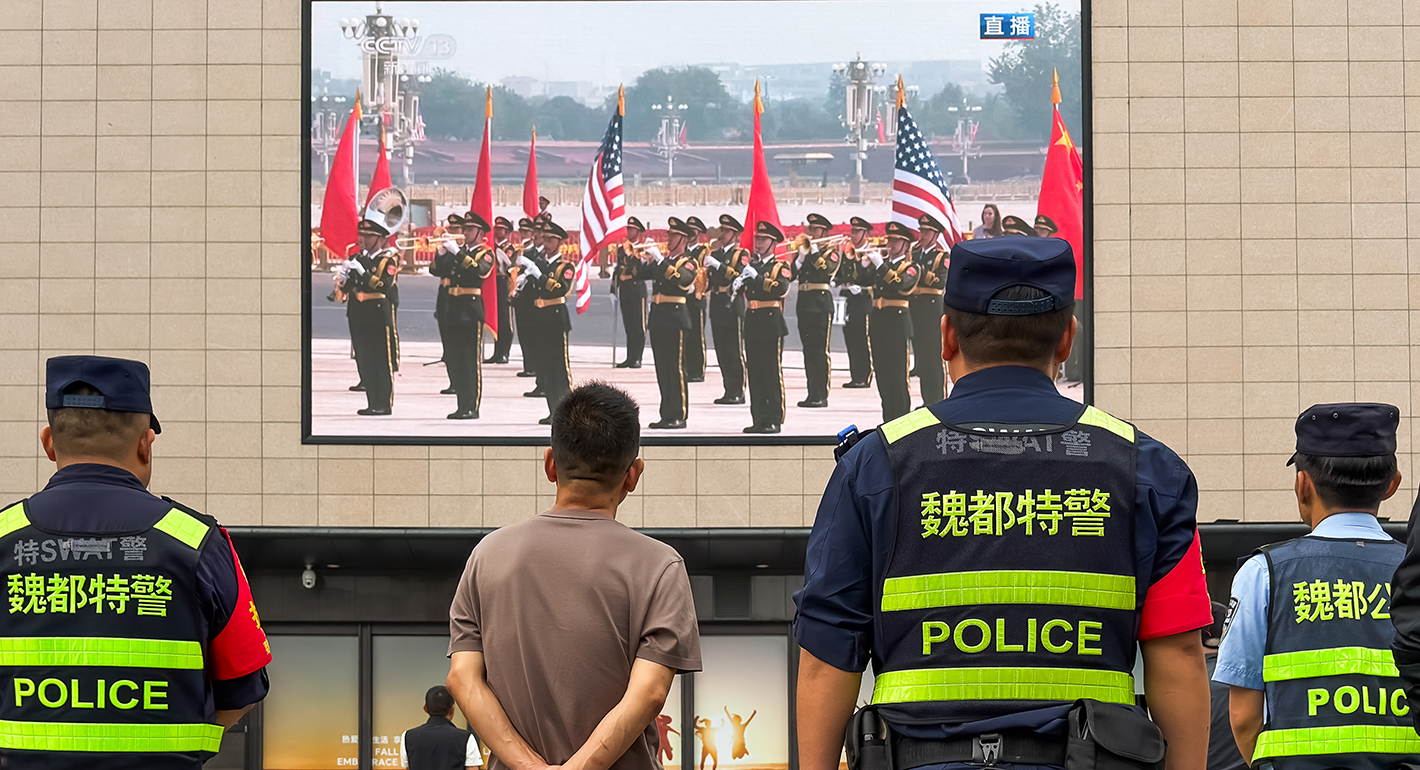
    A New World Police: How Chinese Security Became a Global Export

    China has found a unique niche for itself within the global security ecosystem, eschewing military alliances to instead bolster countries’ internal stability using law enforcement. Authoritarian regimes from the Central African Republic to Uzbekistan are signing up.

      Temur Umarov

Get more news and analysis from
Carnegie Endowment for International Peace
Carnegie global logo, stacked
1779 Massachusetts Avenue NWWashington, DC, 20036-2103Phone: 202 483 7600Fax: 202 483 1840
  • Research
  • Emissary
  • About
  • Experts
  • Donate
  • Programs
  • Events
  • Blogs
  • Podcasts
  • Contact
  • Annual Reports
  • Careers
  • Privacy
  • For Media
  • Government Resources
Get more news and analysis from
Carnegie Endowment for International Peace
© 2026 Carnegie Endowment for International Peace. All rights reserved.