• Research
  • Emissary
  • About
  • Experts
Carnegie Global logoCarnegie lettermark logo
DemocracyIran
  • Donate
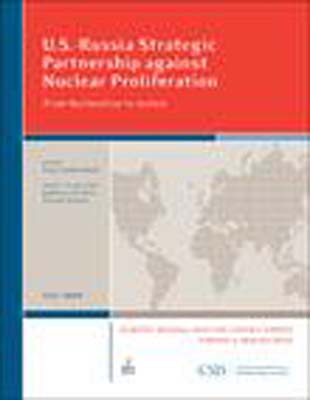
U.S.-Russia Strategic Partnership against Nuclear Proliferation
Report

U.S.-Russia Strategic Partnership against Nuclear Proliferation

The United States and Russia should agree on concrete actions to strengthen the nonproliferation regime as a follow-up to the April 2008 Strategic Framework Declaration.

Link Copied
By Pierre Goldschmidt
Published on Jul 1, 2008

Additional Links

Full Text
Program mobile hero image

Program

Nuclear Policy

The Nuclear Policy Program aims to reduce the risk of nuclear war. Our experts diagnose acute risks stemming from technical and geopolitical developments, generate pragmatic solutions, and use our global network to advance risk-reduction policies. Our work covers deterrence, disarmament, arms control, nonproliferation, and nuclear energy.

Learn More

Source: CSIS/IFRI Report

There are presently clear indications that we are about to see a revival of nuclear energy worldwide. It is important to make this expansion of nuclear energy for the production of electricity and desalinated water as safe and secure as possible. In the coming decade, however, the rate of this expansion will be limited by several factors: in recipient states, by the lack of an adequate industrial infrastructure or an insufficient nuclear safety culture with a truly independent control organization; and in supplier states, by a limited capacity to produce certain types of nuclear equipment, such as reactor vessels. Since there is no rush, we have time to “do” nuclear right. Doing it right means, in particular, putting stronger barriers to proliferation in place before, not after, new nuclear capabilities spread.

The present analysis has identified five areas (among many others) where the United States, Russia, and the European Union should closely cooperate in order to strengthen the nonproliferation regime: enforcing UN Security Council resolutions on Iran; addressing cases of noncompliance; improving security of supply and discouraging the spread of sensitive technologies; strengthening export criteria for the Nuclear Suppliers Group; and preparing the 2010 Nuclear Non-Proliferation Treaty review conference.

This study is part of a series being published by the joint CSIS/IFRI project “Europe, Russia, and the United States: Finding a New Balance,” which seeks to reframe the trilateral relationship for the relevant policymaking communities.

About the Author

Pierre Goldschmidt

Former Nonresident Senior Associate, Nuclear Policy Program

Goldschmidt was a nonresident senior associate at the Carnegie Endowment.

    Recent Work

  • Article
    A Realistic Approach Toward a Middle East Free of WMD

      Pierre Goldschmidt

  • Article
    Serious Deficiencies Exposed by Latest IAEA Safeguards Implementation Report

      Pierre Goldschmidt

Pierre Goldschmidt
Former Nonresident Senior Associate, Nuclear Policy Program
Pierre Goldschmidt
North AmericaUnited StatesCaucasusRussiaNuclear PolicyNuclear Energy

Carnegie does not take institutional positions on public policy issues; the views represented herein are those of the author(s) and do not necessarily reflect the views of Carnegie, its staff, or its trustees.
More Work from Carnegie Endowment for International Peace

  • The tops of people's heads. Raised above their heads are "No Kings" signs, an upside-down American flag, and a rainbow flag.
    Commentary
    Emissary
    Protests Like No Kings Can Only Go So Far to Stem Authoritarianism

    Lessons from other backsliding democracies show that mass mobilization needs to feed into an electoral strategy. 

      Saskia Brechenmacher, Shreya Joshi

  • Commentary
    Europe Doesn’t Like War—for Good Reasons

    The wars in Ukraine and the Middle East are existential threats to Europe as a peace project. Leaders and citizens alike must reaffirm their solidarity to face up to today’s multifaceted challenges.

      Marc Pierini

  • Commentary
    Carnegie Politika
    Blocking of Telegram App Sparks Rare Public Rift Among Russia’s Elites

    The prospect of a total block on Russia’s most popular messaging app has sparked disagreement between the regime’s political managers and its security agencies.

      Andrey Pertsev

  • A member of "Timur's Special Forces Unit" of the Defence Intelligence of Ukraine looks on on Snake Island, also known as Zmiinyi Island, located in the Black Sea, on August 14, 2025, amid the Russian invasion of Ukraine.
    Article
    The Changing Military Balance in the Black Sea: A Ukrainian Perspective

    Ukraine’s asymmetric approach has rendered Russia’s Black Sea Fleet functionally useless. But a long-term commitment will be needed to maintain this balance of power.

      Alina Frolova, Stepan Yakymiak

  • Commentary
    Emissary
    The Iran War Is Uncovering the Weakness in U.S.-Gulf Ties

    Neither the Abraham Accords nor the presence of large U.S. bases are enough to protect Arab Gulf states.

      Marwan Muasher

Get more news and analysis from
Carnegie Endowment for International Peace
Carnegie global logo, stacked
1779 Massachusetts Avenue NWWashington, DC, 20036-2103Phone: 202 483 7600Fax: 202 483 1840
  • Research
  • Emissary
  • About
  • Experts
  • Donate
  • Programs
  • Events
  • Blogs
  • Podcasts
  • Contact
  • Annual Reports
  • Careers
  • Privacy
  • For Media
  • Government Resources
Get more news and analysis from
Carnegie Endowment for International Peace
© 2026 Carnegie Endowment for International Peace. All rights reserved.