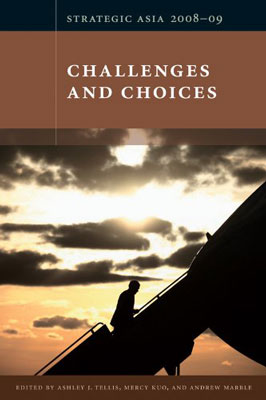
Source: The National Bureau of Asian Research
 Co-edited and introduced by Ashley Tellis, with chapters by leading Asia specialists including George Perkovich, senior associate at the Carnegie Endowment for International Peace, this book, the eighth volume in NBR’s Strategic Asia series, assesses the major strategic choices on Asia facing the U.S. president and administration as well as the broader policy community. Through a combination of country, regional, and topical studies, the book analyzes the impact of U.S. policy and geopolitical developments on Asia’s transformation over the past eight years.
Order this book, or read the introduction by Ashley J. Tellis for free.
About the Editors:
Ashley J. Tellis, Senior Associate at the Carnegie Endowment for International Peace and Research Director of the Strategic Asia Program at NBR, served in the U.S. Department of State as senior adviser to the Undersecretary of State of Public Affairs, and previously as senior adviser to the Ambassador at the U.S. Embassy in India. He also served on the National Security Council Staff as special assistant to the President and senior director for Strategic Planning and Southwest Asia. He is the author of India’s Emerging Nuclear Posture (2001) and co-author of Interpreting China’s Grand Strategy: Past, Present, and Future (2000), as well as the co-editor of six most recent volumes of Strategic Asia, published by NBR.
Mercy Kuo is Director of the Strategic Asia Program at The National Bureau of Asian Research.
Andrew Marble is Editor at The National Bureau of Asian Research.


-1.jpg)


