

• Research
  • Emissary
  • About
  • Experts
Carnegie Global logoCarnegie lettermark logo
DemocracyIran
  • Donate
Nuclear Security Spending: Assessing Costs, Examining Priorities
Report

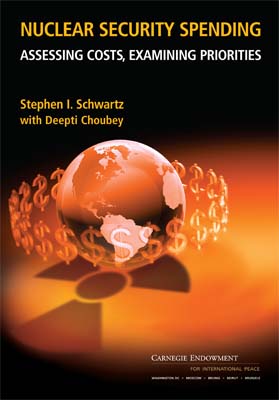
Nuclear Security Spending: Assessing Costs, Examining Priorities

The United States spent over $52 billion on nuclear weapons and related programs in fiscal year 2008, but only 10 percent of that went toward preventing a nuclear attack through slowing and reversing the proliferation of nuclear weapons and technology.

Link Copied
By Stephen I. Schwartz and Deepti Choubey
Published on Jan 12, 2009

Additional Links

Executive Summary, Low Res (2.8 MB)Executive Summary, High Res (33 MB)Full Text, Low Res (2.7 MB)Full Text, High Res (33 MB)PPT Presentation2008 Nuclear Spending Data
Program mobile hero image

Program

Nuclear Policy

The Nuclear Policy Program aims to reduce the risk of nuclear war. Our experts diagnose acute risks stemming from technical and geopolitical developments, generate pragmatic solutions, and use our global network to advance risk-reduction policies. Our work covers deterrence, disarmament, arms control, nonproliferation, and nuclear energy.

Learn More

The United States spent over $52 billion on nuclear weapons and related programs in fiscal year 2008, but only 10 percent of that went toward preventing a nuclear attack through slowing and reversing the proliferation of nuclear weapons and technology. That is the main finding of Nuclear Security Spending: Assessing Costs, Examining Priorities, a new study that uses publicly available documents and extensive interviews with government officials and experts to calculate the U.S. nuclear security "budget." The United States has never tracked nuclear weapons-related spending comprehensively, hindering effective oversight and weighing of priorities in nuclear security policy.

The lack of comprehensive accounting impairs balancing of priorities and fosters the impression that the United States is more interested in preserving and upgrading its nuclear arsenal than in reducing and eliminating the growing threats of nuclear proliferation and limited nuclear or radiological attack. Because classified expenditures and some other relevant costs are omitted from the analysis, total actual spending is significantly higher.

Key Conclusions

  • Only 1.3 percent ($700 million) of the nuclear security budget was devoted to preparing for the consequences of a nuclear or radiological attack.
     
  • Another 56 percent of the total went toward operating, sustaining, and upgrading the U.S. nuclear arsenal. 
     
  • Nuclear security consumes $13 billion more than international diplomacy and foreign assistance; nearly double what the United States allots for general science, space, and technology; and 14 times what the Department of Energy (DOE) budgets for all energy-related research and development.
     
  • Nuclear weapons and weapons-related programs account for at least 67 percent of DOE’s budget, 8.5 percent of the FBI’s budget, 7.1 percent of the Department of Defense budget, and 1.7 percent of the Department of Homeland Security’s budget.

Policy Recommendations

  • Require the executive branch to submit both an unclassified and a classified annual accounting of all nuclear weapons-related spending. Without an accurate understanding of the costs of nuclear spending, Congress and the executive branch cannot conduct essential oversight or devise the most effective policy.
     
  • Place greater emphasis on programs that secure and prevent the proliferation of nuclear weapons, weapons material, technology, and expertise.
     
  • Develop better measures to explain and quantify nuclear weapons-related intelligence expenditures. Greater transparency and insight could lead to a more effective allocation of intelligence assets.
     
  • Release an accurate accounting of the number of veterans who have received or been denied compensation and care for radiation exposure during atmospheric nuclear tests between 1946 and 1962, along with the total cost of such compensation and care.

The authors conclude:

“Implementing these recommendations will increase understanding and accountability, which in turn will lead to greater public support for critical nuclear security programs and a more effective allocation of public resources. When combined with a new focus on nuclear issues, including the Obama administration’s forthcoming Nuclear Posture Review, these efforts will help ensure that political and financial priorities are properly aligned.”

About the Authors

Stephen I. Schwartz is the editor of The Nonproliferation Review, published by the James Martin Center for Nonproliferation Studies at the Monterey Institute of International Studies, the largest nongovernmental organization in the United States devoted exclusively to research and training on nonproliferation issues. He is also the editor and coauthor of Atomic Audit: The Costs and Consequences of U.S. Nuclear Weapons since 1940 (Brookings Institution Press, 1998), the authoritative chronicle of historical expenditures associated with the U.S. nuclear weapons program. Schwartz has previously served as publisher and executive director of the Bulletin of the Atomic Scientists, and as a guest scholar with the Foreign Policy Studies Program at the Brookings Institution.

Deepti Choubey is deputy director of the Nonproliferation Program at the Carnegie Endowment. Her research interests include the calculations of non–nuclear-weapon states, how much the U.S. spends on nuclear security, and the role of nonproliferation for long-term U.S. foreign policy. Prior to joining the Carnegie Endowment in 2006, Choubey was director of the Peace and Security Initiative (PSI) for the Ploughshares Fund.

About the Authors

Stephen I. Schwartz

Deepti Choubey

Former Deputy Director, Nuclear Policy Program

Choubey was previously the director of the Peace and Security Initiative for the Ploughshares Fund. She also worked for Ambassador Nancy Soderberg in the New York office of the International Crisis Group.

Authors

Stephen I. Schwartz
Deepti Choubey
Former Deputy Director, Nuclear Policy Program
Deepti Choubey
North AmericaUnited StatesSecurityMilitaryNuclear Policy

Carnegie does not take institutional positions on public policy issues; the views represented herein are those of the author(s) and do not necessarily reflect the views of Carnegie, its staff, or its trustees.

More Work from Carnegie Endowment for International Peace

  • Research
    The Unintended Consequences of German Deterrence

    Germany's sometimes ambiguous nuclear policy advocates nuclear weapons for deterrence purposes but at the same time adheres to non-proliferation. This dichotomy can turn into a formidable dilemma and increase proliferation pressures in Berlin once no nuclear protector is around anymore, a scenario that has become more realistic in recent years.

      Ulrich Kühn

  • Commentary
    Diwan
    The U.S. Risks Much, but Gains Little, with Iran

    In an interview, Hassan Mneimneh discusses the ongoing conflict and the myriad miscalculations characterizing it.

      Michael Young

  • Commentary
    Diwan
    The Greatest Dangers May Lie Ahead

    In an interview, Nicole Grajewski discusses the military dimension of the U.S. and Israeli attacks on Iran.

      Michael Young

  • Commentary
    Strategic Europe
    The EU Needs a Third Way in Iran

    European reactions to the war in Iran have lost sight of wider political dynamics. The EU must position itself for the next phase of the crisis without giving up on its principles.

      Richard Youngs

  • Trump United Nations multilateralism institutions 2236462680
    Article
    Resetting Cyber Relations with the United States

    For years, the United States anchored global cyber diplomacy. As Washington rethinks its leadership role, the launch of the UN’s Cyber Global Mechanism may test how allies adjust their engagement.

      • Christopher Painter

      Patryk Pawlak, Chris Painter

Get more news and analysis from
Carnegie Endowment for International Peace
Carnegie global logo, stacked
1779 Massachusetts Avenue NWWashington, DC, 20036-2103Phone: 202 483 7600Fax: 202 483 1840
  • Research
  • Emissary
  • About
  • Experts
  • Donate
  • Programs
  • Events
  • Blogs
  • Podcasts
  • Contact
  • Annual Reports
  • Careers
  • Privacy
  • For Media
  • Government Resources
Get more news and analysis from
Carnegie Endowment for International Peace
© 2026 Carnegie Endowment for International Peace. All rights reserved.