• Research
  • Emissary
  • About
  • Experts
Carnegie Global logoCarnegie lettermark logo
DemocracyIran
  • Donate
Consequences of Iran’s Presidential Election Results

Source: Getty

Article

Consequences of Iran’s Presidential Election Results

Mahmoud Ahmadinejad’s election victory could pose an insurmountable challenge to the Obama administration’s engagement strategy, but Iran remains integral to critical foreign policy challenges.

Link Copied
By Karim Sadjadpour
Published on Jun 14, 2009

Additional Links

Full Text
Program mobile hero image

Program

Middle East

The Middle East Program in Washington combines in-depth regional knowledge with incisive comparative analysis to provide deeply informed recommendations. With expertise in the Gulf, North Africa, Iran, and Israel/Palestine, we examine crosscutting themes of political, economic, and social change in both English and Arabic.

Learn More

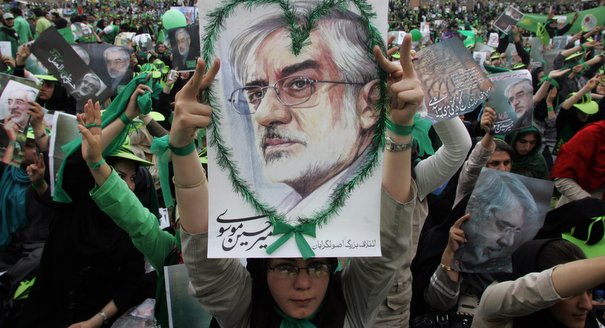
Following the surprise announcement that President Ahmadinejad had won outright the first round of Iran’s presidential election, Karim Sadjadpour explained the implications for the Obama administration’s diplomatic initiative with Iran and the domestic reaction.

Key points:

  • The United States should wait until the election has played out domestically before commenting on or reaching out to the Iranian government.
     
  • Ahmadinejad’s victory could pose an insurmountable challenge to the Obama administration’s engagement strategy, but Iran remains integral to critical challenges including Afghanistan, the Arab–Israeli conflict, terrorism, and energy security. Once the dust settles the United States will eventually have no choice but to talk to Tehran, but it will likely be a cold, hard-nosed dialogue rather than friendly greetings.
     
  • Despite being the true source of power, Supreme Leader Ayatollah Khamenei is rarely held accountable for Iran’s economic malaise or political isolation, given the high profile of the Iranian president. The United States should announce publicly they wish to talk directly with Khamenei.
     
  • In the thirty years since the Islamic revolution, Iran’s political elite have never been so divided.
     
  • While dramatic, the current protests are not yet significant enough to pose an existential threat to the regime.

Sadjadpour said:

“In retrospect, it looks like the entire campaign was a show, in the sense that Ayatollah Khamanei was never going to let Ahmadinejad lose. Assuming these results are allowed to stand, I think we should be clear about what type of regime we are dealing with in Tehran. Just as we talk about Assad’s Syria and Mubarak’s Egypt, I think we are now dealing with Khamanei’s Iran.”

About the Author

Karim Sadjadpour

Senior Fellow, Middle East Program

Karim Sadjadpour is a senior fellow at the Carnegie Endowment for International Peace, where he focuses on Iran and U.S. foreign policy toward the Middle East.

    Recent Work

  • Q&A
    Iran Wanted to Survive the War. Now What?

      Suzanne Maloney, Aaron David Miller, Karim Sadjadpour
  • Q&A
    What’s Keeping the Iranian Regime in Power—for Now

      Aaron David Miller, Karim Sadjadpour, Robin Wright

Karim Sadjadpour
Senior Fellow, Middle East Program
Karim Sadjadpour

Additional Links

Full Text
North AmericaUnited StatesMiddle EastIranPolitical ReformForeign Policy

Carnegie does not take institutional positions on public policy issues; the views represented herein are those of the author(s) and do not necessarily reflect the views of Carnegie, its staff, or its trustees.

More Work from Carnegie Endowment for International Peace

  • Commentary
    Carnegie Politika
    Russia Is Approaching a Political Crossroads

    Two divergent trends—Putin’s hardline vision of how to prosecute the war in Ukraine, and a growing desire for change in Russia—could tear the regime apart. 

      Tatiana Stanovaya

  • Commentary
    Carnegie Politika
    Control Above Reform: What’s Behind Ukraine’s Government and Security Reshuffle?

    Ultimately, Zelensky sided neither with the reform camp nor with the military establishment as such, but with political control.

      Balázs Jarábik

  • Trump and MBS walking through a doorway
    Commentary
    Emissary
    What We Know About the U.S.-Saudi Nuclear Deal

    Despite the agreement’s uncertainty, it’s still a significant development in regional and nuclear policy.

      • Andrew Leber
      • Jane Darby Menton

      Andrew Leber, Jane Darby Menton

  • Trump and Xi standing next to each other
    Commentary
    Emissary
    A Path Forward on AI Safety for the United States and China

    “AI safety in parallel” is modest and pragmatic but vital.

      Matt Sheehan

  • Commentary
    Strategic Europe
    Why Europe Must Take Charge of its Russia Diplomacy Now

    Trump is distracted and Ukraine wants Europe to step up. The continent’s leaders must find their voice and assert it in talks with Russia.

      Alissa de Carbonnel

Get more news and analysis from
Carnegie Endowment for International Peace
Carnegie global logo, stacked
1779 Massachusetts Avenue NWWashington, DC, 20036-2103Phone: 202 483 7600
  • Research
  • Emissary
  • About
  • Experts
  • Donate
  • Programs
  • Events
  • Blogs
  • Podcasts
  • Contact
  • Annual Reports
  • Careers
  • Privacy
  • For Media
  • Government Resources
Get more news and analysis from
Carnegie Endowment for International Peace
© 2026 Carnegie Endowment for International Peace. All rights reserved.