• Research
  • Emissary
  • About
  • Experts
Carnegie Global logoCarnegie lettermark logo
DemocracyIran
  • Donate
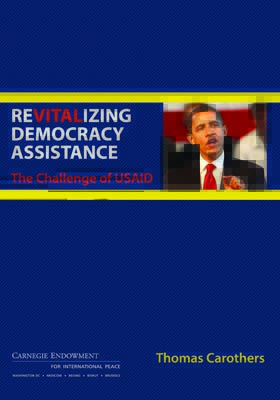
Revitalizing Democracy Assistance: The Challenge of USAID
Report

Revitalizing Democracy Assistance: The Challenge of USAID

USAID—the largest source of U.S. democracy assistance—requires deep-reaching reforms if the Obama administration hopes to adequately address challenges to democracy around the world.

Link Copied
By Thomas Carothers
Published on Oct 27, 2009

Additional Links

Full TextSummary
Program mobile hero image

Program

Democracy, Conflict, and Governance

The Democracy, Conflict, and Governance Program is a leading source of independent policy research, writing, and outreach on global democracy, conflict, and governance. It analyzes and seeks to improve international efforts to reduce democratic backsliding, mitigate conflict and violence, overcome political polarization, promote gender equality, and advance pro-democratic uses of new technologies.

Learn More

Democracy is largely stagnant in the world and a growing number of governments exhibit hostility toward international democracy aid. Faced with this daunting context, President Obama and his foreign policy team have so far moved only cautiously to formulate an approach to democracy promotion. Tackling longstanding problems with the basic structures of U.S. democracy aid would boost this effort. As the largest source of such assistance, USAID is an obvious starting point for deep-reaching reforms.

Key Conclusions

  • With the Obama administration having launched major reviews of development policy, a critical juncture exists for substantial reforms of USAID and other key actors in U.S. democracy assistance, a domain that now consists of $2.5 billion a year of aid programs in more than 80 countries.
     
  • Although USAID has a long record of positive contributions to numerous democratic transitions, its accumulated institutional woes lead to democracy aid efforts that fall short due to lack of flexibility, stifled innovation, and lack of institutional commitment.
     
  • Fixing USAID’s shortcomings will require determined, focused leadership at USAID, with active support from Congress and the Obama administration. As Congress and the administration take up the larger overhaul of U.S. development policy generally, they should not neglect the domain of democracy and governance support. 


Recommendations

  • Fight bureaucratization: The crushing bureaucratization of USAID’s democracy and governance work must be reversed through a comprehensive series of reforms that simplify the procurement process, eliminate duplicative layers of oversight, reduce reporting requirements, and improve the evaluation process.
     
  • Bolster local ownership: USAID should build more flexible funding arrangements with its implementing partners that encourage genuine partnerships with local groups and increase direct funding to local organizations. 
     
  • Strengthen the place of democracy and governance work within USAID: Ensure that democracy and governance is fully supported as an institutional priority and is well-integrated into other areas of foreign assistance, through clear leadership commitment at the top and numerous steps at other levels, such as strengthening the Office of Democracy and Governance and following through on new training commitments. 


“A successful revitalization of USAID’s democracy and governance work would be a telling signal that the Obama administration is forging significant institutional changes that will help the United States meet the serious challenges that democracy’s uncertain global fortunes now pose.”

About the Author

Thomas Carothers

Harvey V. Fineberg Chair for Democracy Studies; Director, Democracy, Conflict, and Governance Program

Thomas Carothers, director of the Carnegie Endowment for International Peace’s Democracy, Conflict, and Governance Program, is a leading expert on comparative democratization and international support for democracy.

    Recent Work

  • Commentary
    When Do Mass Protests Topple Autocrats?
      • McKenzie Carrier

      Thomas Carothers, McKenzie Carrier

  • Article
    The Trump Administration’s Tangled Talk About Democracy Abroad
      • McKenzie Carrier

      Thomas Carothers, McKenzie Carrier

Thomas Carothers
Harvey V. Fineberg Chair for Democracy Studies; Director, Democracy, Conflict, and Governance Program
Thomas Carothers
North AmericaUnited StatesPolitical ReformDemocracyForeign Policy

Carnegie does not take institutional positions on public policy issues; the views represented herein are those of the author(s) and do not necessarily reflect the views of Carnegie, its staff, or its trustees.

More Work from Carnegie Endowment for International Peace

  • India and a Changing Global Order: Foreign Policy in the Trump 2.0 Era
    Research
    India and a Changing Global Order: Foreign Policy in the Trump 2.0 Era

    Trump 2.0 has unsettled India’s external environment—but has not overturned its foreign policy strategy, which continues to rely on diversification, hedging, and calibrated partnerships across a fractured order.

      • Sameer Lalwani
      • +6

      Milan Vaishnav, ed., Sameer Lalwani, Tanvi Madan, …

  • Commentary
    Carnegie Politika
    Lukashenko’s Bromance With Trump Has a Sell-By Date

    Lukashenko is willing to make big sacrifices for an invitation to Mar-a-Lago or the White House. He also knows that the clock is ticking: he must squeeze as much out of the Trump administration as he can before congressional elections in November leave Trump hamstrung or distracted.

      Artyom Shraibman

  • Indian Prime Minister Narendra Modi, wearing an orange cap, and the Chief Minister of Uttar Pradesh, Yogi Adityanath, dressed in saffron robes, are greeting supporters of the Bharatiya Janata Party (BJP) during a roadshow ahead of the Indian General Elections in Ghaziabad, Uttar Pradesh, India, on April 6, 2024.Trump raises hands behind a lecternCarney speaking on stage
    Collection
    The Middle Power Moment?

    The world has entered an era of upheaval—a period of heightened geopolitical rivalry, deepening political polarization, quickening technological change, glaring economic inequality, accelerating environmental crises, and eroding respect for international law. This moment of disruption and fluidity is also one of opportunity, however. It provides openings for middle powers, both established and emerging, to exercise unaccustomed agency and influence the future of global order.

    Carnegie scholars are analyzing middle power responses to this moment of upheaval and assessing whether—and under what conditions—these states can contribute to practical problem solving. They are asking critical, concrete questions: What countries, precisely, are we talking about when we refer to middle powers? In what issue areas do their priorities converge and diverge, including across North-South divides? In what domains can middle powers pack a punch, rather than produce a whimper? Are they willing to shoulder actual burdens and responsibility? Finally, how can middle powers assert themselves globally, without running afoul of or threatening their relations with the United States or China?

  • Mullin with his hand raised, taking an oath
    Commentary
    Emissary
    Can Mullin Revive FEMA?

    Restoring competence and trust to the anemic, neglected disaster recovery agency is a matter of national security.

      • Sarah Labowitz
      • Debbra Goh

      Sarah Labowitz, Debbra Goh

  • Worker pushing machinery toward a car frame
    Commentary
    Emissary
    Europe’s New Industrial Policy Can Learn From U.S. Mistakes

    Although the IAA often differs from the IRA, European policymakers can still take note of the U.S. act’s shortcomings.

      Milo McBride

Get more news and analysis from
Carnegie Endowment for International Peace
Carnegie global logo, stacked
1779 Massachusetts Avenue NWWashington, DC, 20036-2103Phone: 202 483 7600Fax: 202 483 1840
  • Research
  • Emissary
  • About
  • Experts
  • Donate
  • Programs
  • Events
  • Blogs
  • Podcasts
  • Contact
  • Annual Reports
  • Careers
  • Privacy
  • For Media
  • Government Resources
Get more news and analysis from
Carnegie Endowment for International Peace
© 2026 Carnegie Endowment for International Peace. All rights reserved.