• Research
  • Emissary
  • About
  • Experts
Carnegie Global logoCarnegie lettermark logo
DemocracyIran
  • Donate
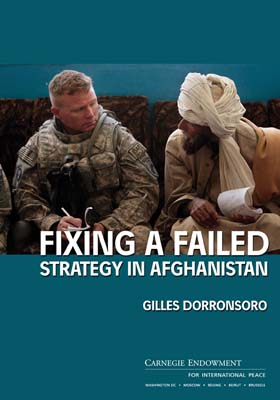
Fixing a Failed Strategy in Afghanistan
Report

Fixing a Failed Strategy in Afghanistan

To correct a failing strategy in Afghanistan, the United States and its allies need to focus on protecting Afghan cities and reallocating more resources to the North.

Link Copied
By Gilles Dorronsoro
Published on Nov 16, 2009

Additional Links

SynopsisFull Text
Program mobile hero image

Program

South Asia

The South Asia Program informs policy debates relating to the region’s security, economy, and political development. From strategic competition in the Indo-Pacific to India’s internal dynamics and U.S. engagement with the region, the program offers in-depth, rigorous research and analysis on South Asia’s most critical challenges.

Learn More

As the debate on future U.S. strategy draws to a close, the war in Afghanistan is spreading to the North (an area that had previously been relatively quiet), the balance of power in Afghanistan has shifted in the Taliban’s favor, and the Afghan government continues to lose legitimacy in the eyes of the population and international community. In order to correct a failing strategy, the United States and its allies need to protect cities and reallocate more resources to the North. 

Gilles Dorronsoro explains that more troops alone will not fix a flawed approach and details what a new, successful U.S. strategy should look like: 

  • Secure key cities and roads: If a state can be rebuilt in Afghanistan it will start in the cities, so less energy should be focused on the Pashtun countryside. This approach will decrease Coalition casualties and increase local participation.
     
  • Redistribute Coalition troops: Troops are heavily deployed in the South and East where the prospects for success are low. They should be refocused on the North, where the Taliban can be stopped.
     
  • Redistribute development aid: Development dollars are currently being directed most heavily to areas where Coalition control is weakest. These scarce resources should instead be focused on the more peaceful districts of Afghanistan.
     
  • Build an Afghan partner: Increase the size and capabilities of the Afghan National Army, but understand that this will not happen overnight. An Afghan army of 150,000 by 2015 is a realistic and achievable goal.


“The Coalition badly needs a success in the next few months to counter the widely held perception that defeat is the likely outcome,” concludes Dorronsoro. “The current strategy could very well fail and result in yet another demand for reinforcements next year. A vigorous debate―more about strategy than resources―is needed.”

About the Author

Gilles Dorronsoro

Former Nonresident Scholar, South Asia Program

Dorronsoro’s research focuses on security and political development in Afghanistan. He was a professor of political science at the Sorbonne in Paris and the Institute of Political Studies of Rennes.

    Recent Work

  • Paper
    Waiting for the Taliban in Afghanistan

      Gilles Dorronsoro

  • Paper
    Afghanistan: The Impossible Transition

      Gilles Dorronsoro

Gilles Dorronsoro
Former Nonresident Scholar, South Asia Program
Gilles Dorronsoro
South AsiaAfghanistanSecurityMilitaryForeign Policy

Carnegie does not take institutional positions on public policy issues; the views represented herein are those of the author(s) and do not necessarily reflect the views of Carnegie, its staff, or its trustees.
More Work from Carnegie Endowment for International Peace

  • Commentary
    Carnegie Politika
    Multiple Wars Are Ruining Central Asia’s Efforts to Diversify Its Trade Routes

    This year’s wars have made alternative routes to transit through Russia no less risky for Central Asian countries.

      Galiya Ibragimova

  • Three people standing outside a fancy building
    Commentary
    Emissary
    The Latest Iran Deal Ignores the Lessons of the Past

    By burying disagreements in imprecision, the new deal risks same fate as its predecessors.

      James M. Acton

  • Man sitting in a chair reading a newspaper with Trump's face above the fold
    Commentary
    Emissary
    Iran Wanted to Survive the War. Now What?

    The United States and Israel may have unwittingly revived the Islamic Republic’s “zombie regime.”

      Suzanne Maloney, Aaron David Miller, Karim Sadjadpour

  • Aerial view of burned-out cars and homes
    Commentary
    Emissary
    The Overlooked Link Between Disaster Response at Home and U.S. Power Abroad

    Natural disasters are no longer local incidents but sources of systemic risk that threaten vital infrastructure and the economy—and public support for international engagement.

      Leonardo Martinez-Diaz

  • Commentary
    Strategic Europe
    Taking the Pulse: Is European Diplomacy on Iran Outdated?

    When the U.S.-Iran memorandum of understanding was announced, the UK, France, Germany, and Italy declared their readiness to help demine the Strait of Hormuz and lift nuclear sanctions on Tehran. But does Europe need new tools to recover a diplomatic role?

      • Rym Momtaz

      Rym Momtaz, ed.

Get more news and analysis from
Carnegie Endowment for International Peace
Carnegie global logo, stacked
1779 Massachusetts Avenue NWWashington, DC, 20036-2103Phone: 202 483 7600
  • Research
  • Emissary
  • About
  • Experts
  • Donate
  • Programs
  • Events
  • Blogs
  • Podcasts
  • Contact
  • Annual Reports
  • Careers
  • Privacy
  • For Media
  • Government Resources
Get more news and analysis from
Carnegie Endowment for International Peace
© 2026 Carnegie Endowment for International Peace. All rights reserved.