• Research
  • Emissary
  • About
  • Experts
Carnegie Global logoCarnegie lettermark logo
DemocracyIran
  • Donate
Toward Realistic U.S.–India Relations
Report

Toward Realistic U.S.–India Relations

Near-term expectations for a partnership between the United States and India too often overlook how the interests, policies, and diplomatic style of the two countries sometimes diverge.

Link Copied
By George Perkovich
Published on Oct 25, 2010

Additional Links

Full Text
Program mobile hero image

Program

South Asia

The South Asia Program informs policy debates relating to the region’s security, economy, and political development. From strategic competition in the Indo-Pacific to India’s internal dynamics and U.S. engagement with the region, the program offers in-depth, rigorous research and analysis on South Asia’s most critical challenges.

Learn More

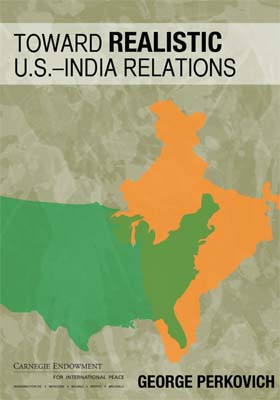
As President Obama prepares to visit India next month, he faces criticism that his administration has done too little to enhance U.S.-India relations. George Perkovich argues that expectations for a partnership between the two countries in the near term are unrealistically high and overlook how their interests, policies, and diplomatic style will often diverge. U.S. policy cannot do much to help India’s rise, but it can inflict major damage on global problem-solving efforts if it defers too readily to the narrow, often mercantile demands of the current relationship. 

Key Conclusions

  • Interests are divergent. Careful analysis of U.S. and Indian interests does not show a close convergence in some key areas, and in cases such as China, Pakistan, and Afghanistan, they differ in how to pursue shared interests even when both states benefit from each other’s successes.
     
  • Democracy can divide. Shared democracy is said to make the United States and India “natural allies,” but domestic politics and economics often keep each state from adopting policies that would befit a partnership. 
     
  • Bilateral relations should not be used to contain China. Emphasizing military competition with China, as some do, is counterproductive. For the foreseeable future, the United States, India, and China will operate in a triangular relationship that mixes cooperation with competition and pressure and none will be close partners of the others. Economic development and effective governance are the keys to countering China’s rising strength. 
     
  • Nuclear energy cannot transform the relationship. The civil nuclear cooperation agreement between the two countries has not turned the relationship into a partnership, as envisioned. But it has undermined U.S. leadership credibility in trying to strengthen the global nonproliferation regime.
     
  • Global problem solving is the priority. The United States can contribute only marginally to India’s success or failure. Washington should focus on global issues—such as trade, nuclear security, peace in Asia, and climate change—that will also affect India’s longer-term interests.

“Rather than maintaining the pretense of partnership, a truly pro-India policy would acknowledge that India has different near-term needs and interests as a developing country than does the United States, even as it recognizes that each will benefit in the long run from the success of the other,” writes Perkovich. “Most of what the U.S. government can do for India lies in the broader global arena, and most of what India needs at home it must do for itself.”

 

About the Author

George Perkovich

Japan Chair for a World Without Nuclear Weapons, Senior Fellow

George Perkovich is the Japan Chair for a World Without Nuclear Weapons and a senior fellow in the Carnegie Endowment for International Peace’s Nuclear Policy Program. He works primarily on nuclear deterrence, nonproliferation, and disarmament issues, and is leading a study on nuclear signaling in the 21st century.

    Recent Work

  • Paper
    How to Assess Nuclear ‘Threats’ in the Twenty-First Century

      George Perkovich

  • Commentary
    “A House of Dynamite” Shows Why No Leader Should Have a Nuclear Trigger

      George Perkovich

George Perkovich
Japan Chair for a World Without Nuclear Weapons, Senior Fellow
George Perkovich
North AmericaUnited StatesSouth AsiaIndiaForeign PolicyNuclear PolicyNuclear Energy

Carnegie does not take institutional positions on public policy issues; the views represented herein are those of the author(s) and do not necessarily reflect the views of Carnegie, its staff, or its trustees.
More Work from Carnegie Endowment for International Peace

  • Article
    India–Africa Strategic Partnership: Challenges, Potential, and Possible Pathways

    A partnership between India, a country of subcontinental size, and Africa, a continent of fifty-four countries, may seem asymmetric until one notes that both are home to nearly the same number of people—1.4 billion. This essay spells out the existing challenges to the partnership, its optimal potential, and the possible pathways to realize it over the next quarter-century.

      Rajiv Bhatia

  • Commentary
    Diwan
    Pushing Beirut into an Armed Conflict With Hezbollah Is Insane

    The party’s domestic and regional roles have changed, so Lebanon should devise a disarmament strategy that encompasses this.

      Michael Young

  • Article
    Continental Asia and the Rise of Portfolio Politics

    “Central Asia” as an analytical category is itself part of the problem. The term is a Soviet administrative inheritance, drawn along lines that served the convenience of Moscow. The Central Asian states the Soviets named no longer see themselves through this category alone and are not aligning across political blocs but are instead building external partnerships sector by sector, assigning different partners to different functions.

      Jennifer B. Murtazashvili

  • Members of the National Democratic Alliance (NDA) attend a meeting along with Bhartiya Janta Party (BJP) President Amit Shah and Indian designated Prime Minister Narendra Modi (C) at the central hall of the parliament, in New Delhi on May 25, 2019.
    Paper
    Delimitation After Defeat: India’s Unfinished Debate Over Representation

    The battle over representation and regional power has been delayed—not resolved—and will shape the future of India’s federal balance.

      • Louise Tillin
      • Andy Robaina

      Louise Tillin, Milan Vaishnav, Andy Robaina

  • San Francisco Skyline
    Paper
    California’s Global Trade Cities: Driving Local and National Outcomes

    Cities across the United States facilitate investment in American communities. Yet, because global attention remains focused on U.S. trade policy, their distinctive and bold local approaches to international trade and investment promotion are often underappreciated.

      • Wyatt Frank
      • Marissa Jordan

      Wyatt Frank, Marissa Jordan

Get more news and analysis from
Carnegie Endowment for International Peace
Carnegie global logo, stacked
1779 Massachusetts Avenue NWWashington, DC, 20036-2103Phone: 202 483 7600
  • Research
  • Emissary
  • About
  • Experts
  • Donate
  • Programs
  • Events
  • Blogs
  • Podcasts
  • Contact
  • Annual Reports
  • Careers
  • Privacy
  • For Media
  • Government Resources
Get more news and analysis from
Carnegie Endowment for International Peace
© 2026 Carnegie Endowment for International Peace. All rights reserved.