

Commentary
Olga Shumylo-Tapiola
Source: Getty
After a long waiting period, Moldova’s political stalemate has ended and the country’s integration with Europe is once again pressing onward.
After a long waiting period, Moldova’s political stalemate is over and the country’s integration with Europe is once again pressing onward. On March 16, after a number of failed attempts, the parliament finally elected a president. And last week, the country started negotiations on a Deep and Comprehensive Free Trade Agreement (DCFTA) with the European Union. The EU’s sweetheart in the region, the current Moldovan government, now has no excuse to delay reforms. Yet a few challenges lie ahead, and the EU must reach out to support Moldova.
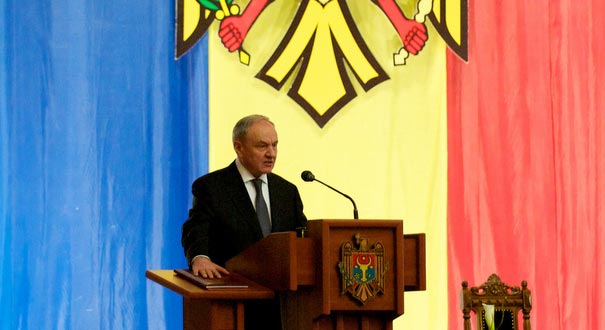
The first bit of good news, the election of Nicolae Timofti—the sixty-three-year-old head of Moldova’s Supreme Magistrate Council—as president of Moldova liberated the country from an almost three-year-long political deadlock. This gives the Alliance for European Integration, the coalition that has ruled Moldova since July 2009, a few more years to produce results before the next parliamentary elections, which are preliminarily scheduled for 2014. And that means more reforms and more Europeanization.
It also means no immediate return to power for the Communist Party—in opposition since the 2009 vote. The Communists are likely to organize demonstrations and try to stir up protests across the country. Yet, they are unlikely to be able to oust the current coalition and return to power before the next election.Another important positive step is the way in which the election was conducted. As one high-level EU official suggested, Moldova is clearly following a European path. And regardless of how long that path has been, during the presidential election the coalition “played by the rules and not with the rules.” The coalition did not simply buy the few missing votes, as some of Moldova’s eastern neighbors might have done.
That the new president comes from the judiciary is also positive—and unusual for the EU’s eastern neighborhood. Though many like to see the Moldovan judiciary as corrupt, Mr. Timofti seems to be an honorable man who is respected by many members of society. Even if his presidential powers are limited, he may serve as a “judge” and a reference point for the coalition.
Yet questions remain: How quickly will the alliance proceed with the painful reforms that are needed in almost all spheres of life in Moldova? Will it have enough votes to pass the necessary laws in parliament? Given that a number of political figures have left the Communist camp with more perhaps to follow, how long will that party survive? Will those who left, such as the group around former minister of trade and economics Igor Dodon, try to join the Alliance for European Integration? If so, how will this affect the alliance’s performance?
Those questions will persist as Moldova reacts to its second bit of good news—the beginning of talks on a DCFTA with the EU. That of course has come at a price—the country had to meet serious preconditions before the talks could begin. Moldova has worked hard and collaboratively, and as a result has progressed quickly in talks on the broader Association Agreement with the EU. What took Ukraine years to negotiate, Moldova accomplished in just about twelve months. That can also be explained by the overall pro-European mood at a high political level in Moldova.
The trade talks with Moldova promise to be easy as well—the country already enjoys autonomous trade preferences from the EU, which means unlimited and duty-free access to EU markets for all of Moldova’s products except agricultural goods. Thus for both sides the talks on trade tariffs should not be painful. Agriculture is the only potential sticking point. Additionally, Moldovan businesses are unlikely to pose a threat to negotiations when it comes to adoption of EU acquis, as there is little in the local economy that needs to be protected from EU businesses. Visiting Chisinau a few weeks ago, the EU trade commissioner, Karel De Gucht, suggested that the talks would be finalized by autumn 2013, a deadline welcomed by Moldovans.
Studies conducted by European and Moldovan independent experts show that a DCFTA will be good for the Moldovan economy. It will also help make the country more attractive to its breakaway region, Transnistria. According to the Moldovan government, the representatives of Transnistria are invited as observers to the talks with the EU—a good confidence-building measure. But the Moldovan government should be encouraged to go even further and work with Transnistria to develop a joint position in these talks.
The EU, though, should keep two potential, distant challenges in mind: Russia and Ukraine. Moscow does not seem to be interested in Chisinau today. As one Russian policymaker put it recently, Moldova’s situation is a done deal, as the country is definitely headed toward the EU. Thus Russia does not express much interest in Chisinau joining its Customs Union or further integration projects.
However, the closer the end of the talks gets, the greater the chance that the rhetoric may change. And that rhetoric shift will be more likely if Transnistria participates in the talks with the EU. The breakaway region, which is currently home to a Russian peacekeeping force, may be used as a trump card by Moscow. Negative statements are likely to follow from the newly appointed Russian envoy to Transnistria.
The second potential “troublemaker” or “deal breaker,” Ukraine, may also appear on the scene by autumn 2013. Officially, Kyiv may find it difficult to maintain positive relations with Chisinau if the EU-Ukraine Association Agreement and DCFTA remain stalled while similar EU-Moldova agreements are finalized and signed. An important player in “5+2” talks on Transnistria today, Ukraine may become rather uncooperative with Brussels and Chisinau because of simple pride. The only way to stop this scenario from happening would perhaps be to appeal to Ukraine’s chairmanship in the Organization for Security and Cooperation in Europe that will take place in 2013.
The European Union must remain present in Moldova and pressure the alliance to move forward with reforms. At the same time, it should also give a supporting hand when it comes to dealing with Moscow or Kyiv.

Former Nonresident Associate, Carnegie Europe
Shumylo-Tapiola is a nonresident associate at Carnegie Europe in Brussels, where her research focuses on Eastern Europe and Eurasia.
Recent Work
Olga Shumylo-Tapiola
Olga Shumylo-Tapiola
Carnegie does not take institutional positions on public policy issues; the views represented herein are those of the author(s) and do not necessarily reflect the views of Carnegie, its staff, or its trustees.
The acknowledgment has sparked fears of a new arms race with China and Russia.

Chris O’Meara

The European Commissioner for Trade is headed to China. But after President Xi’s bridge-building visit to Washington, can a more isolated EU overcome Beijing’s stranglehold on critical raw materials? Who will blink first?

Rym Momtaz, ed.

European NATO countries are wrestling with the possibility of U.S. disengagement from the alliance. With the continent’s security increasingly uncertain, governments must restore the credibility of their collective defense.



Hans-Dieter Lucas, Adam Thomson, Pierre Vimont

Cargo traffic through Russia’s Northern Sea Route has increased because of the disruption caused by the conflict in the Middle East, the Ukraine war, and U.S.-China tensions.

Mikhail Korostikov
An analysis of traffic accident data suggests that Ukrainian drone attacks caused a material but not disastrous fall in Russian gasoline consumption over the summer.

Sergey Vakulenko