

Paper
Douglas H. Paal
Source: Getty
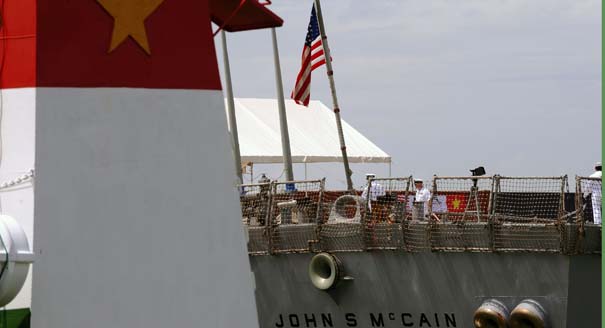
Washington needs to protect its position of impartiality in the South China Sea and avoid singling out Chinese behavior for criticism.
The rhetoric is growing hotter among China, most of its Southeast Asian neighbors, and the United States. Last week, the State Department took the unusual step of issuing a press statement that singled out Chinese behavior for criticism in creating a new administrative district covering most of the disputed islets in the South China Sea. Beijing’s media outlets have been responding with invective that is stoking already high emotions in the Chinese public. The issue of managing tensions and territorial claims that are inherently difficult to resolve has become more difficult, not less.
It was not apparently intended in Washington for the situation to deteriorate in this fashion. In 2010, Secretary of State Hillary Clinton spoke out against unilateral actions in the South China Sea and for the development of an effective code of conduct to govern rivals’ activities in the area. This was widely understood to be a needed shove in China’s direction to quit stalling on agreeing to the code of conduct and to restrain the aggressive actions of its fishermen and oil drillers. It was accompanied by American professions of disinterest in the specific territorial disputes, but insistence on freedom of navigation in the heavily trafficked waters and peaceful resolution of the disputes under international law.
China did not like the American push then, at a time when Chinese diplomacy was scoring costly “own goals” in the East China Sea and on the Korean Peninsula as well. But by the end of 2010, China was trying harder to get along with its neighbors and Clinton’s warning seemed to have done well. More recently, National Security Advisor Thomas Donilon made a trip to Beijing (and Tokyo) two weeks ago that was well received by Beijing’s highest leaders and seemed to put discussion of thorny issues on a high-policy plane. Coming right after his visit, the State Department statement must have arrived as a shock in Beijing.The South China Sea presents complicated issues of evolving international law, historic but ill-defined claims, a rush to grab declining fish stocks, and competition to tap oil and gas reserves. Beijing’s much discussed “nine-dashed line,” that purports to give China a claim on about 80 percent of the South China Sea and its territories, used to be an eleven-dashed line. Two dashes separating Chinese and Vietnamese claims were resolved through bilateral negotiations years ago. This suggests that the remaining nine dashes are equally negotiable. But China rigidly refuses to clarify the basis for its claims, whether they are based on the accepted international law of the United Nations Convention on the Law of the Sea (UNCLOS) or the less widely accepted historical assertions. Beijing’s refusal to choose suggests it wants to maximize its legal and political leverage, even as the growth of its military and maritime assets gains physical leverage over its weaker neighbors.
Beijing is not alone. Hanoi has leased oil exploration blocks in contested waters, and Manila is trying the same. Their colonial occupations left a discontinuous record of historic claims, inclining them to rely more on UNCLOS to manage disputed resources. They eagerly encourage American weight thrown onto their side of the competition with China for free.
This is where the United States needs to move with caution and only after thinking many steps ahead. The overriding strategic objective of the United States in Asia is to manage China’s rise—which appears inevitable—in ways that do not diminish vital American interests in the region. Navigating the transition period peacefully requires strength and consistency as well as the recognition of changing realities. Severe tests of the Sino-American relationship are to be expected as the United States works to persuade China to accept the existing international rules and principles that have brought prolonged peace, stability, and prosperity to the participants, especially China.
China’s immediate neighbors are by definition weaker than the much larger People’s Republic. Beijing’s temptations to exploit that differential in power need to be resisted with policies that reward positive behavior and raise the cost of negative behavior.
It was likely such a calculus that led to last week’s State Department warning to Beijing. Many in Washington resented China’s strong-arm tactics at the recent ASEAN Regional Forum meeting that prevented the issuance of a communiqué from the annual gathering for the first time in forty-five years, explicitly due to disputes about the South China Sea. Moreover, China has increased its naval deployments and added to its various civilian fleets operating in the sea. China’s announcement of the creation of Sansha municipality and its sister military garrison in the disputed area seemed to push Washington’s patience past its limits. One can imagine U.S. officials arguing that aggressive People’s Liberation Army officers and other Chinese nationalists need to be taught that their policies are counterproductive.
The test for such an initiative by the United States is whether it is effective in reaching its main strategic goal. Judging from the outrage coming from China at being singled out, after Vietnam and the Philippines had taken steps without being criticized to secure resources in the contested sea before China’s own actions, the U.S. statement seems to be backfiring.
Just weeks before the recent upswing in tensions, the Obama administration had successfully hosted a visit by Philippines President Benigno S. Aquino III that Manila had hoped would bring Washington more closely in line behind Philippine claims. Obama gently let Aquino know that Washington’s support for the alliance is strong and growing, but that South China Sea claims are for Manila to handle alone or together with the other claimants. The United States will provide support for principled negotiations and a peaceful resolution, but not specific outcomes.
Now, by singling Beijing out for criticism, but not the others, Chinese observers believe the United States has taken sides against China. This has undermined the U.S. assertions of a principled approach based on international law by appearing not to be impartial.
U.S. direct interests in the South China Sea are not unlimited. The United States has no territorial claims on the minuscule land features there. American firms and citizens are not now at risk. Freedom of navigation is paramount, and China has a minority view under UNCLOS of what constitutes legitimate activity by naval vessels in its exclusive economic zones, which it claims for most of the South China Sea. There is a constant risk of American intelligence collection activity crashing into China’s insistence on the right to deny such activity. So far, this potential source of friction is being managed through political leadership by both sides, in the interest of preventing serious incidents and a deterioration of the overall U.S.-China relationship.
In view of the potential disruptive effects brought about by China’s rise and its neighbors’ responses, the United States has a further interest in a peaceful settlement. Moreover, reinforcement of the rule of international law is in America’s interest in reducing the cost of maintaining stability and managing change going forward.
Today, the South China Sea is not at the “Sudetenland” moment of the twenty-first century, which calls for standing up to aggression and the rejection of appeasement. China has not militarized its foreign policy and does not appear equipped to do so for a long time. Its neighbors are not supine, and they show on occasion, when needed, that they are able to coalesce against Chinese actions that they judge as going too far. At the same time, China and those neighbors have more going constructively in trade, investment, and other relations with each other than is at risk in this dispute.
This suggests the makings of a manageable situation, even if it remains impossible to resolve for years to come. Different Asian societies are quite accustomed to living with unresolved disputes, often for centuries.
In light of this reality, the United States would do well to adhere to principled positions it has already articulated, and stand for a process that is fair to all disputants and those who will be affected at the margins. To do that, Washington will need to protect its position of impartiality and avoid repetition of the misconceived State Department press statement.

Distinguished Fellow, Asia Program
Paal previously served as vice chairman of JPMorgan Chase International and as unofficial U.S. representative to Taiwan as director of the American Institute in Taiwan.
Recent Work
Douglas H. Paal


Douglas H. Paal, Tong Zhao, Chen Qi, …
Carnegie does not take institutional positions on public policy issues; the views represented herein are those of the author(s) and do not necessarily reflect the views of Carnegie, its staff, or its trustees.

Are Germany’s economic, industrial, and political struggles becoming a liability for the EU’s ability to rise to the geopolitical moment?

Rym Momtaz, ed.

China’s police training infrastructure construction projects provide benefits to recipient countries, promote China’s image as a major global security provider, and are likely to reinforce alignment between Beijing’s security priorities and those of countries in the Global South.


Cameron Waltz, Sheena Chestnut Greitens, Kim Nguyen, …

AI capabilities are moving fast. Most institutions—including governments—can’t keep up.


Anton Leicht, Scott Singer

The Bureau of Industry and Security needs to adjust its focus and practices to maintain its position as the U.S. government’s primary champion of international technological competition.

Geoffrey Irving
They face an uphill climb, but they could draw on a strategy that other diplomats have used in the past.


Shana Tabak, Alejandro Martin Rodriguez