• Research
  • Emissary
  • About
  • Experts
Carnegie Global logoCarnegie lettermark logo
DemocracyIran
  • Donate
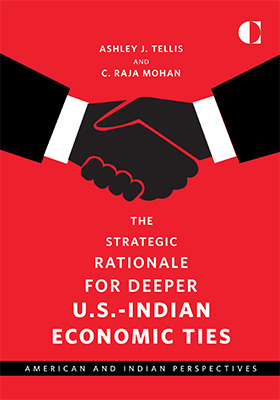
The Strategic Rationale for Deeper U.S.-Indian Economic Ties
Report

The Strategic Rationale for Deeper U.S.-Indian Economic Ties

The U.S.-India relationship was often distant during the Cold War, but the partnership is now critical for both countries’ strategic aims.

Link Copied
By Ashley J. Tellis and C. Raja Mohan
Published on Aug 7, 2015

Additional Links

Full TextBrief
Program mobile hero image

Program

South Asia

The South Asia Program informs policy debates relating to the region’s security, economy, and political development. From strategic competition in the Indo-Pacific to India’s internal dynamics and U.S. engagement with the region, the program offers in-depth, rigorous research and analysis on South Asia’s most critical challenges.

Learn More

The U.S.-India relationship was often distant during the Cold War, but the partnership is now critical for both countries’ strategic aims. India is important to the U.S. effort to maintain its international primacy, while the United States is essential to India’s attainment of its great power ambitions. Deepened economic intercourse, including one day through a comprehensive U.S.-Indian free-trade agreement, is vital to realizing both countries’ aspirations.

The Case for Deeper Economic Cooperation

  • The United States has consistently pursued a policy of securing hegemony, yet China now threatens the economic and geopolitical underpinnings of U.S. power.
     
  • India, since the British Raj, has harbored aspirations for great power status and regional hegemony alongside ideals of liberal internationalism.
     
  • Through stronger bilateral economic ties, American resources could enhance India’s productivity, expand its technological frontier, and spur further economic liberalization. Meanwhile, the United States would gain access to India’s lower-cost exports, relatively cheap labor, and vast domestic market, increasing America’s international competitiveness.
     
  • Increased U.S. competitiveness internationally would reinforce Washington’s global primacy, permitting it to effectively balance China’s rising power. The economic benefits accruing to India from deeper economic links with the United States would advance Indian national development, regional hegemony, and international prominence.

How the United States and India Can Promote Economic Cooperation

  • The United States must be willing to walk difficult roads to enhance economic cooperation with India, given that such integration is essential to its regional and international interests. While domestic U.S. constituencies have become wary of Indian economic practices and free-trade agreements more generally, they must be outweighed by larger considerations of revitalizing economic growth bilaterally and preserving U.S. global hegemony.
     
  • India must understand that sustained economic growth hinges on expanding its global trading links, and that its prior policies of trade expansion through shallow free-trade agreements are no longer viable. Partnership with the West, particularly the United States, is critical to achieving India’s twin aspirations for national development and regional primacy. India’s existing tactic of buying time and space for domestic development without making commitments to genuine trade liberalization is counterproductive for these aims.
     
  • A step-by-step approach to deepening bilateral trade and investment to make a free-trade agreement possible at some point in the future may be the most effective way to advance each country’s specific geopolitical interests. Such an approach would incrementally tackle challenges to a comprehensive agreement, and it would best serve India’s development aspirations and buttress the United States’ international preeminence.
Read Full Text

About the Authors

Ashley J. Tellis

Former Senior Fellow

Ashley J. Tellis was a senior fellow at the Carnegie Endowment for International Peace.

C. Raja Mohan

Former Nonresident Senior Fellow, Carnegie India

A leading analyst of India’s foreign policy, Mohan is also an expert on South Asian security, great-power relations in Asia, and arms control.

Authors

Ashley J. Tellis
Former Senior Fellow
C. Raja Mohan
Former Nonresident Senior Fellow, Carnegie India
North AmericaUnited StatesSouth AsiaIndiaEconomyForeign Policy

Carnegie does not take institutional positions on public policy issues; the views represented herein are those of the author(s) and do not necessarily reflect the views of Carnegie, its staff, or its trustees.

More Work from Carnegie Endowment for International Peace

  • Trump seated and gesturing while speaking
    Commentary
    Emissary
    The Iran War Is Making America Less Safe

    A conflict launched in the name of American security is producing the opposite effect.

      • Sarah Yerkes

      Sarah Yerkes

  • illustration of AI chat bubbles
    Commentary
    California Sees Ways AI Can Support Policymaking. Here’s What It Needs to Succeed.

    For AI to capture the public’s policy concerns, people need to know that the models are elevating human concerns in human words, not generating their own.

      • Micah Weinberg headshot

      Micah Weinberg

  • Commentary
    Strategic Europe
    Taking the Pulse: Is it NATO’s Job to Support Trump’s War of Choice?

    Donald Trump has demanded that European allies send ships to the Strait of Hormuz while his war of choice in Iran rages on. He has constantly berated NATO while the alliance’s secretary-general has emphatically supported him.

      • Rym Momtaz

      Rym Momtaz, ed.

  • A white humanoid robot with a black head and hips stands behind a rope barrier. It stands with its feet apart, knees bent, and elbows raised at its sides.
    Commentary
    Europe Is Falling Behind in General-Purpose Robotics. Here’s What It Can Do to Catch Up.

    The continent needs to improve conditions for production of complete AI robotic systems and preserve its edge in hardware.

      Pavlo Zvenyhorodskyi

  • India and a Changing Global Order: Foreign Policy in the Trump 2.0 Era
    Research
    India and a Changing Global Order: Foreign Policy in the Trump 2.0 Era

    Trump 2.0 has unsettled India’s external environment—but has not overturned its foreign policy strategy, which continues to rely on diversification, hedging, and calibrated partnerships across a fractured order.

      • Sameer Lalwani
      • +6

      Milan Vaishnav, ed., Sameer Lalwani, Tanvi Madan, …

Get more news and analysis from
Carnegie Endowment for International Peace
Carnegie global logo, stacked
1779 Massachusetts Avenue NWWashington, DC, 20036-2103Phone: 202 483 7600Fax: 202 483 1840
  • Research
  • Emissary
  • About
  • Experts
  • Donate
  • Programs
  • Events
  • Blogs
  • Podcasts
  • Contact
  • Annual Reports
  • Careers
  • Privacy
  • For Media
  • Government Resources
Get more news and analysis from
Carnegie Endowment for International Peace
© 2026 Carnegie Endowment for International Peace. All rights reserved.