

Paper
While there are notable demographic, economic, and geographic divides over AI, there is also substantial alignment between Republicans and Democrats.
- +2
Ian Klaus, Mark Baldassare, Rachel George, …
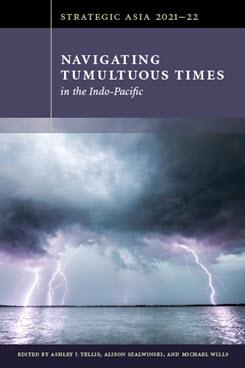
An assessment of the impact of three major trends on the geopolitical environment of the Indo-Pacific region: intensifying strategic competition between China and the United States, growing pushback against globalization, and the Covid-19 pandemic.
Source: National Bureau of Asian Research
Strategic Asia 2021–22: Navigating Tumultuous Times in the Indo-Pacific assesses the impact of three major trends on the geopolitical environment of the Indo-Pacific region: intensifying strategic competition between China and the United States, growing pushback against globalization, and the Covid-19 pandemic. Each chapter examines how these challenges shape the security environment, grand strategy, and national and economic power for a country or in a region and analyzes the implications for U.S. interests.
Read the introduction by Ashley J. Tellis for free or order this book.
Ashley J. Tellis holds the Tata Chair for Strategic Affairs and is a senior fellow at the Carnegie Endowment for International Peace and Research Director of the Strategic Asia Program at the National Bureau of Asian Research (NBR).
Alison Szalwinski is vice president of research at NBR.
Michael Wills is executive vice president at NBR.
Former Senior Fellow
Ashley J. Tellis was a senior fellow at the Carnegie Endowment for International Peace.
Alison Szalwinski
National Bureau of Asian Research
Alison Szalwinski is assistant director for political and security affairs at NBR.
Michael Wills
National Bureau of Asian Research
Michael Wills is senior vice president for strategy and finance at NBR.
Carnegie does not take institutional positions on public policy issues; the views represented herein are those of the author(s) and do not necessarily reflect the views of Carnegie, its staff, or its trustees.

While there are notable demographic, economic, and geographic divides over AI, there is also substantial alignment between Republicans and Democrats.



Ian Klaus, Mark Baldassare, Rachel George, …

Are Germany’s economic, industrial, and political struggles becoming a liability for the EU’s ability to rise to the geopolitical moment?

Rym Momtaz, ed.

China’s police training infrastructure construction projects provide benefits to recipient countries, promote China’s image as a major global security provider, and are likely to reinforce alignment between Beijing’s security priorities and those of countries in the Global South.


Cameron Waltz, Sheena Chestnut Greitens, Kim Nguyen, …

AI capabilities are moving fast. Most institutions—including governments—can’t keep up.


Anton Leicht, Scott Singer

The Bureau of Industry and Security needs to adjust its focus and practices to maintain its position as the U.S. government’s primary champion of international technological competition.

Geoffrey Irving