

Article
Individual leaders and public attitudes—especially in democracies—matter for credibility.
Lauren Sukin, Samuel Seitz

Democratic backsliding happens under diverse circumstances, and because it evolves in different ways, pro-democratic coalitions and actors are presented with different challenges and means to resist or overcome democratic decay.
Rachel Beatty Riedl

Nonresident Scholar, Democracy, Conflict, and Governance Program
Jennifer McCoy is a nonresident scholar in the Democracy, Conflict, and Governance Program, where she focuses on political polarization and democratic resilience in the U.S. and around the world.
Kenneth Roberts
Murat Somer
Murat Somer is a professor of political science at Koç University in Istanbul and an expert on political polarization, religious and secular politics, ethnic conflict, autocratization, and democratization in Turkey and around the world.
Carnegie does not take institutional positions on public policy issues; the views represented herein are those of the author(s) and do not necessarily reflect the views of Carnegie, its staff, or its trustees.

Individual leaders and public attitudes—especially in democracies—matter for credibility.

Lauren Sukin, Samuel Seitz

The new Serbian leadership may have promised to keep on cooperating with Russia, but soon they will have to make a choice between fighting corruption and sealing lucrative deals with Moscow. The two are mutually exclusive, even if the new leaders in Belgrade haven’t yet realized it.
Maksim Samorukov
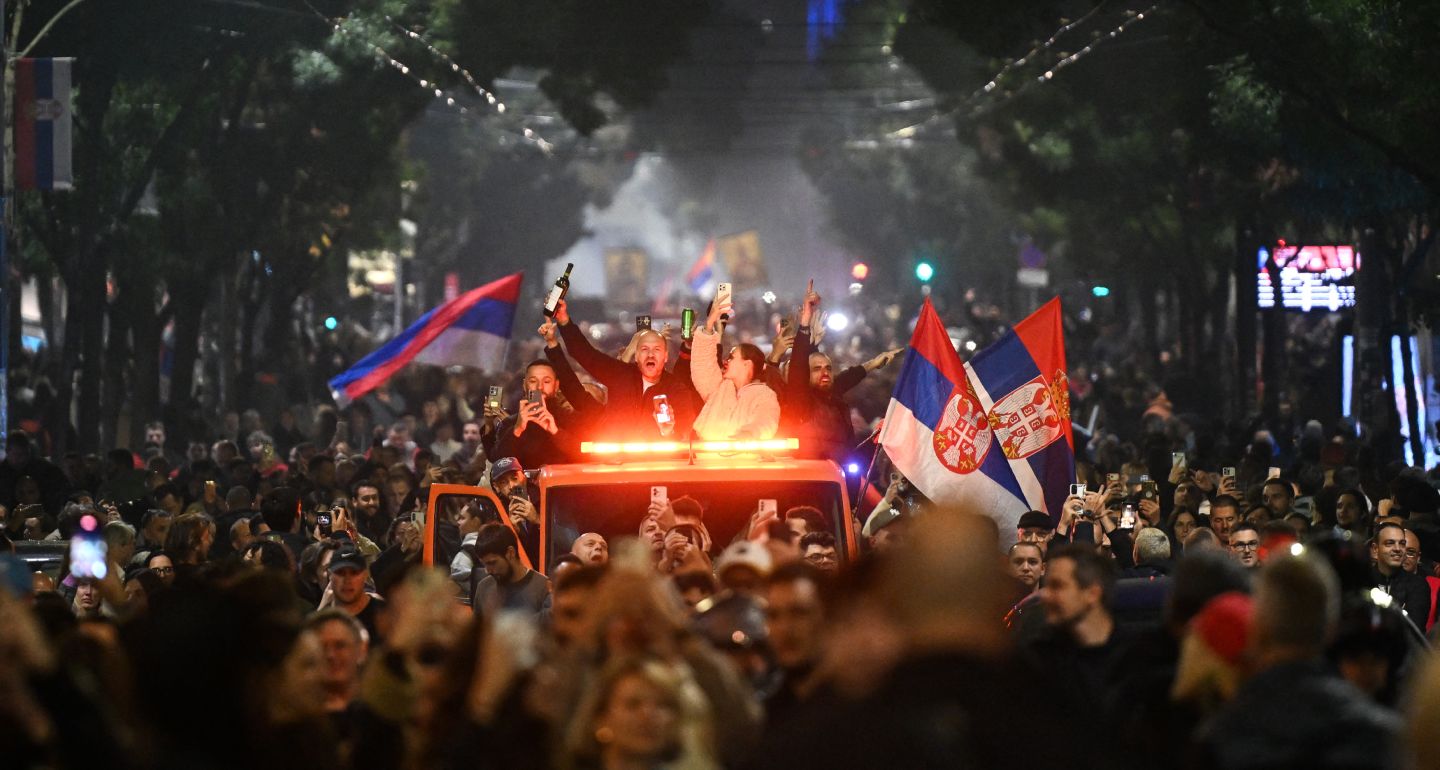
Serbia’s electoral earthquake is an extremely rare example of an entire political system being defeated by street protesters who played by the rules.
Alexander Baunov

The concept authored by Sergei Kiriyenko and his team can be considered not only an apologia for the Putin regime, but also a blueprint for Russia’s future configuration.
Andrey Pertsev

The illusion of reproducing the ideology would come at the cost of the continent’s prosperity.
Giovanna De Maio