

Commentary
Pavlo Zvenyhorodskyi
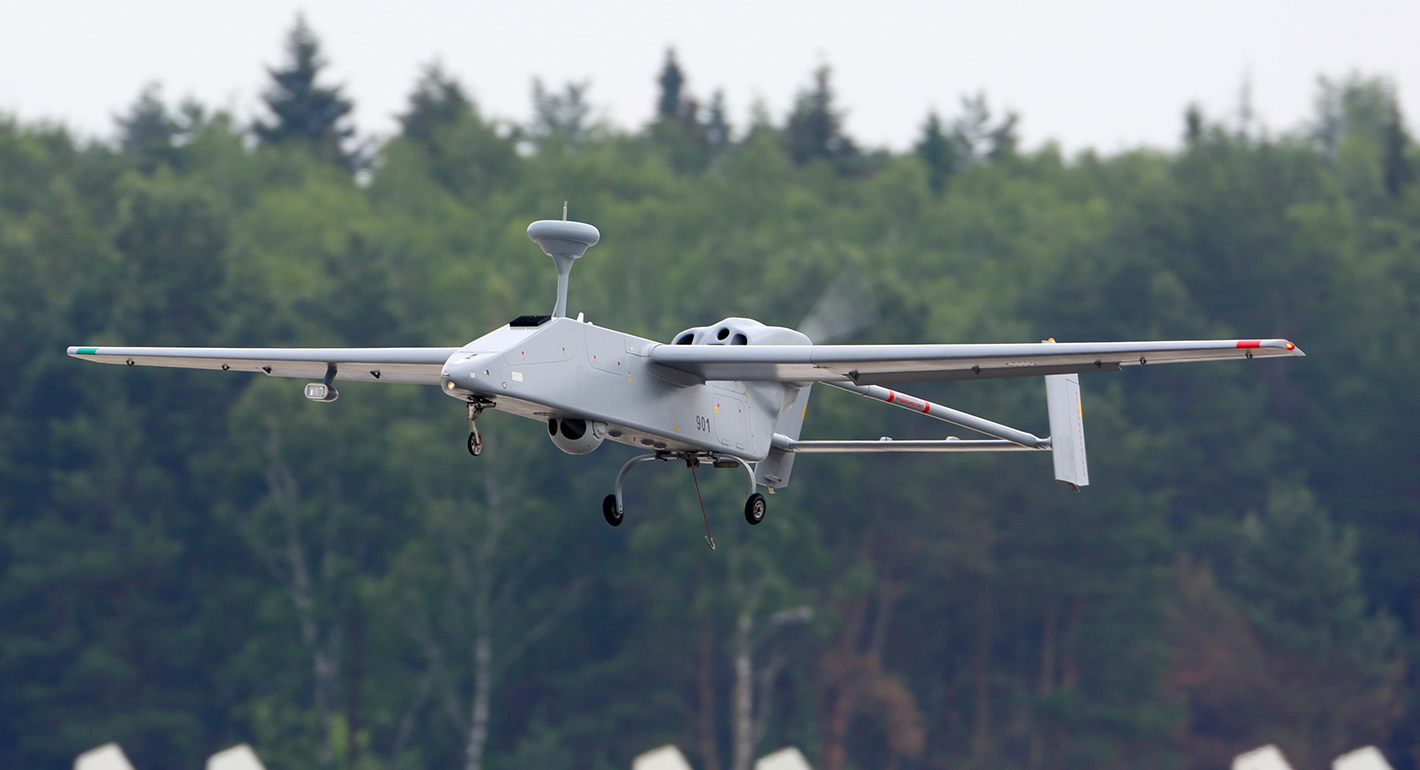
Source: Getty
Moscow is testing Europe’s defenses with drone incursions and could decide to use drones against the continent on a much larger scale once the war in Ukraine pauses. European countries will need Kyiv to help them prepare for such a possibility.
As Russian drone incursions into European airspace have intensified over the past two years—spreading from Eastern to Western Europe—they should not be viewed simply as spillovers from the war in Ukraine that will end once the fighting ceases.
At this stage, the Kremlin appears to be experimenting with the use of drones in North Atlantic Treaty Organization (NATO) airspace to test the institutional and technical readiness of the alliance’s European members to intercept drones, as well as the resilience of their publics to withstand the incursions.
If Moscow eventually concludes that European militaries and societies are ill-equipped to counter the incursions, it is likely to continue employing them against European NATO members even after a ceasefire in Ukraine is reached. It could use incursions in ways that blur the line between war and peace to pursue its broader coercive agenda across the continent—intimidating the population and seeking to shape public opinion in its favor. More worryingly, Moscow could decide that weak European anti-drone defenses would improve its odds of success in a direct military campaign against another European country, should it choose to pursue one.
European capitals must therefore build the technical, institutional, and societal resilience needed to counter the Russian drone threat. To be effective, these solutions must integrate Ukraine, whose geographic position and experience in countering large-scale Russian drone attacks make it an indispensable component of Europe’s future anti-drone defense architecture.
Sign up for the latest analysis and invitations to public events from the Carnegie Russia and Eurasia Program.
Since the beginning of Russia’s full-scale invasion of Ukraine in 2022, drones have gradually become one of the most important tools on the battlefield. Initially, both Ukraine and Russia employed commercially available quadcopters primarily for reconnaissance and artillery spotting. Over time, drones evolved into precision strike weapons capable of directly engaging enemy personnel and equipment.
Ukraine was an early innovator in this domain. Facing a larger and better-equipped adversary, the Ukrainian Armed Forces experimented with new ways of employing drones to gain an asymmetric advantage. These included deploying first-person view drones armed with explosives against enemy trenches.1 Such innovations helped Ukraine briefly achieve a technological edge on the battlefield in 2022.
Yet Russia quickly adapted to narrow the gap and expanded its drone capabilities.2 It increased production of one-way attack drones and later equipped many of them with fiber-optic cables to circumvent Ukrainian electronic warfare measures. These adaptations enabled Russian forces to improve the effectiveness of drone operations on the battlefield and contributed to gains along parts of the front line.
At the same time, Moscow recognized that drones could serve purposes far beyond the front line. It invested heavily in long-range strike systems, progressively upgrading its Iranian Shahed drones and producing the longer-range Geran-2, capable of flying up to 2,500 kilometers (approximately 1,500 miles).3 This new capability allowed Russia to strike targets deep inside Ukrainian territory at a fraction of the cost of cruise or ballistic missiles. By launching hundreds of long-range drones in coordinated waves, Moscow was able to project the war across the entirety of Ukraine.4 In addition to Ukrainian defense production facilities, it has deliberately targeted energy infrastructure, railways, and residential areas, aiming to degrade Ukraine’s resilience and coerce the population into pressuring the government to accept Russian terms—although so far without success.
The Kremlin was also eager to test these tools against another adversary: Ukraine’s European backers. Several years into the war, Moscow started directing long-range drones—mostly without payload—into the airspace of various European countries.
Several years into the war, Moscow started directing long-range drones—mostly without payload—into the airspace of various European countries.
In September 2025, around two dozen Russian drones crossed into Poland, forcing the temporary closure of four airports, including Warsaw Chopin Airport, and raising concerns among local communities about insufficient preparedness for this new threat.5 Even though some Western officials, such as NATO Secretary General Mark Rutte, took a cautious stance on whether the incursion was intentional,6 both the Polish government and the European Union (EU)—joined by ten other European countries—called it a deliberate violation of Polish airspace by Russia.7
In response, NATO launched Operation Eastern Sentry to patrol the airspace of its Eastern flank. However, because the operation relied mainly on fighter jets,8 it exposed the alliance’s stark lack of cost-effective drone interceptors to an already anxious European public. Moscow seemed all too happy to exploit this anxiety. In the following months, numerous drones were spotted in a dozen more European countries, including some of Ukraine’s strongest supporters, such as Germany.9 They flew over military bases, shipyards, and airports, causing significant disruptions in their operations. A July 2026 analysis of these incidents by the International Institute for Strategic Studies concluded that even though not all of the drones were directed by Russia, the overall pattern suggests that most of them were likely part of a deliberate campaign organized by Moscow.10
Most recently, Romania—Ukraine’s neighbor and another staunch supporter of Kyiv—has experienced an increased number of Russian drone incursions in its airspace. In May, a Russian Geran-2 drone hit a residential building in the border town of Galați,11 while in July, Romanian F-16 fighter jets shot down three drones, presumed to be Russian, over three consecutive days.12 While the intentionality of these incursions has not been proven yet and the drones could have been diverted off course by jamming, it is clear that Russian planners must have been aware of the risks involved. By sending drones to operate in such close proximity to the Romanian border, they knowingly accepted a significant probability that they could cross into NATO territory and cause damage there.
All this raises an important question: As Moscow experiments with the use of drones in NATO airspace, what is it hoping to achieve?
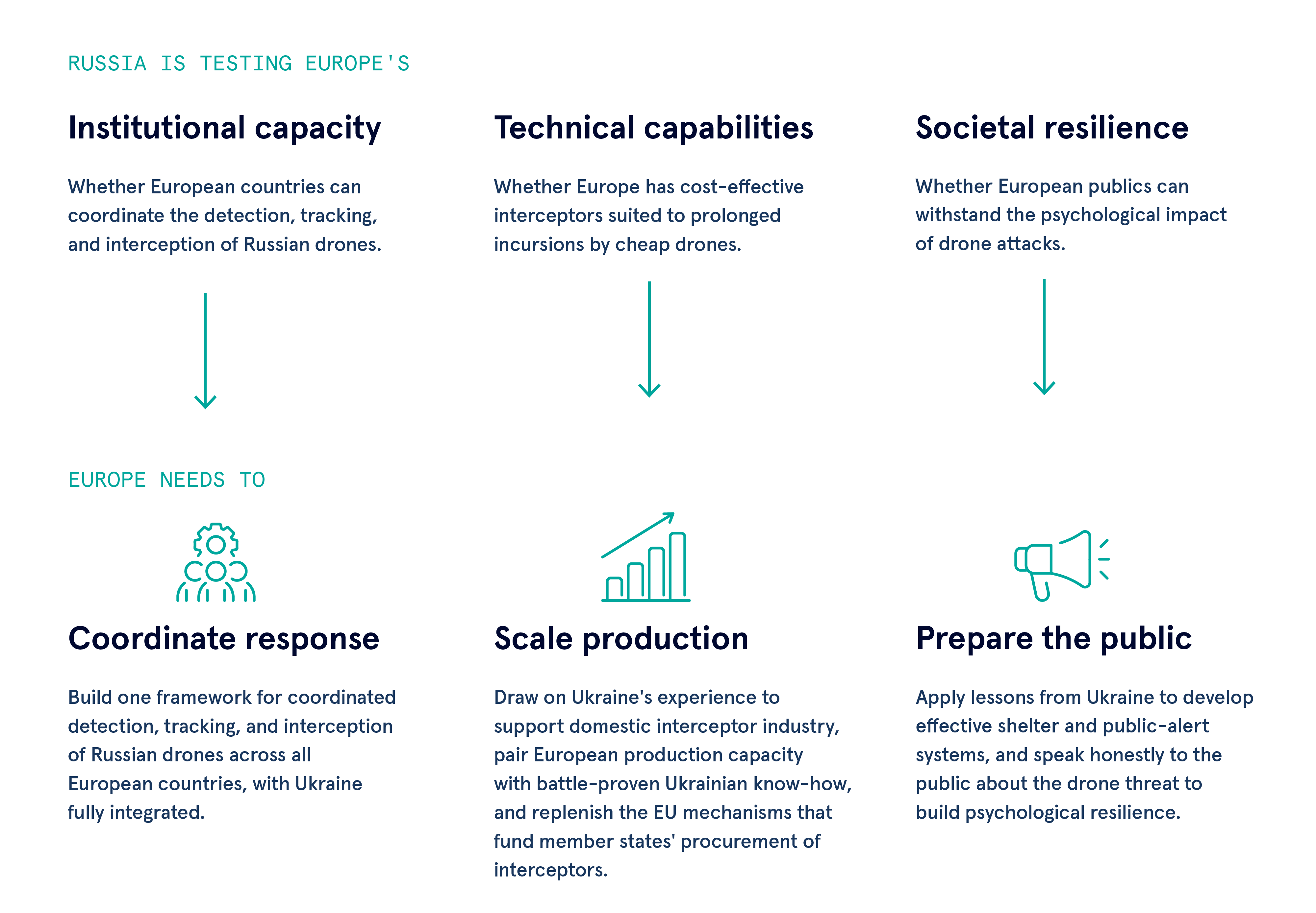
Moscow’s main objective at this stage is likely to probe European countries’ capacity to respond to the drone incursions on multiple levels and assess whether it could continue using drones against Europe after a potential ceasefire in Ukraine.
One level Moscow is testing is European countries’ institutional and technical capacity to respond to the incursions. This analysis is consistent with the assessment by senior European officials, including EU Defense Commissioner Andrius Kubilius, who have concluded that the Kremlin is using the incidents to test Europe’s anti-drone defenses.13
Here, the Kremlin is presented with a mixed picture.
On the one hand, over the past year, European governments have reacted to the incursions with a slew of new initiatives. Beyond Operation Eastern Sentry, NATO has introduced Drone Edge, an initiative to invest $40 billion in counter-drone capabilities over the next five years.14 Meanwhile, the European Commission has proposed the European Drone Defence Initiative and the Eastern Flank Watch,15 as well as the Action Plan on Drone and Counter Drone Security focused on developing a united EU approach to countering drone threats.16 Romania’s shooting down of Russian drones also demonstrated that NATO countries are increasingly showing resolve to intercept Russian drones rather than letting them fly over their territory unchallenged, as was the case initially.
On the other hand, these efforts suffer from major flaws. They include reliance on expensive legacy systems as the main tool for intercepting drones. This has been demonstrated by Eastern Sentry’s use of fighter jets and the Romanian military’s use of F-16s to intercept drones all three times in July. According to estimates, Russia is producing up to 400 long-range drones per day,17 with each unit costing between $30,000 and $50,000.18 If European nations were to rely on fighter jet missiles costing hundreds of thousands of dollars to intercept Russian drones in the event of a direct confrontation, they would quickly exhaust their interceptor stockpiles and leave their skies undefended.
Another flaw lies in the fragmented nature of the existing institutional arrangements for drone interception, which, while seeking to deepen coordination among European countries, largely exclude some of the key players in the European defense landscape. For instance, the EU initiatives acknowledge the need for cooperation with Ukraine and other non-EU neighbors, but they do not propose a concrete mechanism for coordinating detection, tracking, and interception of drones with these countries. Should Russia decide to launch drone incursions spanning the airspace of these non-EU countries—which is especially likely in Ukraine’s case—the lack of coordination could significantly delay detection and slow the EU member states’ response.
The second level Moscow is likely seeking to assess with its incursions is the resilience of the European public to the psychological effects of drone incidents, including changes in support for Ukraine and overall morale.
Although the Kremlin has officially denied any involvement in the incursions, it has found ways to amplify their psychological impact on the population of targeted European countries. Dmitry Medvedev, Russia’s former president and current deputy chairman of the Security Council, who often acts as the Kremlin’s chief firebrand, commented on the incursions into European airspace in fall 2025. According to Medvedev, the incursions should show the European public “the threat of war” and persuade them to get rid of politicians who were gaining “political points on blood,” referring to their support for Ukraine.19
On this level, the indicators Moscow is likely to consider also cut in more than one direction. So far, there is no indication that the incursions have weakened European public support for Ukraine. Polls from mid-2026 have shown that a majority of EU citizens support the bloc’s response to Russia’s invasion of Ukraine.20 Additionally, nearly all EU governments—except Czechia, Hungary, and Slovakia—have committed to contributing to the €90 billion (approximately $103 billion) loan for Ukraine for 2026–2027, a move that would have been politically impossible if their public had been broadly opposed to continued support.21
Most European governments have yet to openly acknowledge to their people that, should incursions intensify, even the most advanced interception systems will not be able to stop every drone.
At the same time, most NATO, EU, and national-level efforts responding to Russian drone incursions have so far focused narrowly on interception capabilities, with almost no attention paid to building broader societal resilience. Only a few European countries, such as Finland, have built an adequate shelter network and layered public alert systems.22 Most European governments have yet to openly acknowledge to their people that, should incursions intensify, even the most advanced interception systems will not be able to stop every drone. Societies therefore need to immediately start putting in place comprehensive preparedness measures, including shelter infrastructure, public alert systems, and community-level emergency response plans. The fact that these discussions are not taking place likely reflects many European governments’ unwillingness to have difficult conversations with the public that could further undermine their already fragile political standing.
For Moscow, this could be an indicator that, should it decide to further use drone incursions as a tool of coercion against European societies—or employ drones in a direct military conflict with another European country—the European public would be caught unprepared, amplifying the psychological and disruptive impact of any such drone campaign.
As some of the lessons Moscow is taking from the incursions point in its favor, the Russian leadership could conclude that drones can remain an effective tool against Europe even if the front line in Ukraine freezes.
One approach the Kremlin could take is to intensify drone incursions into European airspace. It could try to exploit the gaps in coordination on drone interception between EU and non-EU countries by sending more drones across the continent’s skies. It could route drones through Ukrainian airspace or the airspace of other non-EU countries to narrow the window that target countries have to respond. As the European public appears unprepared for repeated incidents, Moscow could fly drones over major urban areas, triggering air raid sirens and causing panic, in an attempt to influence public opinion in its favor. In doing so, it could selectively target states where governments have taken a harder line on Russia, signaling to their publics that such disruptions would cease if they elected leaders more accommodating toward Moscow.
Following the traditional Russian playbook of gray zone warfare, the Kremlin would continue to deny any connection to these “little green drones.” It may also try to shift the blame onto Ukraine, portraying the incursions as failed Ukrainian operations against targets inside Russia—similar to incidents that took place in the Baltics earlier this year.23 Here, Moscow could use Ukrainian drones it has recently obtained for such purposes, according to the Polish government’s estimate.24 Russia could also use its own drones and claim these were false flag operations staged by Kyiv to discredit Moscow.
Alternatively, should the Russian leadership consider full-scale military aggression against another European country—such as one of the Baltic states or Poland—after a ceasefire in Ukraine, the lack of cheap counter-drone capabilities such as interceptor drones deployed at scale on NATO’s Eastern flank could tip Moscow’s calculus in favor of doing so. The Kremlin could conclude that using thousands of new drones accumulated by that time could quickly overwhelm air defenses and pave the way for a ground invasion.
As Moscow is evaluating whether long-range drones can serve as an effective tool against Europe even after a potential ceasefire in Ukraine—either in the form of gray zone incursions or drone strikes in the event of a direct conflict—Europe should take structural measures to alter Moscow’s cost-benefit assessment. It should show the Kremlin that Europe has the technological and institutional capacity, as well as the societal resilience, to withstand any such attacks.
First, European countries should draw on Ukraine’s experience to develop a domestic industrial ecosystem capable of producing cheap and effective counter-drone solutions at scale. While not all of Ukraine’s approaches to drone production are applicable to other countries, its defense innovation platform Brave1 could serve as a useful model.25 Brave1—a government-run platform that funds and fast-tracks defense technology innovation and battlefield integration—has helped Ukraine develop one of the most innovative defense tech ecosystems in the world. European capitals could build similar mechanisms that provide promising startups with research and development grants, testing opportunities, and structured feedback from the armed forces, allowing them to iterate more quickly and adapt their products to the end user’s needs. This would help European governments empower domestic manufacturers of drone interceptors, sensors, electronic warfare systems, and other equipment needed for a comprehensive counter-drone stack.
European countries could also combine their industrial capacity with Ukrainian technological know-how to scale the production of interceptors that have already proven effective on the battlefield. They could draw on successful cooperation models employed by the United Kingdom and Germany: London has signed a licensing agreement to produce Octopus interceptors developed by the Ukrainian Armed Forces,26 while German companies have established joint ventures with Ukrainian defense tech startups, such as TAF Industries and WIY, to produce their anti-drone systems in Germany.27 This would allow Europe to produce and deploy combat-tested counter-drone systems more quickly, while simultaneously helping Ukraine expand the production capacity of its defense tech sector. These efforts would supplement the recent EU-Ukraine Drone Alliance, which, based on publicly available information, facilitates knowledge-sharing and engagement between European and Ukrainian drone companies, but includes only a small pool of firms on both sides and is not designed to directly fast-track co-production deals.28
Additionally, European governments should support the replenishment of existing EU mechanisms that fund EU member states’ procurement of weapons systems developed by European and Ukrainian companies. This includes European Commission initiatives, such as the Security Action for Europe (SAFE), whose €150 billion loan facility will soon be fully allocated.29 Extending these mechanisms would create predictable market opportunities for European and Ukrainian drone interceptor producers and generate revenue they could reinvest in research and development to enhance their systems’ performance.
Yet investing in hardware alone will not suffice. Europe also needs an institutional framework for joint counter-drone defense across the continent that integrates Ukraine. Given its strategic location and advanced anti-drone capabilities, the country could significantly boost Europe’s collective efforts in detecting, tracking, and intercepting Russian drones.
One solution would be to give NATO a greater role in coordinating Europe’s anti-drone response. There have been some steps in that direction: Following the July 2026 NATO summit in Ankara, NATO’s Supreme Allied Commander Europe was reportedly granted broader authority to engage aerial threats.30 However, there has been no indication of new mechanisms for early warning and information sharing among NATO member states and between the alliance and European countries outside it, including Ukraine.
Another option would be to strengthen anti-drone defense coordination at the EU level. In this regard, the earlier-mentioned European Drone Defence Initiative, the Eastern Flank Watch, and the Action Plan on Drone and Counter Drone Security are all positive steps. Yet they, too, stop short of calling for Ukraine’s full integration into a joint European drone defense network.
To succeed, any of these solutions will need to work out a way to fully integrate Ukraine. Such integration would allow European partners to leverage the vast network of sensors, radars, and other detection systems that Ukraine has built since the start of the full-scale invasion to provide early warning. Air defense units in Denmark, Germany, Poland, and other European countries would thus gain valuable time to track incoming drones, assess their trajectory, and prepare to intercept them.
European countries could also forward-deploy some of their interception capabilities on Ukrainian territory to shoot down Russian drones before they reach further into the continent’s airspace. However, given that European capitals likely lack the political will to station interceptor operators in Ukraine while the war remains active—for fear of being drawn into the conflict—this part of Ukraine’s integration would probably only become feasible after a ceasefire is reached.
In addition, Ukraine’s integration into Europe’s anti-drone institutional framework would enable routine exchanges and training programs through which Ukrainian instructors could train drone operators from other European armed forces. This would be essential since, as Ukraine’s experience shows, effective counter-drone defense depends as much on skilled operators as on the hardware itself.
Finally, European countries need to build the societal resilience required to withstand continued Russian drone incursions or potentially even large-scale drone attacks after a ceasefire in Ukraine. Here, too, Ukraine’s experience could play an important role in informing their efforts. European capitals could fund studies of the successes and failures of the Points of Invincibility—the network of emergency shelters rapidly built by the Ukrainian government since the beginning of the invasion—as well as Kyiv’s approach to air alerts, crisis communication, and safety protocols used during Russian aerial attacks.31 Any findings could guide European countries’ efforts in developing shelter networks and alert systems that maximize protection for civilians in the event of drone attacks and minimize disruptions to their daily lives.
In parallel, European governments, especially in the western part of the continent, need to make clear to their publics that they are no longer living in peacetime. Disruptions caused by Russian drones—along with cyberattacks against public services, sabotage of critical infrastructure, and assassinations by Kremlin agents—will likely remain an undeniable part of Europe’s security reality for years to come. Only with this understanding will European societies be able to build the psychological preparedness needed to withstand the cognitive effects Moscow seeks to achieve through its drone operations.
As Moscow assesses European countries’ response to its drone incursions, it is already looking beyond the horizon of the current war in Ukraine. Europe must therefore adapt rapidly and develop effective ways to counter Moscow’s potential threats to the continent’s security. The long shadow of Russian drones is already stretching across Europe, and it is unlikely to recede even if the guns in Ukraine fall silent.
The author would like to thank Eric Ciaramella, Andrew S. Weiss, Eugene Rumer, and Nate Reynolds for their helpful feedback on previous drafts.
The author acknowledges the use of LLM tools for preliminary copyediting.

Senior Research Analyst, Technology and International Affairs
Pavlo Zvenyhorodskyi is a senior research analyst in the Technology and International Affairs Program at the Carnegie Endowment for International Peace.
Recent Work
Pavlo Zvenyhorodskyi

Pavlo Zvenyhorodskyi, Scott Singer
Carnegie does not take institutional positions on public policy issues; the views represented herein are those of the author(s) and do not necessarily reflect the views of Carnegie, its staff, or its trustees.

Ahead of a tough winter for Ukraine, Donald Trump’s swing back toward Russia bodes ill. But instead of panicking, Kyiv’s European allies are focusing on action.

Rym Momtaz

Funding Ukraine remains a priority for European leaders. As Russia’s war of aggression heads into another winter, two feasible options to mobilize support for Kyiv should be fast-tracked.


Vladyslav Rashkovan, Gregory P. Wilson

Russian strikes are weakening the economy sustaining Ukraine’s war effort. Closing the growing funding gap will require more European support and politically contentious reforms in Kyiv.

Balázs Jarábik

Much has been said of the changes Brussels is trying to make to the EU enlargement process. Here’s why gradual integration might—or might not—be the answer.

Dimitar Bechev

Despite a new textbook, an influx of Russian teachers and managers, and an end to the teaching of Ukrainian, the Kremlin is unlikely to have “reprogrammed” locals.

Konstantin Skorkin