

Commentary
Georgia Schaefer-Brown, Jane Munga
Source: Getty
Washington is racing China to the AI frontier but missing a second race: diffusion. For African developers, the choice of model is a practical matter of affordability, access, and agency.
When U.S. President Donald Trump hosted Chinese President Xi Jinping in September, and again during Trump’s visit to China this month, their discussions on AI had a familiar focus—the frontier. Washington has doubled down on its quest to win the AI race, where winning is measured by building the most advanced model. After rebranding AI as “super intelligence,” Trump established the Super Intelligence Force to ensure that America leads the world in its development and manages the risks. Yet, another AI race is playing out to capture the global market—a race to deployment, which determines whose models the world uses.
This second race is between closed- and open-weight models. Closed-weight models, such as OpenAI’s GPT, Anthropic’s Claude, and Google’s Gemini, are the most common among U.S. frontier labs. These models run on their developers’ servers, and users pay to connect through an application programming interface. The provider maintains control of how far the model can be customized. In contrast, open-weight models, such as DeepSeek’s DeepSeek-R1, Alibaba’s Qwen, and Moonshot’s Kimi, are more prevalent among Chinese labs. The provider of an open-weight model publishes its architecture and weights—that is, the “set of learned parameters that overlay the model architecture to produce an output from a given input.” Users can download, modify, and run the model on their own infrastructure with its full training data, all without per-use fees. The source code, however, stays private unless it is an open-source model. Open-source models, such as Ai2’s OLMo, publish their source code and information about the training data, so developers can study how the model was built and even rebuild it. The difference between an open- and closed-weight model is important for customers because it determines what they can build with a model. It therefore is a key determinant for the overall diffusion of AI.
Washington’s AI Action Plan, titled “Winning the Race,” calls for exporting the full American AI technology stack to partners abroad. However, around the world and especially in Africa and the Global South, developers are increasingly moving away from closed U.S. models toward Chinese open-weight ones. Research shows that Alibaba’s Qwen models alone constitute the largest model ecosystem on Hugging Face—the leading platform for sharing and downloading AI models—with more than 150,000 derivatives. (Google’s models come second, with 83,000 derivatives.) This staggering uptake should send a strong message to Washington: The other AI race cannot be ignored.
Developers are choosing what China offers, and that choice could change if America were to provide competitive products.
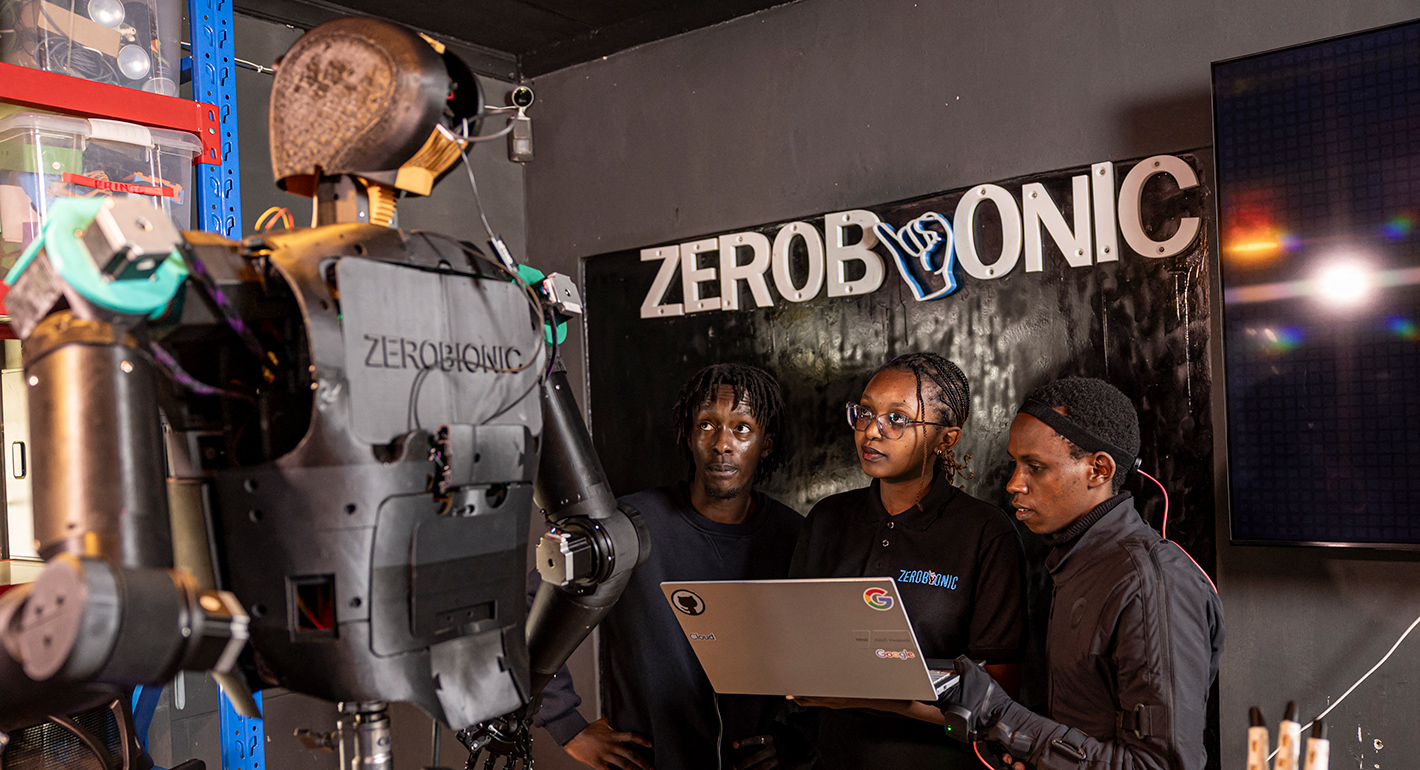
Many African developers have turned to Chinese open-weight models, and the same pattern is unfolding elsewhere, even in Silicon Valley. This, however, should not be read as choosing China. Developers are choosing what China offers, and that choice could change if America were to provide competitive products. In Uganda, for example, Sunflower, a multilingual language model, is built on Alibaba’s Qwen 3, but for newer work, its developer used Google’s open-weight Gemma. The developer made this switch because Gemma fit its needs: Its smaller models cost about the same to train as Qwen 3, need less compute to run, can be embedded in phones, and can be trained for speech and text, which matters in areas with lower literacy rates. These are the demand signals at play in Africa’s AI ecosystem—not who or what is leading the frontier.
In his testimony to the U.S. Senate in 2025, Microsoft President Brad Smith said America must win both an innovation race and a diffusion race—the latter, at least, will be determined by the country whose technology is most broadly adopted around the world. The stakes are both economic and strategic for the United States. As former U.S. national security adviser Jake Sullivan warned, “while the U.S. has been running one race, China has been running another,” built on industrial scale. Open-model proliferation creates a feedback loop in which adoption drives iteration and further adoption. Developers who adopt, adapt, and share Chinese models add to a common base of improvements that Chinese labs can draw on, helping China innovate close to the frontier. Those models are then deployed across China’s factories, logistics networks, and other connected infrastructure, where the operational data they generate are fed back to improve them, reinforcing China’s industrial dominance. Therefore, Washington should encourage U.S. AI firms to compete for developers, like those in Africa, while they also run the frontier race. Ceding the deployment race would make Chinese models the default across the Global South, with consequences for the frontier itself.
Understand the world with the latest from our scholars around the world.
For most African developers, the choice between open and closed models rests on three key issues: affordability, access, and agency. Developers want models that are affordable; accessible, with the connectivity and compute already available; and downloadable, so they can be adapted to local languages and kept under local control. If the United States and its allied tech companies want to win over African companies, they have to engage on those terms. American AI companies must be incentivized to supply open-weight models to emerging markets like Africa.
For most African developers, the choice between open and closed models rests on three key issues: affordability, access, and agency.
American firms should first address the affordability demand. Closed models are estimated to cost users about six times more than open models on average, which makes leading U.S. models too expensive for many developers. In Nairobi, the heart of Africa’s Silicon Savannah, a legal records startup reported that its product cost about $25,000 to build using Chinese open models and estimated it would have cost more than $1 million using Claude. For African builders, basic arithmetic decides the choice.
There has been some movement here. U.S. companies have recently released a broader range of models, with some now priced on par with (or lower than) Chinese models, and with similar capability levels. Several are even open-weight models, such as Google’s Gemma. Cost, however, is just one of the signals.
A common critique of open models is that they achieve only about 90 percent of closed models’ performance at release, and they trail the frontier in capability by an estimated four months. But this critique needs to be understood in the context of Africa’s building ecosystem. What are African developers looking for? Consider travel: A car is enough for shorter, in-country distances, and a plane is enough for longer intercontinental distances—neither travel requires a spaceship. The same principle applies for African builders: They are looking for the ideal model, not necessarily the ultimate super powerful one. A frontier model is a remarkable tool, but developers only need a model that is good enough to build something that works for them.
The second demand, access, is largely about connectivity to the internet. Closed models run in the cloud, which means users must stay connected to the internet. This is a real constraint in Africa, as 36 percent of the population uses the internet compared to 94 percent in high-income countries such as the United States, and connectivity is generally more expensive in Africa. Because smaller open-weight models, such as Gemma 3n, can be downloaded—even on capable phones—and work offline, their accessibility is much higher than cloud-based services.
Where a model runs also determines who controls it, which brings in the third demand, agency. An open-weight model runs on the developer’s infrastructure, which restricts data from looping back to the model provider, offering a dependable foundation that the creator of the model cannot change or withdraw. With a closed model, the developer—whether in Silicon Valley or in China—holds the keys to usage. This makes it easier to shut off a rogue agent or a malicious actor, but it also means the developer can turn model access off for other users. When Anthropic suspended access to its advanced models, Fable 5 and Mythos 5, for nearly three weeks in June 2026 to comply with the U.S. Commerce Department’s export controls, that decision was prompted by the U.S. government. For all developers, this resulted in a sudden loss of access. An open-weight model cannot be remotely turned off once it has been downloaded, so anyone can modify it and even edit out its built-in safeguards. This difference creates a trade-off between agency and security. For the United States, open models raise national security concerns, yet for African developers, they ensure that access remains within their control.
To fulfill these three demands, Washington policymakers must run the other AI race alongside the race to the top. Both races, for frontier development and AI diffusion, must become a priority.
First, Washington should widen what it exports. A bill introduced in Congress could direct the Commerce Department to help promote U.S. open-weight models globally. Currently, the American AI Exports Program invites full-stack packages built around data centers that industry consortia will build, own, and operate, rather than targeting the developers who want to use the models. Export packages should include American open-weight options such as Google’s Gemma, OpenAI’s GPT OSS, and Ai2’s OLMo, which are identified as Western alternatives to Chinese open-weight models. This promotional push would be timely, as the argument that Chinese models are always cheaper is already weakening. Open models may be free to download, but running them still carries inference costs—the operational costs of processing a task or query—and server hosting costs. Some open models can use more tokens to complete a task, which can offset their lower price per token, whether they run on a developer’s own devices or through a hosted service. This is where American open-weight models offer some competition, as research has shown that models like OpenAI’s GPT OSS are among the most token efficient.
Second, Washington should help American companies compete for African developers. Releasing a model’s weights is a commercial decision, so companies need a business model to justify it. The government can help create the business case through levers such as advance purchase commitments and procurement preferences for American AI. China’s AI firms are courting developers in Africa, and every company who builds on Chinese models is a gain in the diffusion race. Washington therefore should focus its diffusion strategy in the Global South as much as it has focused on reaching the frontier.
America needs to achieve what China did with DeepSeek-R1—popularize the use of its own large-scale open models. Targeted commercial diplomacy would put U.S. open models in front of African research institutions and startups, where development happens. U.S. government research has warned that the United States risks being left without a major developer anchoring its open ecosystem just as China’s market share is accelerating. Google’s Gemma comes close to filling that role, even though it is largely outmatched by Qwen. This concern has become especially salient after 2025, when Meta abandoned Llama, a once-popular open-source model, in favor of Muse Spark, a paid and closed model that was launched this year.
A gap already exists between African uptake of Chinese models and U.S. models, and it will be difficult to close. Once developers build their products around a model, switching becomes expensive; hence, a practical choice may become a lasting dependence. Africa’s digital infrastructure is a case in point. Huawei built around 70 percent of the continent’s 4G networks, and Huawei and ZTE built national fiber-optic networks for more than twenty African countries, thus hardwiring infrastructure dependencies into Africa’s digital economy.
Africa has made its demand for open models clear, and America’s main competitor has picked up the signal.
Third, Washington should recognize that many countries in the Global South most want predictability. Suspensions, such as when Anthropic cut off access to its most advanced models, make American AI look unreliable. Restrictions on open weights also should not take the form of blanket bans; instead, open weights’ risks should be managed through measures such as safety testing and by finding ways to punish offenders. The U.S. approach to AI safety has retreated from international cooperation and now relies on frontier labs evaluating whether their advanced models cross dangerous capability thresholds. Elements of this approach can be worked into global AI governance frameworks through shared capability evaluations and incident reporting. In an interconnected world, AI safety cooperation is key and inevitable, even among adversaries, as now evidenced by Trump’s pledge to work with China to develop joint AI guardrails.
The diffusion window for American open models is still open, but it is steadily closing. Gone are the days when Silicon Valley was viewed as the primary source for AI technology. Countries and developers across the Global South are exercising agency, for reasons starkly different from those that drive U.S. policy. Africa has made its demand for open models clear, and America’s main competitor has picked up the signal. Some expect that, as security risks grow, Beijing will use its ability to restrict its most capable models from releasing weights, but for now, Chinese open-weight models remain a real alternative, and Washington should plan on that continuing. If the United States wants to lead the AI frontier, it is time policymakers read the demand signals and let them shape an AI strategy that runs both the frontier and diffusion races.
Fellow, Africa Program
Jane Munga is a fellow in the Africa Program focusing on technology policy at the Carnegie Endowment for International Peace.
Recent Work
Georgia Schaefer-Brown, Jane Munga
Carnegie does not take institutional positions on public policy issues; the views represented herein are those of the author(s) and do not necessarily reflect the views of Carnegie, its staff, or its trustees.

Recent interest in understanding competitive cyber statecraft has been motivated by the recognition that various states are pursuing both diplomatic and operational lines of effort to achieve their respective national strategic objectives in and through cyberspace.
Joe Devanny, Arthur P.B. Laudrain

Alongside official pushback, Chinese tech and policy communities are meeting calls for a slowdown with skepticism—rather than rejection—that mirrors the reactions in the United States.


Matt Sheehan, Sophie Zhuang

The choices California makes while implementing its frontier AI law has ramifications for AI governance in the United States and around the world.


Scott Singer, Jon Bateman, Michael Chen, …

Democrats now have the gavel and the purse, but the executive branch still pulls the levers on the U.S. role in the world.



James M. Acton, Dan Baer, Mark Baldassare, …
Four scenarios for an uncertain future.



Alasdair Phillips-Robins, Teddy Tawil, Sam Winter-Levy