In late August, Yemen’s National Unity Government took a step toward greater independence and a stronger north-south unity by cancelling a contract to Dubai Port Worlds (DPW), signed by the government of former President Ali Abdullah Saleh, the country’s erstwhile and longtime ruler. The deep drama of the move is hidden from the headlines by an overwhelming bureaucratic dryness, and while the developments lack the pulse-quickening panache of drone strikes or the past year’s full-throated protests, they are key to understanding where Yemen is going and what the new government hopes to accomplish as it pulls itself out of the last regime’s wreckage.
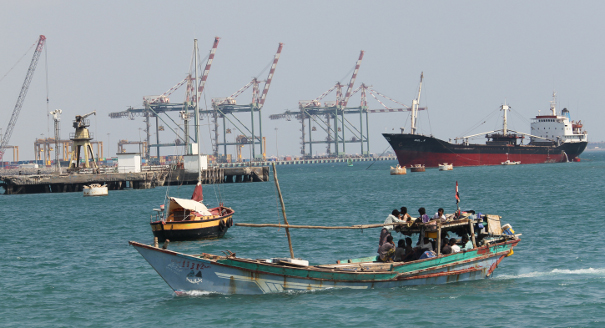
Signed in 2008, the contract gave DPW the right to manage the port of Aden for the next 100 years. This was a scandal from the beginning; while it wasn’t unreasonable for Yemen to contract outside help in running the port, the terms of the contract benefitted only two parties: DPW and the president himself. Contracts between a nation and an independent company generally present very favorable terms to the nation whose natural resources are being used. In this case, however, it was quite the opposite: in exchange for a quick cash infusion to the former regime, the terms of the contract were fixed to the DPW’s overwhelming advantage, falling in line with Saleh’s habitual strategy of scrambling to fix immediate problems at the expense of long-term solutions.
To understand the depth of the scandal, it is important to know the symbolic and actual value of the port of Aden. Despite its strategic location and favorable weather that have rendered it an ideal refueling location, the port had been in declining due largely to mismanagement and corruption. The country’s overall instability namely the 2000 USS Cole bombing and the attack on the Limburgh, a French ship—worsened security conditions and drove up insurance rates for ships fueling at Aden. Consequently, the port had become a ghost, a symbol of the corruption, mismanagement, and violence that had encapsulated the country.
The 2008 contract could have been a fresh start. But like much else undertaken by the Saleh regime, this was done with a mixture of cynicism, intrigue, and incompetence. By that year, the Southern Movement—a catch-all term for anyone in the south agitating for broader rights—was picking up steam, but had yet to become the full-fledged secession movement into which it would later morph. At that point the bulk of demands were primarily economic, reflecting the needs of a neglected south: relative even to the rest of Yemen, the south has been mired in deep poverty, a legacy of its own misrule and the punitive rule of the north. One demand was for more social mobility, the number one driver of which was military promotion; policies from Sanaa made it difficult for southerners to advance. Beyond that, the movement also demanded a return of land and ownership over industrial properties, which had been appropriated by northerners following the civil war. Saleh then signed away the port—which was the economic heart of the south and its primary engine for growth. Not only did this give the regime ready cash, but it ensured that the money would be used at Sanaa’s discretion. In 2008 few believed it would be funneled into economic opportunities in the south, and it would be difficult to think of a move that more utterly disregarded southern demands as the port handover.
In July of this year, workers at the port of Aden marched in protest of DPW’s mismanagement. This allegedly was pivotal to the contract’s cancellation; the government argued that DPW was incompetently run and fell short of its promises. The protest was well-timed, as Hadi had already asked parliament to look into the failings of DPW. Specifically, DPW was supposed to have built up infrastructure and bring up the capacity of shipping containers to 900,000. Neither of these was accomplished, as Yemeni transport minister Waed Abdullah Bathib told Reuters earlier this year, which gave them a reason to terminate the contract.
Dubai Port Worlds has yet to comment on the cancelation. While it is possible that neither of these goals were met, it is important to note that DPW recorded only a mild increase of profit in the first half of 2012, and its parent company, Dubai World, is undergoing a massive debt restructuring. And though it is hard to say if management was really the issue, it’s as good a reason as any for the new government to cancel the contract. As far as a political maneuver is concerned, the government of Abd Rabbu Mansour Hadi has taken an extremely important step, both symbolically and economically, away from Saleh’s legacy and more toward one of independence. It is possible that another company will take over the port, but if the negotiations are done transparently and fairly, it could come to symbolize another break with a corrupt past. Of course, if a deal is signed behind closed doors, it would make Hadi seem like a continuation of Saleh, rather than a clean break.
The fall of Saleh in late 2011 provided an opportunity for reconciliation. And though Hadi’s government was met with skepticism by the Southern Movement—who boycotted the single-candidate election that validated his power—the president is shrewdly taking this opportunity to change that opinion by allowing the Port of Aden Corporation (a southern organization, and a key player in canceling the contract) to take the lead. Hadi, himself a southerner—though also a Saleh insider—has understood that north-south relations are probably Yemen’s most pressing existential concern, and he has thus reached out to southern leaders in attempt to defuse tensions. There is extremely little trust between the north and the south, but this is a step toward re-establishing the trust needed for Yemen to survive as a united nation. And while there isn’t a magic bullet that can solve all Sanaa’s problems, a move like this—which returns the port back to Yemeni hands and lets Aden and the capital meet in a boardroom as partners—can go a long way toward ameliorating the civil strife between north and south.
Brian O’Neill is a Chicago-based independent analyst and a former writer and editor for the Yemen Post.