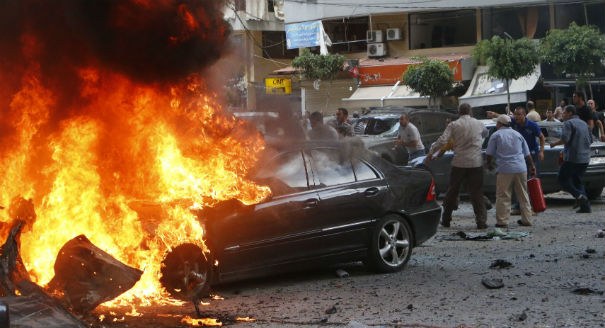
On Tuesday, July 9 a car bomb ripped through Lebanon’s southern suburb of Dahyeh, setting fire to the parking lot in which the culprit, a Nissan 4x4, was located. The vehicle, which had been laden with 35 kilos (70 pounds) of explosives, targeted the Islamic Cooperative Center—a supermarket believed to be owned by a senior Hezbollah official—in the crowded neighbourhood of Bir el Abed. This district forms part of the security perimeter surrounding Hezbollah’s leadership and is under constant watch by the organization’s internal security services. For the bombers to make it this close to the party’s inner sanctum highlights that Hezbollah’s foray into the Syrian civil war is increasingly having violent domestic implications, which the group may not be able to deal with in the future.
As Hezbollah politicians, including the organizations’ Deputy Secretary General Sheikh Naim Qassem, attempt to implicate Israel and its agents for the 53 injuries, Tel Aviv denied any involvement. While official Israeli statements may be brushed aside by some as mere propaganda, a claim of responsibility posted on Facebook by a shadowy and largely unknown Syrian rebel group makes this stance more difficult to support. Written by the leader of the 313 Brigade-Special Forces, it stated that the bombing was in retaliation for Hezbollah’s involvement in the siege on Homs, claimed responsibility for previous attacks against the group, and promised that it was not the last time that the brigade would plant a bomb on Lebanese soil. The question then becomes why would Hezbollah use Israel as a scapegoat for Tuesday’s bombing when it seems clear that the blame lies with a segment of the Syrian rebels?
Hezbollah’s reaction to the Bir el Abed bombing falls within the scope of the group’s narrative for its increasingly explicit and decisive involvement in Syria. Hassan Nasrallah has stated that the organization, alongside Iran and Russia, is helping the legitimate Syrian government fight against jihadis backed by the United States and Israel. According to the narrative, Syrian rebels are largely a group of radical Sunni jihadis that threaten not only Lebanon’s Shi’a population, but all of its sects—and therefore overarching confessional harmony. Framing the Syrian opposition as the work of external actors looking to unleash takfiri groups on Lebanon allows the group to consolidate its domestic support, scare other minorities into acquiescence, and publically ignore the ramifications of its Syrian escapade. While the July 9 bombing and the rhetoric accompanying the claim of responsibility fits well into this narrative, it also calls into question Hezbollah’s ability to keep up the charade.
The promise of further retaliation inside the southern suburbs widens the impact of Hezbollah’s involvement in Syria from the border area of Hermel to the organization’s seat of power. The targeting of the Islamic Cooperative Center’s parking lot highlights that while the bombers were unable to breach Hezbollah’s tight security and drive the Nissan closer to party offices, they had no qualms about targeting Shi’a civilians going about their Ramadan shopping. Such ruthlessness raises doubts about the ability of Hezbollah’s constituency to bear the brunt of these attacks, particularly when it will become increasingly apparent that they are not a symptom of the Syrian crisis but rather a retaliation for Hezbollah’s involvement in the conflict. In a sign of what may be to come, small rifts are already appearing in the group’s support base. A delegation from the Baalbek region representing the families of fallen Hezbollah fighters met with Shura Council member Mohammad Yazbek in June. They told the organization that they found Hezbollah’s defence of the Syrian regime “flawed and intolerable,” an act which, according to the delegation, did not fall within the group’s raison d’etre—resistance to Israel—and one that would widen the Sunni-Shiite rift in Lebanon.
In the immediate term Hezbollah can stomach a consistent amount of casualties and the complaints of a small fraction of constituents whose sons have been “martyred” defending the Assad regime. With its fighters now engaged in a prolonged struggle in Homs and with rumours of a coming Aleppo offensive, the organization will probably convince the Shi’a that a stream of yellow-flag-draped coffins is worth protecting a co-member of the “Axis of Resistance” as well. Meanwhile Hezbollah will be hard-pressed is in its ability to convince supporters that indiscriminate attacks in their crowded neighbourhoods and commercial areas are the price that civilians must pay for the group’s military actions. If Hezbollah stays the course, the group may eventually be moved by fears and frustration among its supporters to limit its participation in Syria, lest domestic attacks continue and further instability in Lebanon arises.
Furthermore, Hezbollah must also contend with increasing inter-confessional strife that is directly correlated to the group’s involvement in Syria. While former Prime Minister Saad Hariri, in an attempt to curtail any sectarian fallout, echoed the official Hezbollah stance, he does not speak for an increasingly militant set of Sunni groups. In contrast to Hariri’s statement, the recent bombing was met with celebratory gunfire and the handing out of sweets in the northern city of Tripoli. This jovial celebration was attended by the armed supporters of a newly influential set of Salafi clerics. These radical fighters have shown an increased willingness to step up both their rhetoric and, with the late June battle between the Lebanese Armed Forces and supporters of Sheikh Ahmed Assir in Sidon, to target one of the pivotal institutions to Lebanon’s stability. Though Assir is currently on the run, his supporters and those of other sheikhs remain in the hotbeds of Tripoli and Sidon.
These downtrodden and economically marginalized Sunnis have put their lot in with the Syrian rebels and view their struggle as an extension of Syria’s sectarian tug-of-war. The bombing showed that Hezbollah is not the invincible goliath it once was believed to be, and moving forward radical Lebanese Sunnis may provide a lucrative pool of man power for future attacks. With Lebanese officials confirming that the CIA had warned them about multiple bomb plots based on phone intercepts, some of which were from Beirut, it is even possible that this may have already begun. Thus, it now seems that groups aligned with the Syrian rebels will increasingly target the southern suburbs of Beirut. With this prospect Hezbollah will have to deal with a two-fold domestic problem: a support base increasingly under siege by Syrian groups with the tactile support of increasingly emboldened Lebanese Sunni radicals.
Alexander Corbeil is a Senior Middle East Analyst with The Atlantic Council of Canada and a blogger for The Foreign Policy Association.