• Research
  • Emissary
  • About
  • Experts
Carnegie Global logoCarnegie lettermark logo
DemocracyIran
  • Donate
{
  "authors": [
    "Haian Dukhan"
  ],
  "type": "commentary",
  "blog": "Sada",
  "centerAffiliationAll": "",
  "centers": [
    "Carnegie Endowment for International Peace"
  ],
  "collections": [],
  "englishNewsletterAll": "",
  "nonEnglishNewsletterAll": "",
  "primaryCenter": "Carnegie Endowment for International Peace",
  "programAffiliation": "",
  "programs": [],
  "projects": [],
  "regions": [
    "Middle East",
    "Israel",
    "Syria",
    "Levant"
  ],
  "topics": [
    "Security",
    "Military"
  ]
}
Attribution logo

Source: Getty

Commentary
Sada

Syria’s Security Implications for Israel: Advantage of a Stalemate

A prolonged conflict in Syria may be the best way to ensure Israel's security.

Link Copied
By Haian Dukhan
Published on Sep 5, 2013
Sada

Blog

Sada

Sada is an online journal rooted in Carnegie’s Middle East Program that seeks to foster and enrich debate about key political, economic, and social issues in the Arab world and provides a venue for new and established voices to deliver reflective analysis on these issues.

Learn More

Israeli Prime Minister Binyamin Netanyahu declared, at the outset of the Syrian uprisings in 2011, “I extend it [Israel’s hand] to the people of Syria, Lebanon and Iran, with awe at the courage of those fighting brutal repression." However, less than a month later, Netanyahu said that an Islamic wave—that is, anti-Western, anti-liberal, anti-Israeli, and ultimately anti-democratic—is washing through the Arab countries. Given the accelerating events on the ground, the Israeli leadership started to re-evaluate its stance on the ongoing events. Its intelligence services have had to brainstorm possible alternatives to the current regime should Assad be toppled, and the kind of security developments that would ensue. Israel has decided not to adopt “the enemy of my enemy is my friend” principle in the Syrian case—because all sides of the conflict are hostile to the Jewish state.

Previously, and although Syria and Israel are officially in a state of war, the Syrian regime has always managed to respect the red lines of the Israeli leadership. Undeclared trust between the two regimes has developed, and the Israel-Syria border has remained rather quiet since 1973. Despite the fact that the Assads have largely managed to preserve some form of calm along the border with Israel, a victory for Assad in the current war against the opposition will be considered a victory for Hezbollah and Iran—both of which are now active combatants in Syria's war. A win for the Assad regime will allow Iran to extend its ability to project power regionally—becoming more of an acute threat to Israel. 

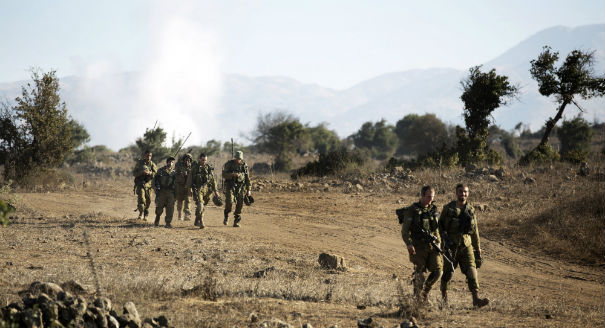
The opposition is no great alternative for Israel either as hostile armed Islamist groups dominate the Syrian opposition forces. Commenting on this, IDF intelligence chief Maj.-Gen. Aviv Kochavi remarked that "right before our eyes a center of global jihad is developing on a scale that may affect the borders of the State of Israel." Israel particularly dreads the idea of Syrian chemical weapons falling into the hands of Islamic radicals. A barrier that runs along most of the Israeli-Syrian border is expected to be completed this month to prevent any attempts from radical groups to cross the borders and attack Israeli citizens or soldiers.

What could Israel do to deal with the two threats? A prolonged conflict with maximum destruction to both sides may be the best way to ensure Israel's security and guarantee its future. First, the war is creating an anti-Iran sentiment in some parts of Syria and the rest of t he Arab world. This achieves an accidental alignment between Arab countries and Israel that distracts from the Arab-Israeli conflict. Second, Syria's conflict is depleting Iran's resources, which are already reeling from sanctions. A few thousand Hezbollah fighters are involved in the Syrian fighting, and many of its fighters who fought against Israel for two decades have either been killed or wounded on Syrian lands. A prolonged conflict is likely to turn Syria into Iran's Vietnam—exhausting Iran and Hezbollah and straining their resources. Third, as long as the conflict is going on in Syria, Israel no longer faces pressure to cede the Golan Heights, which it has occupied since 1967.

The Arab Spring has produced a great deal of change in Israel’s political and strategic environment. Not only has it led to the fall of some of Israel’s allies and the emergence of new regimes that are less inclined to establish relationships with it, but it has also added a new factor to the process of Arab decision making—the popular will of people, which may not accept security arrangements with Israel. 

Haian Dukhan is PhD candidate at the University of St Andrews, Centre for Syrian Studies, Scotland.

For an alternate take on this issue, read Oded Raanan's “A Lose-Lose Situation." 

About the Author

Haian Dukhan

Haian Dukhan
SecurityMilitaryMiddle EastIsraelSyriaLevant

Carnegie does not take institutional positions on public policy issues; the views represented herein are those of the author(s) and do not necessarily reflect the views of Carnegie, its staff, or its trustees.

More Work from Sada

  • Commentary
    Sada
    Duqm at the Crossroads: Oman’s Strategic Port and Its Role in Vision 2040

    In a volatile Middle East, the Omani port of Duqm offers stability, neutrality, and opportunity. Could this hidden port become the ultimate safe harbor for global trade?

      Giorgio Cafiero, Samuel Ramani

  • Commentary
    Sada
    Sub-Saharan African Migrants in Morocco: Security Concerns and the Test of Human Rights

    Is Morocco’s migration policy protecting Sub-Saharan African migrants or managing them for political and security ends? This article unpacks the gaps, the risks, and the paths toward real rights-based integration.

      Soufiane Elgoumri

  • Commentary
    Sada
    A House Divided: How Internal Power Struggles Shape Iraq’s Foreign Policy

    Iraq’s foreign policy is being shaped by its own internal battles—fractured elites, competing militias, and a state struggling to speak with one voice. The article asks: How do these divisions affect Iraq’s ability to balance between the U.S. and Iran? Can Baghdad use its “good neighbor” approach to reduce regional tensions? And what will it take for Iraq to turn regional investments into real stability at home? It explores potential solutions, including strengthening state institutions, curbing rogue militias, improving governance, and using regional partnerships to address core economic and security weaknesses so Iraq can finally build a unified and sustainable foreign policy.

      Mike Fleet

  • Commentary
    Sada
    The Role of E-commerce in Empowering Women in Saudi Arabia: Assessing the Policy Potential

    How can Saudi Arabia turn its booming e-commerce sector into a real engine of economic empowerment for women amid persistent gaps in capital access, digital training, and workplace inclusion? This piece explores the policy fixes, from data-center integration to gender-responsive regulation, that could unlock women’s full potential in the kingdom’s digital economy.

      Hannan Hussain

  • Commentary
    Sada
    A War Fueled by Hate Speech: Sudan’s Fall into Fragmentation

    Hate speech has spread across Sudan and become a key factor in worsening the war between the army and the Rapid Support Forces. The article provides expert analysis and historical background to show how hateful rhetoric has fueled violence, justified atrocities, and weakened national unity, while also suggesting ways to counter it through justice, education, and promoting a culture of peace.

      Samar Sulaiman

Get more news and analysis from
Carnegie Endowment for International Peace
Carnegie global logo, stacked
1779 Massachusetts Avenue NWWashington, DC, 20036-2103Phone: 202 483 7600Fax: 202 483 1840
  • Research
  • Emissary
  • About
  • Experts
  • Donate
  • Programs
  • Events
  • Blogs
  • Podcasts
  • Contact
  • Annual Reports
  • Careers
  • Privacy
  • For Media
  • Government Resources
Get more news and analysis from
Carnegie Endowment for International Peace
© 2026 Carnegie Endowment for International Peace. All rights reserved.