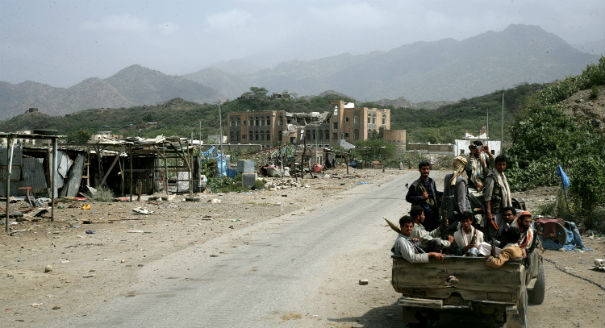
Over the past few months, tensions between Houthi rebels and Salafi groups along the border area between Saudi Arabia and Yemen have risen—they threaten, once again, to bring the contentious border to a boiling point, especially if outside actors increase support for competing sectarian factions across the region.
The present state of border tensions can be partially explained by a contentious relationship between the two neighbors that stretches back to the 1960s, when Riyadh began granting generous government subsidies to various Yemeni factions—ranging from tribal sheikhs to clerics and political leaders. The tribes residing along the border benefited in particular, as a result of a Saudi effort widely seen by the Yemeni government as “destabilizing” interference. Riyadh also sought to influence Yemeni affairs by supporting a number of Wahhabi educational institutions throughout the county. Over time, as Saudi influence increased and its Wahhabi institutions grew stronger, former President Ali Abdullah Saleh, the country’s strongman for nearly 33 years, initially sought to counterbalance his mighty neighbor by incrementally supporting Houthi militants, a Zaydi-Shi'i group, by providing them with cash grants. Saleh also sought to consolidate his power by pitting Yemen’s many competing tribes and political factions against one another, a strategy that partially explains his early support for the Houthis.
Although the Houthis have been seen as a threat for much of the last decade, Saudi Arabia has now come to perceive them as an even greater strategic threat at its border. The group, which some in Saudi Arabia and Yemen allege is supported by Iran, controls a number of northwestern border provinces, including Saada, al-Jawf, and Hajjah, as well as swaths of land in Amran Province. Meanwhile, the Houthi rebels, who see themselves as politically marginalized in Sunni-majority Yemen, allegedly are pushing for access to the Red Sea—in a bid to consolidate their regional presence and arguable semi-autonomy—and Riyadh fears that Tehran seeks to expand its regional influence by inflaming tribal and sectarian tensions along the strategic Bab el-Mandeb Strait that connects the Red Sea to the Gulf of Aden. The Houthis, for their part, see Wahhabi-sponsored groups residing along the border as a significant threat to their religious practices.
The 2010 ceasefire between the Houthis and the Yemeni government did not translate into peace—neither between the government and the Houthis nor between the Houthis and Salafi groups who compete with them for power and economic resources in the rugged northwestern provinces. Renewed sectarian clashes between Houthis and Salafis in September threatened once again to escalate tensions along the fragile Yemeni-Saudi border. At least twelve fighters from both groups were killed in clashes after Salafis apparently failed to meet a Houthi deadline to vacate their homes. The Houthis also view themselves as a “resistance movement” opposing “foreign interference,” and they see Salafis as Saudi pawns.
Despite the Houthis’ apparent commitment to Yemen’s national dialogue, the border could once again reach a boiling point should Riyadh decide to double down on its support for Salafi groups. The Houthi clan has accused the regime’s old guard and the Islamic Islah Party (which includes Salafis and Muslim Brotherhood members) of not supporting the dialogue process. In contrast to the Houthis, who use the national dialogue to advocate for a federalist system, the Islah Party—influenced by the al-Ahmar family, one of Yemen’s most prominent and well-to-do families—prefers a centralized state, which would benefit the status quo of the country’s long-standing but divided economic and political elites. Over the decades, the extended al-Ahmar family has benefited generously from Saudi government subsidies. In recent years, the Islah party and its Muslim Brotherhood supporters have also received generous allowances from Qatar, a move that could potentially reignite sectarian tensions between the Houthis and Salafis. However, should Qatar and Saudi Arabia increase support for competing Yemeni factions, fear of sectarian exclusion could prompt the Houthis to expand their territorial reach, the move Riyadh fears most.
Complicating this picture is the issue of Yemeni migrants in Saudi Arabia. So far this year, an estimated 17,000 migrants, mostly Yemenis, have illegally crossed the border into Saudi Arabia with the hope of a better life. In addition to Yemeni migrants, the International Organization for Migration (IOM) estimates that in 2012 alone, some 84,000 people, mostly Ethiopians and Somalis, entered Yemen en route to Saudi Arabia. Although an unknown number of these migrants were eventually able to cross the border, an estimated 25,000 of them are currently held at IOM facilities in Haradh, a Saudi border town. King Abdullah of Saudi Arabia announced in the spring that his government would grant foreign workers a three-month grace period to regularize their residency or voluntarily leave the country to avoid deportation, aiming to stem illegal migration. Though the king’s grace period has since been extended to November, tensions have risen between the kingdom and the Yemeni government over border policies.
Amid fears of more sustained border tensions, Saudi Arabia’s interior minister, Prince Muhammad bin Nayef, visited Sanaa in May to discuss issues related to “bilateral security cooperation” with Yemeni Foreign Minister Abu Bakr al-Qirbi. The two leaders discussed the status of Yemeni migrants in the kingdom and al-Qaeda’s ability to capitalize on Saleh’s departure to seize control of swaths of land in the southern and eastern part of the country. Al-Qaeda is increasingly capable of orchestrating hit-and-run attacks in Yemen—including abductions and kidnappings—with potentially devastating consequences not only to targets along the fragile border but across the region. The latest development from Yemen not only illustrates the apparent rise of al-Qaeda in the Arabian Peninsula (AQAP), but more broadly sheds light on how instability in the impoverished country could have a potentially disastrous impact on the region and beyond. Fearing AQAP’s rise, and faced with the hundreds of thousands of undocumented Yemeni migrants, Saudi Arabia has arguably been left with little choice but to step up its border security. Saudi’s efforts to fortify the border, however, are likely to further inflame historical tensions between the two neighbors.
As a result, tensions along the contentious border are only likely to increase over the next several months, irrespective of how Yemen’s national dialogue unfolds. Crackdowns at the Saudi border and the resulting deportation of Yemeni workers have exacerbated the already tense situation and added another crisis to Yemen: the end of remittances from the expelled Yemeni workers, estimated at about two billion dollars annually, is expected to severely impact the country’s already struggling economy. Furthermore, the largely unpredictable dynamics between Houthis and Salafis could once again ignite regional conflict, despite Saudi Arabia’s best efforts to stabilize the border.
Sigurd Neubauer is a DC-based defense and foreign affairs specialist. He is a scholar at the American Middle East Institute in Pittsburgh, Pennsylvania. The opinions expressed here are his own.