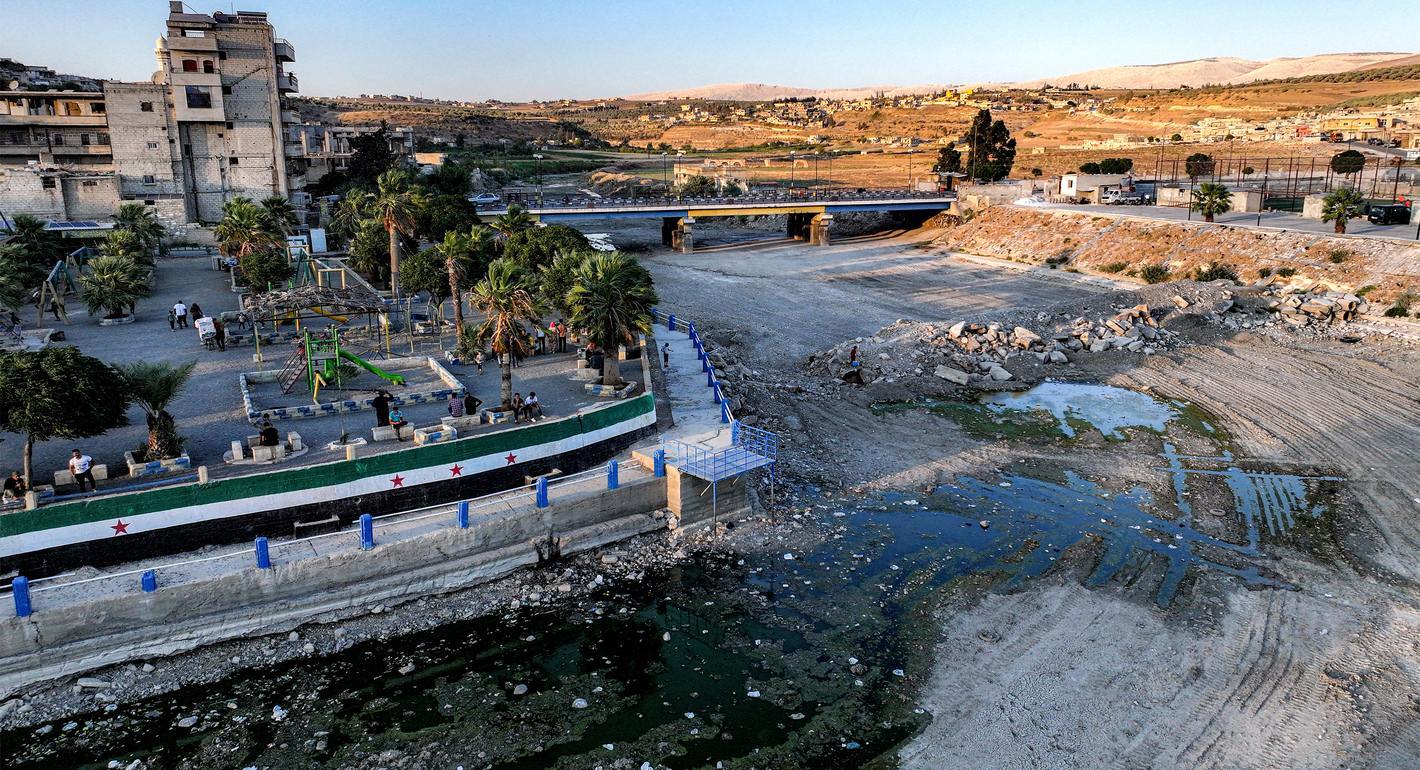
The Syrian conflict is destroying the economy and creating a long term economic crisis for Syria that will make a lasting peace in the future even more difficult. With the ongoing fighting, the economy’s downward trend persists and experts expect Gross Domestic Product (GDP) to decrease by a further 13.9 percent by year-end (it is already down 14.4 percent in 2012). Furthermore, de-industrialization, debt, and geographic division worsen the outlook of Syria’s economy beyond the current conflict. Addressing the country’s economic crisis and presenting viable measures for an economic recovery should go hand in hand with the political reconciliation process.
The country’s main economic drivers were hit particularly hard. Among those, Syria’s oil sector is at a standstill. The energy infrastructure has been severely damaged, wells set on fire, and new projects put on hold. Crude oil production that was at 380,000 barrels per day prior to the conflict has fallen to 20,000 barrels per day, according to Syria’s oil minister. By mid-2013, much of Syria’s oil-rich territory (located mostly in the east and northeast) had fallen out of the hands of the regime. According to Jihad Yazigi, Editor-in-Chief of the Syria Report, “Depending on where they are located, oil ?elds are either controlled by the Kurdish Democratic Union Party in the northeast or by various Islamist and tribal militias (in the eastern region near Deir Ezzor), which can explain decline in production.” Gas production has fallen by one third, the relatively moderate decline attributed to the location of gas fields in areas still under regime control, such as Palmyra and Hama. Prior to the conflict, about 90 percent of local oil and gas production—amounting to 35 percent of total export earnings and to about one fifth of government revenue—was sold to Europe, but sanctions have barred this source of income.
The expansion of violence this year also caused a sharp decline in food production levels, lowering production levels maintained in farming areas in the first two years of the war. There have been numerous reports of crop destruction used by the Syrian army as retaliatory measures against local populations. In areas where farm lands have been spared, transporting the crops has turned into a daunting if not impossible task. Laborers have fled areas such Homs and Daraa, causing labor shortages and a dwindling agricultural production: for example, this year’s wheat harvest dropped by about 50 percent to 1.5 million tons.
Even the industrial sector, based around Damascus and Aleppo, has been largely devastated. According to a Byblos bank report, about 75 percent of production facilities in Aleppo are no longer operable. The resulting de-industrialization is one of the most important factors to shape the country’s future. The process of de-industrialization by itself is not problematic; however, when a developing country such as Syria faces it as a result of war, its growth trajectory becomes stunted. This will impede the country from growing its income levels and will delay convergence with developed economies, especially because Syria does not yet have the tools to transform into a fully developed service economy (usually the next step after de-industrialization). Furthermore, Syria’s industrial elites are relocating to other Arab countries. Egypt has managed to attract Syrian businesses thanks to its wide industrial base and lower production costs. Wealthy investors who had given Syria a chance after the liberalization of its economic sector in 2000 have retreated from the country, going back to England, France, the United States, or other countries where they were formerly established. These Syrians who have gone back into exile are one symptom of the ongoing capital flight. The Damascus Stock Exchange is another proof of the trend: stocks have lost 86 percent of their value since the beginning of the uprising.
Likewise, the Syrian pound has spiraled out of control from 47 pounds to the dollar when fighting broke out to around 140 today. Official figures have put inflation at 68 percent, but the actual rate, as reflected by the prices of domestic goods, may be in the hundreds. Meanwhile, pre-conflict foreign reserves of $18 billion, which the Syrian government has been selling to offset changing exchange rates, have dwindled down to an estimated 2 to 3 billion—though as Yazigi notes, “The level of foreign reserves is currently the country’s best kept secret.” However, the Assad regime can still count on its allies, in the form of Iran and Russia, to help finance imports and the increasing costs of the ongoing war, with Iran providing a $3.6 billion credit line, though the big question is whether Iran, faced with its own economic woes, can keep funneling money to its ally in the long term.
The Syrian regime and the various opposition groups each rely on their outside partners to procure their food and energy needs, reinforcing the long-term lack of trade among the various regions, and giving way to further economic fragmentation. The old Syrian trading families have been replaced by smugglers and small traders who are willing to take more risks. Moreover, new trade routes have emerged between Syria and Turkey's Mediterranean port of Mersin, where goods destined for Syria arrive, are repacked, and are sent to the borders. The same can be said of Lebanon; while traditional trading families in Beirut eye suspiciously these new commerce practices, small traders and smugglers have jumped on the bandwagon, going through rebel-friendly areas such as Ersal to deliver food or gas.
The large foreign debt, massive deindustrialization, and regional divide make rebuilding Syria’s economy daunting. But rebuilding the economy will be integral to setting up a cohesive power structure. As stakeholders move forward with peace talks, economic recovery measures need to be addressed along with the political, ethnic, religious, and sectarian issues driving the conflict. While rebuilding the economy may not take on the same urgency as ending the fighting, paying attention to it now will aid the success of a peace deal in the long term.
Mona Alami is a French Lebanese journalist who writes about political and economic issues in the Arab world. She is a regular contributor to Sada.
Update: An earlier version of this article identified the unofficial exchange rate between Syrian pounds and U.S. dollars as around 200. This figure has been updated to reflect more recent data.